Ministry of Finance
INDIA’S REAL GDP ESTIMATED TO GROW BY 7.4% IN FY 2025–26, WITH NOMINAL GDP GROWTH AT 8%
IN THE BUDGET FOR FY 2026-27, NOMINAL GDP IS PROJECTED TO GROW BY 10.0% OVER THE FIRST ADVANCE ESTIMATES OF FY 2025-26
SERVICE SECTOR REMAINS PRIMARY DRIVER OF GROWTH, EXPANDING BY 9.1%
TOTAL RESOURCES SHARED WITH STATES THROUGH THE FINANCE COMMISSION ROUTE ESTIMATED AT ₹16.56 LAKH CRORE IN BE 2026-27; INCLUDING TAX DEVOLUTION(₹15.26 LAKH CRORE) AND FC GRANTS(₹1.4 LAKH CRORE),
THE EFFECTIVE CAPITAL EXPENDITURE OF UNION GOVERNMENT IN FY 2026-27 ESTIMATED AT ₹17.15 LAKH CRORE, THAT IS 4.4% OF GDP
EFFECTIVE CAPITAL EXPENDITURE OF THE UNION GOVERNMENT INCLUDES GOI’S CAPITAL EXPENDITURE (₹12.22 LAKH CRORE) AND GRANTS-IN-AID TO STATES (₹4.93 LAKH CRORE) FOR CREATION OF CAPITAL ASSETS
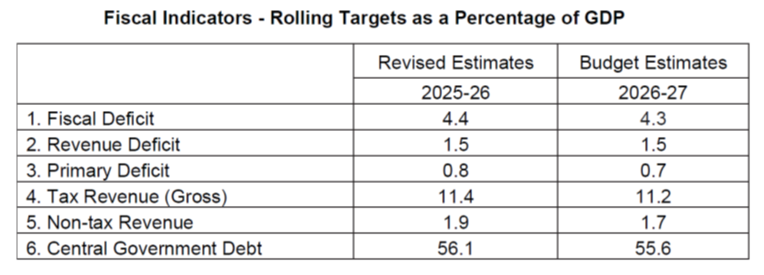
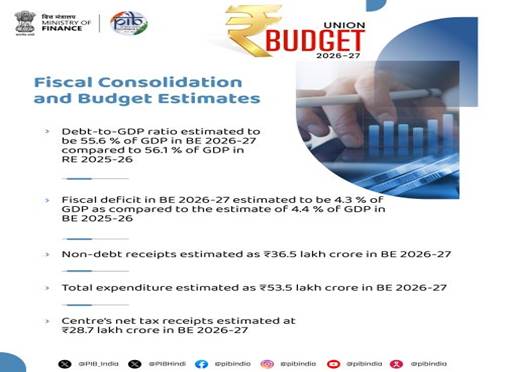
CENTRAL GOVERNMENT DEBT TO GDP IS ESTIMATED AT 55.6% IN BE 2026-27, AS AGAINST 56.1% IN FY2025-26
PRIVATE FINAL CONSUMPTION EXPENDITURE (PFCE) IS PROJECTED TO GROW BY 7%, ACCOUNTING FOR 61.5% OF GDP - THE HIGHEST LEVEL SINCE FY12
GROSS FIXED CAPITAL FORMATION (GFCF) RISES BY 7.8% IN FY26
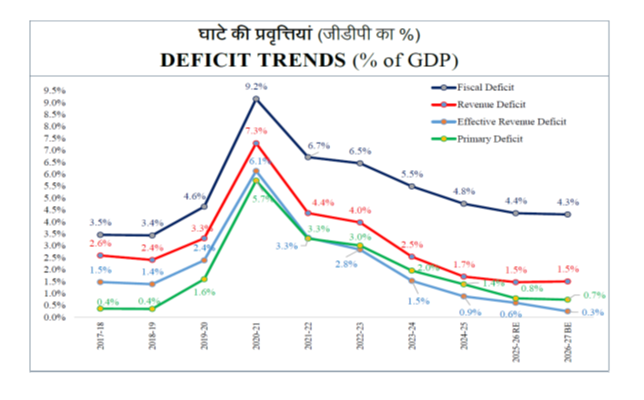
FISCAL DEFICIT FOR BE 2026-27 IS ESTIMATED AT 4.3%, WHILE FISCAL DEFICIT FOR RE 2025-26 IS 4.4%
REVENUE DEFICIT FOR BE 2026-27 IS ESTIMATED AT 1.5%; EFFECTIVE REVENUE DEFICIT FOR BE 2026-27 ESTIMATED AT 0.3%
GROSS TAX REVENUE IS ESTIMATED AT 11.2% OF GDP FOR BE 2026-27
THE CURRENT ACCOUNT DEFICIT DECLINED TO 0.8 PER CENT OF GDP IN H1 FY26 FROM 1.3 PER CENT IN H1 FY25.
INDIA’S TOTAL EXPORTS REACHED USD 825.3 BILLION IN FY25; DESPITE UNCERTAIN GLOBAL TARIFF SCENARIO
GROSS FOREIGN DIRECT INVESTMENT (FDI) INFLOWS WERE RECORDED AT USD 81.0 BILLION IN FY25
Posted On:
01 FEB 2026 12:36PM by PIB Delhi
India’s growth outlook remains positive, supported by strong domestic demand, structural reforms, and a stable macroeconomic environment. The country received three sovereign rating upgrades during the year. Inflation outlook remains benign, as per Macroeconomic Framework Statement and Medium-term Fiscal Policy cum Fiscal Policy Strategy Statement laid by Union Minister for Finance and Corporate Affairs, Smt. Nirmala Sitharaman on the table of the Parliament along with Budget for FY 2026-27. The document further adds that public investment, deregulation, labor market reforms, human capital investments, tax reforms, digital transformation, and the formalization of the economy are expected to drive the economy into a higher growth trajectory. Strong balance sheets in the corporate and financial sectors are also expected to drive a virtuous cycle of growth, fuelled by increased private-sector investment.
MACRO-ECONOMIC FRAMEWORK STATEMENT
Economic growth
As per the first advance estimates published by the National Statistics Office, India’s real GDP is estimated to grow by 7.4 per cent in FY 2025–26, with nominal GDP growth at 8 per cent. The services sector remains the primary growth driver, expanding by 9.1 per cent. Manufacturing and construction have grown by 7 per cent. Agriculture is estimated to grow at 3.1 per cent. In the Budget for FY 2026-27, nominal GDP is projected to grow by 10.0 per cent over the First Advance Estimates of FY 2025-26.
Consumption and Investment
Domestic demand continues to anchor growth. Private final consumption expenditure (PFCE) is projected to grow by 7 per cent, accounting for 61.5 per cent of GDP - the highest level since FY12. Government final consumption expenditure is also estimated to strongly rebound with a YoY growth of 5.2 per cent in FY26 as against 2.3 per cent in FY25. High-frequency indicators, such as UPI transactions, air and rail traffic, e-way bills, etc., reflect sustained momentum in both urban and rural consumption. Investment activity remains strong, with gross fixed capital formation (GFCF) rising by 7.8 per cent in FY26, higher than the previous year. Further, the share of GFCF has remained stable at around 30 per cent of GDP for the past three years.
External sector
India’s total exports (merchandise and services) reached USD 825.3 billion in FY25, with continued momentum in FY26. Despite tariffs imposed by the United States, merchandise exports grew by 2.4 per cent (April–December 2025), while services exports increased by 6.5 per cent. Merchandise imports for April-December 2025 increased by 5.9 per cent. Gross Foreign Direct Investment (FDI) inflows were recorded at USD 81.0 billion in FY25, and the momentum strengthened in FY26 with the highest inflow recorded in the first seven months of any financial year. The current account deficit declined to 0.8 per cent of GDP in H1 FY26 from 1.3 per cent in H1 FY25.
MEDIUM TERM FISCAL POLICY CUM STRATEGY STATEMENT
Fiscal Indicators
Union Budget 2026-27 has as its fiscal anchor the debt glide path indicated in Budget 2025-26 and Budget 2024-25 (regular) and is being presented against the backdrop of ongoing fiscal consolidation announced in FY 2021-22, which has provided a good foundation for making available the resources required to balance the development priorities without compromising on fiscal prudence. As announced in Budget 2021-22, the Government made true its intention of reaching a fiscal deficit below 4.5 per cent of GDP in FY 2025-26. Going ahead, it would be the Endeavour of the Government to adopt a fiscal stance that would put the Central Government debt on a declining path. Major fiscal indicators of the Union Government in the Revised Estimates (RE) of FY 2025-26 and the Budget Estimates (BE) of FY 2026-27 as a per cent of GDP, are summarized in the table below.
Receipts
In BE 2026-27, Gross Tax Revenue (GTR) is estimated at ₹44.04 lakh crore. It represents a growth of 8.0 per cent over RE 2025-26. Direct Taxes at ₹26.97 lakh crore are the major contributor to GTR (61.2 per cent of the GTR). Indirect taxes are estimated at ₹17.07 lakh crore. In BE 2026-27, the GTR to GDP ratio is estimated at 11.2 per cent. The Budget 2026-27 is also the first year of the award period of Sixteenth Finance Commission (SFC). SFC has recommended for retaining the share of devolution to the States at 41 per cent of divisible pool. The Tax Revenues (Net to Centre) are projected to be ₹28.67 lakh crore. In BE 2026-27, NTR of the Central Government is projected at ₹6.66 lakh crore. Revenue Receipts of the Union Government [comprising Tax Revenues (Net to Centre) and Non- Tax Revenues (NTR)], are estimated at ₹35.33 lakh crore. Revenue Receipt estimates assume a growth of 5.7 per cent over RE 2025-26.
Expenditure
The total expenditure of the Central Government in BE 2026-27 is projected to be ₹53.47 lakh crore (13.6 per cent of GDP) showing a growth of 7.7 per cent over RE 2025-26 of ₹49.65 lakh crore. The Budget for FY 2026-27 projects ₹12.22 lakh crore (3.1 per cent of GDP) towards capital expenditure. This includes capital support to States through SASCI (Special Assistance as Loan to States for Capital Expenditure) with an outlay of ₹2.0 lakh crore. Effective Capital Expenditure of the Union Government includes GoI’s capital expenditure and Grants-in-aid for creation of capital assets. Together, they constitute investments that enhance and upgrade productive capacity of the economy. In BE 2026-27, the allocation under Grants in- aid for creation of capital assets is projected at ₹4.93 lakh crore (or 1.3 per cent of GDP). Thus,
The effective capital expenditure in FY 2026-27 is estimated at ₹17.15 lakh crore (or 4.4 per cent of GDP).
Tax devolution and Finance Commission grants to the states
Based on recommendations of the Finance Commission (FC), the Union Government devolves taxes to States during the FC cycle. As mentioned previously, SFC recommended retaining States’ share at 41 per cent in the divisible pool, and this recommendation is accepted by the Government. In BE 2026-27, tax devolution to the States is estimated at ₹15.26 lakh crore compared to ₹13.93 lakh crore in RE 2025-26 which includes an additional amount of ₹9,084.02 crore on account of dues receivable by the Union Government from States under devolution from the previous years. Tax devolution to the States in BE 2026-27 is 3.9 per cent of GDP and ₹1.33 lakh crore more than tax devolution of RE 2025-26 (including past arrears). In BE 2026-27, the Finance Commission grants are estimated at ₹1.4 lakh crore. Thus, total resources shared, tax devolution and FC Grants, with States through the Finance Commission route are estimated at ₹16.56 lakh crore in BE 2026-27.
Fiscal policy strategy for 2026-27
The fiscal policy strategy for FY 2026-27 will continue to be guided by the debt glide path indicated in the Budget 2025-26. The medium-term aim to reach a debt to GDP ratio of 50±1 per cent by FY 2030-31, with the fiscal deficit acting as the operational target. In line with the above targets, it is estimated that Central Government debt to GDP ratio will be 55.6 per cent of GDP in BE 2026-27 with Fiscal Deficit target of 4.3 per cent of GDP. Other aspects of the fiscal strategy include support to economic growth through continued focus on capital expenditure, leaving adequate fiscal room to respond to global economic events and to ensure continued prosperity of the country in its journey towards Viksit Bharat. Other aspects include reforms in tax policy, expenditure policy, government borrowings, Lending and Investments.
****
Nanu Bhasin/Virat M/Mahesh Z/Prakash Patil
(Release ID: 2221389)
Visitor Counter : 24537
Read this release in:
Tamil
,
Malayalam
,
Kannada
,
Bengali
,
Bengali-TR
,
Khasi
,
Urdu
,
Marathi
,
हिन्दी
,
Manipuri
,
Assamese
,
Punjabi
,
Gujarati
,
Odia
,
Telugu