Ministry of Finance
“INDIA’S MOVEMENT FROM SWADESHI TO STRATEGIC RESILIENCE, AND FROM RESILIENCE TO STRATEGIC INDISPENSABILITY, CANNOT BE ACHIEVED THROUGH INSULATION ALONE”: ECONOMIC SURVEY 2025-26
STRATEGIC INDISPENSABILITY DEMANDS MAKING INDIA A SOURCE OF STABILITY AND VALUE RATHER THAN ONLY A PARTICIPANT IN GLOBAL MARKETS, STATES ECONOMIC SURVEY
“INSTITUTIONAL INCENTIVE STRUCTURE THAT ENCOURAGES ACTION, EXPERIMENTATION, AND LEARNING UNDER UNCERTAINTY IS INDIA’S OVERARCHING PRIORITY”: ECONOMIC SURVEY 2025-26
THE NEW ‘COMPLIANCE REDUCTION AND DEREGULATION INITIATIVE’ HAS IDENTIFIED 23 PRIORITY AREAS ACROSS FIVE BROAD SECTORS FOR STATE LEVEL DEREGULATION;76% OF ACTIONABLE REFORMS ALREADY IMPLEMENTED
Posted On:
29 JAN 2026 1:36PM by PIB Delhi
Economic Survey 2025-26 states that India’s transition from Swadeshi to strategic resilience, and ultimately to strategic indispensability, will be determined not only by how fast the economy grows, but by whether domestic capabilities become embedded in global production systems in ways that enhance reliability, learning, and external stability. It further states that strategic resilience rests on the State’s ability to anticipate vulnerabilities, coordinate across institutions, and respond under stress without disorder. Strategic indispensability demands more: the capacity to build capabilities that others depend upon, making India a source of stability and value rather than only a participant in global markets.
The Survey also notes that a world of deep uncertainty requires a shift towards an entrepreneurial state, not to replace markets, but to act under uncertainty, structure risk, and learn systematically. Hence it argues for institutional incentive structure that encourages action, experimentation, and learning under uncertainty as India’s overarching priority. It also adds that no country that has successfully navigated structural transformation attempted to make its entire bureaucracy entrepreneurial. Equally, it may not be possible for the bureaucracy to be entrepreneurial all the time, because stability and predictability too are necessary traits of good administration. Instead, successful states created bounded institutional spaces - zones where experimentation was permitted, accountability rules were differentiated, and learning was explicit.
Economic Survey says that policies that operate in uncharted terrain, whether in industrial strategy, financial regulation, technology governance, or social policy, cannot be optimised beforehand. They must be tested, revised, and sometimes abandoned. Political leadership must send consistent signals that reversible failure is acceptable, experimentation is necessary, and course correction is a mark of competence rather than weakness. Institutional forgiveness becomes meaningful only when it is paired with a clear distinction between good-faith error and malfeasance.
Economic Survey adds that in the decades ahead, India will face decisions for which there are no manuals. In each case, outcomes will depend less on the correctness of initial choices and more on the State’s capacity to learn, revise, and act with confidence under uncertainty. It also states that the ability of the State to learn, correct course, and act with confidence under uncertainty ultimately depends on how responsibilities, authority, and ownership are organised within its institutions. India’s most consequential constraint today is no longer the absence of policy intent, ideas, or resources, but the incentive structures within institutions that shape how decisions are taken under uncertainty. It cautions that in a world defined by uncertainty, it is not the most controlling states that will succeed, but those that learn fastest, adapt most intelligently, and retain the confidence to correct course.
The Survey notes that a State’s capacity is not a single reform agenda, but a composite outcome shaped by how decisions are taken, how risk and failure are processed, how administration is organised around outcomes, how regulation is designed and delivered, and how incentives shape the behaviour of officials, firms, and citizens.
State capability is also a function of the human systems through which public authority is exercised in practice. As governance challenges become more complex, the quality of public outcomes increasingly depends on how civil servants interpret roles, exercise judgment, and engage with citizens. State capacity is the foundation on which strategic resilience is built and the pathway through which strategic indispensability becomes possible. Capacity is therefore not built by proclamation, but through steady alignment across institutional systems. It is co-created through the everyday behaviour of the State, firms, and citizens, and rests on a shared obligation and a reciprocal contract across the three.
Economic Survey also says that Regulation is one of the most consequential interfaces between the state and the economy. Regulatory capacity is a question of institutional design as much as it is of intent or effort, spanning rule-making, enforcement, accountability, and the structuring of delegated authority. Regulatory capacity depends on how formal powers granted to regulators are structured, exercised, and constrained through institutional design. Some important considerations in the institutional design choices are Clarity in rulemaking and guidance, Separation within authority, Regulatory boards that anchor accountability, Proportionality and discipline in enforcement, Due process as an operational norm, Democratic anchoring and transparency and Democratic anchoring and transparency.
It stresses that Regulators need experts capable of balancing freedom with oversight, while businesses require professionals who can harness this freedom to drive growth while adhering to regulations. The Survey suggests that Schools of Regulatory Studies could be established either as new stand-alone institutions or as additions to existing institutions to provide for these talents. It also states that delays in most regulatory processes, including approvals, investigations, enforcement actions, disputes, and appeals, impose real economic costs. To address this, decisions must be subject to strict timelines, with provisions for deemed approvals when authorities fail to act within prescribed periods.
The Survey notes that in India, the private corporate sector is not merely a subject of regulation; it is a structural participant in the incentive environment that determines whether the state upgrades its capacity or governs through discretion. When firms compete on productivity, quality, and performance, they develop a direct interest in strong, predictable, and impartial public institutions.
If the private corporate sector co-shapes the incentive environment in which state capacity evolves, citizens shape it even more pervasively through the daily norms that determine whether public systems must rely on enforcement or can function through internalised responsibility. When citizens internalise norms of responsibility in shared spaces, treat learning as a habit, respect physical and technical work, use technology without becoming captive to it, and understand that today’s comfort can sometimes become tomorrow’s burden, they will reduce the state's need for constant enforcement, and create the trust on which institutional capacity grows.
The Survey notes that competing in the global big league, whether in manufacturing, logistics, institutions, or elite sports, requires incurring near-term costs for returns that are uncertain, delayed, and often invisible in the short term. Where delayed gratification weakens, systems begin to substitute shortcuts for capability, visibility for depth, and speed for learning.
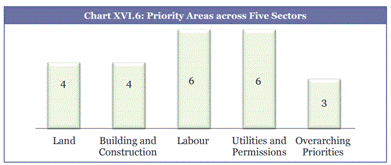
The Survey adds that the ongoing Compliance Reduction and Deregulation Initiative identified 23 Priority Areas across five broad sectors for State level deregulation. These Priority Areas were identified through extensive consultations with Central Ministries, States, industry associations, and knowledge partners. Deregulation, when pursued as a continuous and coordinated governance process, is not a retreat of the State but a strengthening of it. What distinguishes this exercise from earlier deregulation drives is not only the number of reforms, but the institutional process: cross-agency coordination, iterative problem-solving with States, and real-time learning, which touch the core elements of state capacity.
With 36 States and Union Territories expected to implement 23 Priority Areas each, the total number of actionable reforms across the country amounts to 828.
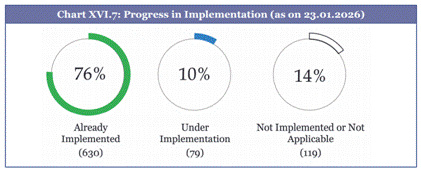
As of 23 January 2026, 630 Priority Areas, representing 76 per cent of the total, have already been implemented. Another 79 Priority Areas, accounting for 10 per cent, are under active implementation.
Economic Survey concludes that the nature of the challenge now facing India is changing and its recent economic performance has demonstrated that macroeconomic stability and growth can be sustained even in a turbulent global environment. In a more uncertain world, risk is unavoidable. The advantage lies in managing it better. Countries that can act before certainty emerges, correct course without paralysis, and align incentives across the State, firms, and citizens are better placed to convert growth into influence. State capacity is therefore not an administrative concern at the margin. It is the foundation on which strategic resilience is built and the pathway through which strategic indispensability becomes possible.
***
AKP
(Release ID: 2219918)
Visitor Counter : 4426