Ministry of Electronics & IT
India AI Mission Modeled to Address Diverse Needs and Real-World Challenges: Shri S. Krishnan, Secretary, Meity
Secretary, Meity speaks at session “From Algorithms to Outcomes: Building AI that Works for People”
India AI Impact Summit is all about finding impactful applications that we can create using AI: Shri S. Krishnan
Secretary, Meity urges attendees to visit the 600+ startups and companies at the expo and witness sectors where AI is being used
Posted On:
17 FEB 2026 3:42PM by PIB Delhi
The second day of the India AI Impact Summit 2026 opened with a high-impact session that examined the dual imperatives of people-centric AI and sovereign technological capability.
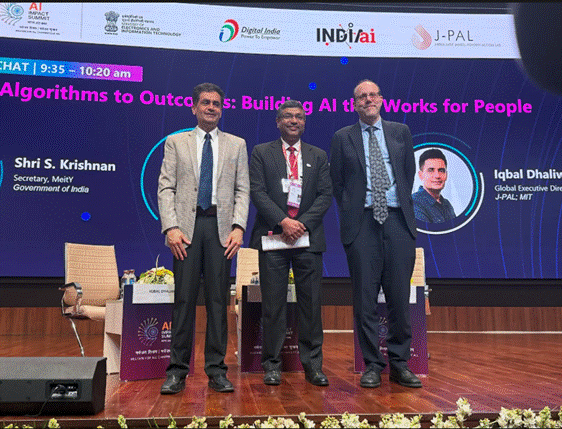
The session “From Algorithms to Outcomes: Building AI that Works for People” at the India AI Impact Summit 2026 focused on ensuring that artificial intelligence systems translate into measurable improvements in public service delivery and citizen welfare. The discussion centred on how compute, models and data must ultimately lead to deployable applications that enhance productivity, strengthen governance and deliver tangible benefits to citizens.
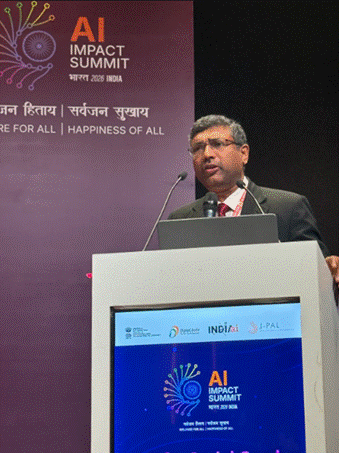
Addressing the session, S. Krishnan, Secretary, MeitY, said that the India AI Mission is modeled to address diverse needs and real-world challenges. He emphasized that the India AI Impact Summit is all about finding impactful applications that we can create using AI. The Secretary remarked, “We are providing compute, models, and data for one reason only, to build applications with real impact. Whether AI succeeds beyond the hype depends entirely on whether it delivers solutions that improve lives. If you walk through the expo, you’ll see hundreds of startups working across healthcare, agriculture, education, and manufacturing. That’s where impact will come from. Governments will never have enough teachers, doctors, or judges, but if AI can enhance productivity, service quality can improve dramatically. The challenge is to choose what works, scale it responsibly, protect privacy, and ensure public money creates measurable outcomes.” He concluded by urging attendees to visit the 600+ startups and companies at the expo and to witness the sectors where AI is being used.
The session was attended by Iqbal Singh Dhaliwal, Global Executive Director, J-PAL, and Michael Kremer, University Professor in Economics, University of Chicago, among other policymakers and sector leaders.
Iqbal Singh Dhaliwal, Global Executive Director of J-PAL, underscored the importance of rigorous evaluation, stating, “If you’ve spent enough time in development, you’ve seen many silver bullets come and go. A technology can look incredibly promising in theory or even in a lab setting, but fail once it meets the realities of the field. That’s why evidence matters so much. We need to ask not just whether AI works, but for whom it works, in what contexts, and with what outcomes. Without rigorous evaluation, we risk mistaking excitement for impact. AI has enormous potential, but only if it is tested in the field and scaled responsibly, with people and outcomes at the centre.”
Michael Kremer, J-PAL, University Professor in Economics, University of Chicago, added, “We’re seeing early evidence of impact in areas like traffic enforcement, automated driver’s licence testing, health, and education, including personalised adaptive learning that doubled the pace of student learning with just one hour a week. But technology alone is not enough. Improving government services is not always a market with strong private incentives, so philanthropy and government play a key role. Adoption within public systems is hard, and procurement matters. Evaluation is critical so states can learn from each other. AI has tremendous potential, but realizing it requires evidence, system-level change, and careful implementation.”
The session formed a key part of the Summit’s broader agenda, bringing together policymakers, researchers and industry leaders to deliberate on translating AI capabilities into scalable public applications. Discussions highlighted the importance of structured implementation and cross-sector collaboration in advancing AI-driven service delivery.
*****
Mahesh Kumar/ Pawan Faujdar/ Navin Sreejith/ Allen Roy Joseph
(Release ID: 2229115)
Visitor Counter : 1044