Ministry of Finance
INDIA’S INDUSTRIAL PERFORMANCE REMAINS ROBUST AS INDUSTRY GROSS VALUE ADDED GREW BY 7.0 PERCENT YEAR-ON-YEAR, IN REAL TERMS, IN THE FIRST HALF OF FY2025-26: ECONOMIC SURVEY 2025-26
MANUFACTURING GVA GREW BY 7.72 PER CENST AND 9.13 PER CENT IN Q1 AND Q2 OF FY26
MEDIUM AND HIGH-TECHNOLOGY ACTIVITIES ACCOUNTS FOR 46.3 PER CENT OF INDIA’S TOTAL MANUFACTURING VALUE ADDED
FINANCIAL FLOWS FROM NON-BANK SOURCES TO THE COMMERCIAL SECTOR RECORDED A CAGR OF 17.32 PER CENT OVER THE PERIOD FY20 TO FY25, THE SURVEY STATES
CORE INDUSTRIES MAINTAINED STRONG MOMENTUM, WITH INDIA REMAINING THE SECOND-LARGEST GLOBAL PRODUCER OF STEEL AND CEMENT
INDIA'S COAL INDUSTRY REACHED HISTORIC HEIGHTS IN FY25, PRODUCING 1,047.52 MILLION TONNES (MT) OF COAL
INDIA’S PHARMACEUTICAL SECTOR RECORDED SUSTAINED EXPANSION, WITH THE INDUSTRY REMAINING THE THIRD-LARGEST GLOBALLY BY VOLUME
THE AUTOMOTIVE INDUSTRY RECORDED NEARLY 33 PER CENT GROWTH IN PRODUCTION DURING FY15–FY25
GOVERNMENT HAS TAKEN UP SEVERAL INITIATIVES TO PROMOTE MANUFACTURING OF ELECTRIC VEHICLES IN INDIA
ELECTRONICS AND MOBILE MANUFACTURING EMERGED AS MAJOR GROWTH DRIVERS, WITH ELECTRONICS RISING FROM THE 7TH TO THE 3RD LARGEST EXPORT CATEGORY (FY22-FY25)
Posted On:
29 JAN 2026 2:09PM by PIB Delhi
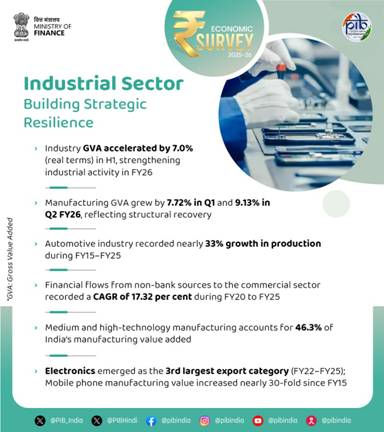
India’s industrial performance remains robust as Industry Gross Value Added (GVA) grew by 7.0 per cent year-on-year, in real terms, in the first half of FY2025-26, marking a clear pickup after growth had eased to 5.9 per cent in the previous fiscal year (FY2024-25), says the Economic Survey 2025-26 tabled in Parliament by Union Minister of Finance and Corporate Affairs, Smt. Nirmala Sitharaman today.
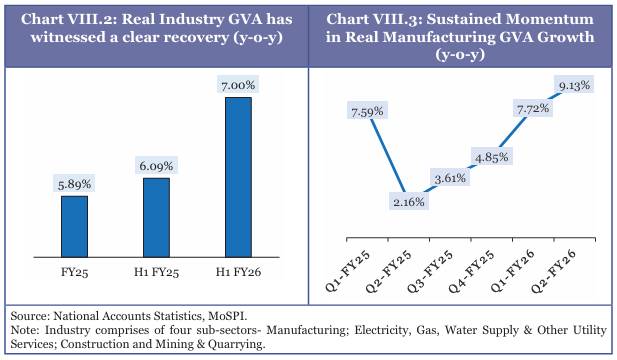
The Economic Survey of 2025-26 notes that Manufacturing GVA grew by 7.72 per cent and 9.13 per cent in Q1 and Q2 of FY26, respectively, primarily driven by ongoing structural shifts within the sector. It additionally mentions, these include a gradual move toward higher-value manufacturing segments, improved availability of industrial infrastructure through corridor-led development, and greater adoption of technology and formalisation across firms.
The Economic Survey states that, Medium and high-technology activities now account for 46.3 per cent of India’s total manufacturing value added. This is attributed due to various government initiatives such as the Production Linked Incentive (PLI) schemes and the India Semiconductor Mission, alongside the strengthening of domestic capacities in electronics, pharmaceuticals, chemicals and transportation sectors. The Survey optimistically further states that India’s global standing has strengthened, as its ranking in terms of Competitive Industrial Performance (CIP) improved to 37th in 2023, up from 40th position in 2022.
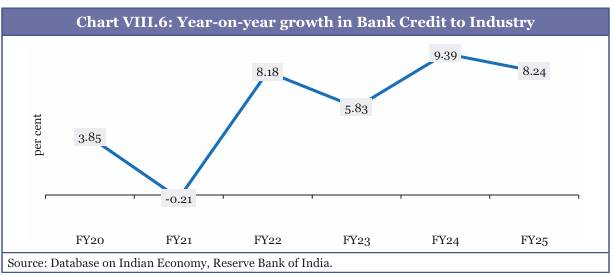
Though Bank-based industrial credit growth from commercial banks moderated to 8.24 per cent in FY25 compared to 9.39 per cent in FY24, assessments indicate an ongoing diversification of funding sources away from banks, the Survey states. Quoting the Monthly Economic Review of August 2025 the Survey noted, ‘decrease in bank credit coincides with the increase in the overall flow of financial resources to the commercial sector’. Financial flows from non-bank sources to the commercial sector recorded a CAGR of 17.32 per cent over the period FY20 to FY25.
CORE INPUT INDUSTRIES
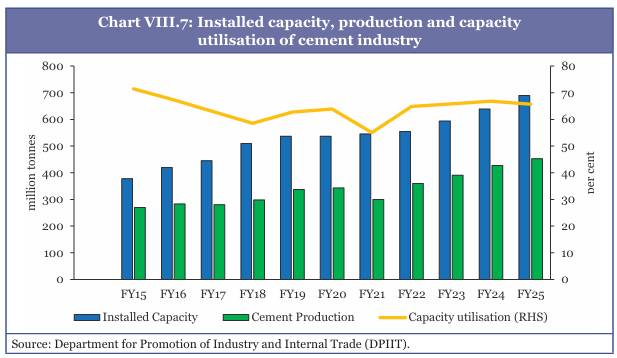
Core industries maintained strong momentum, with India remaining the second-largest global producer of steel and cement, emphasizes the Economic Survey. India is the second-largest cement producer in the world after China. Domestic cement consumption in India is approximately 290 kg per capita, compared to a global average of 540 kg per capita. The Survey states, the Government's focus on mega infrastructure projects such as highways, railways, housing schemes, smart cities and rural development and industrial growth is expected to fuel cement demand significantly.
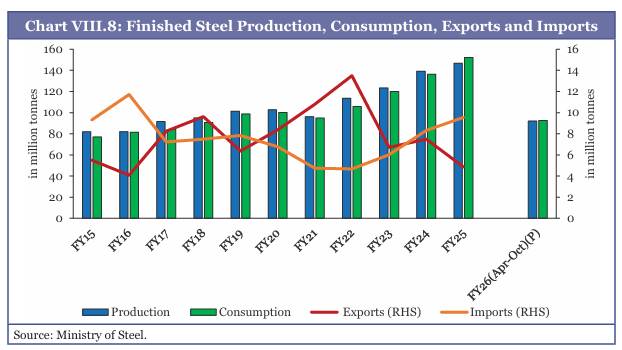
The Steel sector has undergone a major transformation in the last five years, largely driven by strong domestic demand from the construction and manufacturing sectors.
India's coal industry reached historic heights in FY25, producing 1,047.52 Million Tonnes (MT) of coal—a 4.98 per cent increase from the previous year's 997.83 MT.
The Chemicals and Petrochemicals sector continues to play a significant role in industrial development of the economy, the sector contributed 8.1 per cent to the overall manufacturing sector's GVA in FY24
The automotive industry recorded nearly 33 per cent growth in production during FY15–FY25. Government has taken up several initiatives to promote manufacturing of Electric Vehicles in India. The Survey further mentions that the Government initiatives have driven significant growth in Electric Vehicle (EV) registrations in recent years.
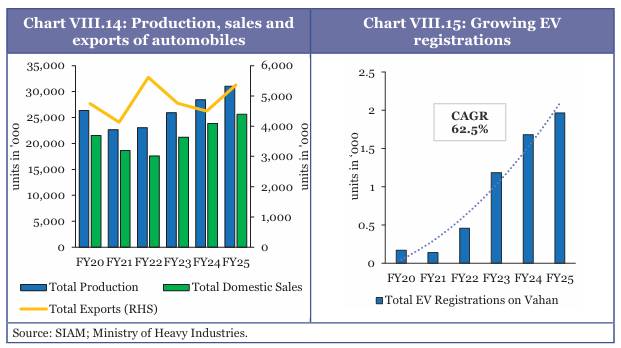
The Strategic Policy Interventions for Electric Mobility includes, PLI Scheme for Automobile & Auto Components Industry (PLI-Auto Scheme), PLI scheme for ‘National Programme on Advanced Chemistry Cell (ACC) Battery Storage’ (PLI ACC Scheme), PM E-DRIVE Scheme, PM e-Bus Sewa-Payment Security Mechanism (PSM) Scheme, Scheme to Promote Manufacturing of Electric Passenger Cars in India (SMEC), the Survey adds.
The Survey mentions India’s electronics sector has undergone a structural transformation in recent years, ascending from the seventh-largest export category in FY22 to the third-largest and fastest-growing in FY25. The Survey notes that this growth is underpinned by a remarkable surge in domestic production and export volumes (Chart VIII.16). Central to this expansion is the mobile manufacturing segment, which witnessed a nearly 30-fold increase in production value, rising from ₹18,000 crore in FY15 to ₹5.45 lakh crore in FY25.
The Indian pharmaceutical industry is the world’s third-largest by volume, meeting approximately 20 per cent of global generics demand, with exports to 191 countries in FY25. The Survey additionally mentions in FY25, the sector’s annual turnover reached ₹4.72 lakh crore, with exports growing at a CAGR of 7 per cent over the last decade (FY15 to FY 25).
A Roadmap For The Next Leap
The Survey mentions, India’s industrial sector continues to display strong momentum despite an evolving and challenging global environment, supported by reforms in infrastructure, logistics, ease of doing business and innovation systems. The Economic Survey optimistically points to the vital aspect of the next phase of industrialisation will require a calibrated shift from a model centred mainly on import substitution towards one focused on scale, competitiveness, innovation and deeper integration into GVCs. Rather than seeking complete self-reliance in every segment, India needs to build strategic resilience through diversification and creating depth of capabilities. This requires an increase in private sector investment in R&D, technology adoption, skills, and quality systems.
*****
NB/Samrat/Pankaj
(Release ID: 2219990)
Visitor Counter : 7076