Ministry of Finance
INCLUSIVE GROWTH BASED ON SPIRIT OF ‘SABKA SAATH, SABKA VIKAS, SABKA PRAYAS, SABKA VISHWAS’ HAS YIELDED MEASURABLE GAINS FOR INDIA
INDIA HAS MADE SIGNIFICANT STRIDES IN REDUCING NON-MONETARY POVERTY; INDIA’S POVERTY RATED REDUCED SIGNIFICANTLY TO 5.3% IN 2022-23
POPULATION COVERED BY SOCIAL PROTECTION SYSTEMS HAS INCREASED FROM 22 PER CENT IN 2016 TO 64.3 PER CENT IN 2025.
GOVERNMENT’S SOCIAL SERVICES EXPENDITURE (SSE) HAS KEPT PACE WITH THE DEVELOPMENT OF THE SOCIAL SECTOR WITH A COMPOUND ANNUAL GROWTH RATE 12% DURING FY 22 TO FY 26
Posted On:
29 JAN 2026 1:56PM by PIB Delhi
Government has taken significant efforts to provide affordable housing, social and food security, financial inclusion, universal access to basic amenities, and improving the overall well-being and standards of living with spirit of ‘Sabka Sath, Sabka Vikas, Sabka Vishwas, Sabka Prayas’. These efforts have yielded significant measurable gains towards eradication of poverty and prevent inequality from rising, which has been clearly underlined in the findings of the Economic Survey tabled in the Parliament today by the Union Minister for Finance and Corporate Affairs, Smt. Nirmala Sitharaman.
The Economic Survey underlines that the Policies such as income support, social protection, labour market regulation, and education for all help the state in its endeavour to ensure the goals of upward social mobility across generations and throughout an individual’s lifespan.
The aspirations of netizens and policy efforts are commonly assessed using benchmarks of poverty and deprivation. One such metric is the World Bank’s (WB) International Poverty Line (IPL), which represents the minimum amount of money a person needs per day to afford basic necessities such as food, clothing, and shelter. In June 2025, the WB raised the poverty line from USD 2.15 to USD 3.00 a day, adjusted for the purchasing power of money to 2021 prices.
The Economic Survey Highlights that, with the revised IPL, the poverty rates for India in 2022-23 are 5.3 per cent for extreme poverty and 23.9 per cent for lower-middle-income poverty. According to the WB, India has made significant strides in reducing non-monetary poverty Alongside the WB poverty estimates, poverty estimates by researcers based on the Tendulkar committee poverty line also indicate a sharp and broad-based decline in poverty in India. Between 2011-12 and 2023-24, sustained economic growth, supported by redistributive interventions, is estimated to have reduced the poverty rate from 21.9 per cent in 2011-12 to 4.7 per cent in 2022-23 and further to 2.3 per cent in 2023-24.The estimates indicate low poverty incidence across states and in both rural nd urban areas.
The Sustainable Development Goal (SDG) National Indicator Framework (NIF) Progress Report, 2025, provides a comprehensive picture of the impact of these initiatives in achieving a transformative scale-up towards achieving the SDG targets.
The population covered by social protection systems has increased from 22 per cent in 2016 to 64.3 per cent in 2025, indicating a substantial expansion in social security coverage in the country. The population using improved drinking water sources in rural areas has increased from 94.6 per cent in 2015-16 to 99.6 per cent in 2024-25. Universal household electrification was achieved in 2021-22, while 100 per cent of the districts were declared open defecation free (ODF) in 2019-20, and over 96 per cent of Swachh Bharat Mission (SBM) villages have achieved theODF plus status (As of 31 December 2025).
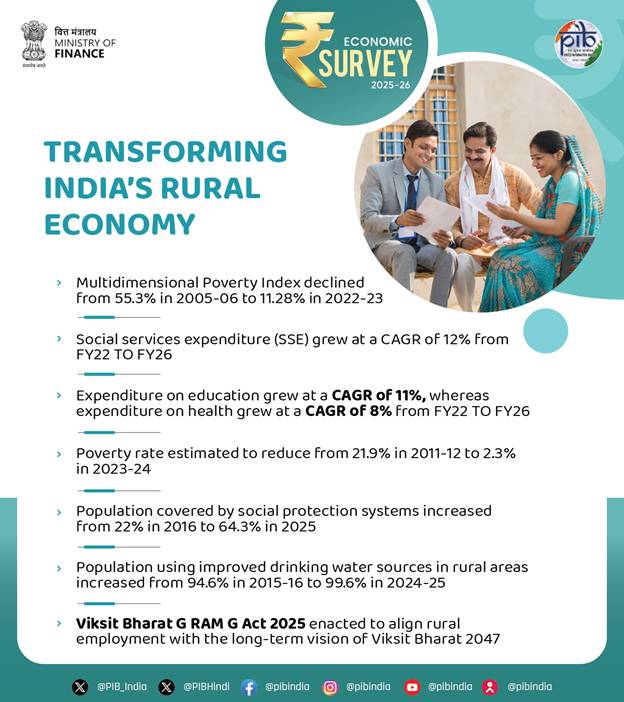
The general government’s social services expenditure (SSE) has kept pace with the development of the social sector. The general government’s SSE has shown a rising trend since FY22.During the five years from FY22 to FY26 (BE), the SSE grew at a compound annual growth rate (CAGR) of 12 per cent. Expenditure on education has grown at a CAGR of 11 per cent, whereas expenditure on health grew at a CAGR of 8 per cent during the same period.
*****
NB/KV/Sri
(Release ID: 2219941)
Visitor Counter : 14119