Ministry of Finance
RIGHT SKILLING, ENTREPRENEURIAL SPIRIT AND GOVERNMENT INITIATIVES CONTINUE TO BRING DOWN UNEMPLOYMENT, SAYS THE ECONOMIC SURVEY 2025-26
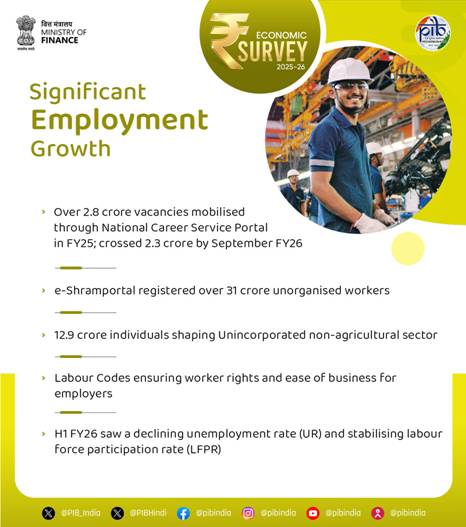
OVER 2.3 CRORE VACANCIES MOBILISED IN FIRST SIX MONTHS OF CURRENT FISCAL THROUGH NATIONAL CAREER SERVICE PORTAL
SOCIAL PROTECTION EXTENDED TO OVER 31 CRORE REGISTERED UNORGANISED WORKERS THROUGH E-SHRAM PORTAL
LABOUR CODES ENSURING WELFARE FOR WORKERS AND EASE OF BUSINESS FOR EMPLOYERS
AMID RISING FEMALE LABOUR FORCE, ECONOMIC SURVEY ACKNOWLEDGES NEED FOR FLEXI WORK HOURS
ENTREPRENEURIAL ACTIVITIES LEADING SELF-EMPLOYMENT REVOLUTION IN RURAL INDIA; 12.9 CRORE INDIVIDUALS (28% WOMEN) SHAPING UNINCORPORATED NON-FARM SECTOR
55% RISE IN NUMBER OF GIG WORKERS FROM FY21 TO FY25
Posted On:
29 JAN 2026 1:54PM by PIB Delhi
The labour markets in India are undergoing significant structural transformations driven by digitalisation, green energy transition, and emerging forms of employment such as gig and platform work. In this backdrop, a series of significant initiatives by the Government of India continue to bring down unemployment, catalyse job creation and extend welfare cover to the workforce. This was stated by the Economic Survey 2025-26 tabled in Parliament today by Union Minister for Finance and Corporate Affairs Smt. Nirmala Sitharaman.
In the post-pandemic growth phase, the emphasis has shifted from the quantity of jobs to the quality of work, reflecting a more inclusive and sustainable vision of the labour market, the Survey notes. Recent initiatives aimed at promoting labour-intensive sectors and strengthening skill development underscore the Government’s renewed commitment to quality employment and human capital enhancement, with a view to fully harness India’s demographic dividend.
India has recorded significant employment growth in recent years, supported by structural reforms, tax rationalisation, and a sustained focus on skill development. Measures such as deregulation, GST 2.0, and labour reforms implemented by states have contributed to rising labour force participation and employment growth across industry and services, says the Survey.
CURRENT EMPLOYMENT TRENDS:
India has witnessed a positive trend in Female Labour Force Participation Rate (FLFPR) in recent years, rising from 23.3 per cent in 2017-18 to 41.7 per cent in 2023-24, alongside a decline in Unemployment Rate (UR) from 5.6 per cent to just 3.2 per cent, reflecting a shift toward greater inclusion and economic empowerment. The Economic Survey quotes data from several pertinent surveys to give an overview of India’s employment trends.
The quarterly and monthly Periodic Labour Force Survey (PLFS) data show a steady labour market with seasonal variations. It indicates that the period from April to September 2025 (H1 FY26) saw a declining unemployment rate (UR) in the current weekly status (CWS), a stabilising labour force participation rate (LFPR), and substantial employment levels, signalling an improvement in employment conditions. A total of 56.2 crore people (aged 15 years and above) were employed in Q2 FY26, reflecting a creation of around 8.7 lakh new jobs in Q2 compared to Q1 of FY26.
Citing insights drawn from PLFS data, the Survey says, “Rural employment is dominated by agricultural workers (57.7 per cent) and self-employment (62.8 per cent), with women workers showing relatively higher participation in them. In contrast, urban employment is primarily concentrated in the services sector (62.0 per cent), with regular wage or salaried jobs making up the largest share (49.8 per cent).”
The Annual Survey of Industries (ASI), which covers the organised manufacturing sector, results for FY24 highlight the manufacturing sector’s resilience, showing a 6 per cent YoY increase in employment over the previous year. This translates to an addition of over 10 lakh jobs in FY24 compared to FY23. “The sector added more than 57 lakh jobs over the past decade, between FY15 and FY24, with a CAGR of 4 per cent,” says the Economic Survey.
According to the Quarterly Bulletin of Unincorporated Sector Enterprises (QBUSE), the unincorporated non-agricultural sector comprises a total of 7.9 crore establishments, employing 12.9 crore individuals. The share of working owners among total employed workers in the sector increased from 58.9 per cent in 2023-24 to 60 per cent in Q2 FY26, indicating a shift towards self-employment and entrepreneurial activities. The rural workforce in the sector was six crore in Q2 FY26, indicating the significant contribution of unincorporated enterprises to rural economic activities. Additionally, women represent 28.7 per cent of the workforce in the sector. The increasing trend of digitisation in the unincorporated non-agricultural sector is reflected in the rising use of the internet among business units, which increased steadily from 26 per cent in 2023-24 to 39 per cent in Q2 FY26.
EMPOWERING THE WORKFORCE:
The Economic Survey highlights the role of recent policy initiatives in identifying unorganised workers and enhancing their integration with the formal economy through the welfare and skill development systems.
e-Shram:
The Survey draws attention to the e-Shram portal as a key institutional mechanism for extending social protection to unorganised workers, and bridging the gap between informal and formal employment. The portal serves as a National Database of Unorganised Workers, which includes data on construction workers, migrant workers, gig and platform workers, street vendors, domestic workers, and agriculture workers. “As of January 2026, the portal has over 31 crore registered unorganised workers, marking a significant advancement in India’s efforts to formalise and support its informal workforce. Notably, women account for 54 per cent of total registrants, substantially strengthening the reach of gender-focused welfare schemes,” the document states.
The e-Shram platform facilitates the identification of job opportunities, apprenticeship opportunities, and skilling linkages, helping workers transition to improved employment prospects. These efforts align with the broader vision of enhancing productivity and social protection for India’s informal workforce.
National Career Service Portal:
Launched in 2015, the National Career Service (NCS) portal has emerged as a one-stop solution connecting job seekers, employers, training providers and career guidance and counselling agencies. It offers a range of services, including free registration, job application processing, interview assistance, and other employment-related services, and a multi-lingual helpline.
“Since its launch, the portal has evolved into a key employment facilitation platform, with over 5.9 crore registered job seekers and 53 lakh job providers across diverse sectors and mobilising approximately 8 crore vacancies,” states the Economic Survey. “It recorded over a 200 per cent increase in job vacancies in FY24 compared to FY23. Vacancies mobilised exceeded 2.8 crore in FY25 and have already crossed 2.3 crore by September FY26,” the document adds.
In addition, the NCS portal’s integration with the Ministry of External Affairs’ e-Migrate system enables certified recruiting agencies to post verified international job vacancies and provides job seekers with access to global opportunities under safe and monitored conditions. Further, its integration with the Skill India Digital Hub (SIDH) enables candidates to enhance their skill sets before applying for jobs. The portal is partnering with private portals to provide free online training on 'career skills' and ‘digital skills’. Currently, the portal is integrated with 30 State employment portals, including seven states/UTs, which are directly using it for job seeker registrations, the Survey elaborates.
CATALYSING JOB GROWTH THROUGH LABOUR CODES:
The Economic Survey 2025-26 highlights the potential of the Labour Codes to catalyse job growth and accelerate economic development. The four Labour Codes- Code on Wages 2019, Industrial Relations Code 2020, Code on Social Security 2020, and Occupational Safety, Health and Working Conditions Code 2020 have consolidated 29 central laws to streamline regulations and extend protections to workers. The implementation of these Codes was notified on 21 November 2025.
The Survey notes that the Codes have attempted to strike a balance between regulation and flexibility, while protecting worker rights and ensuring social security for workers. They are a result of the deliberations held in the tripartite meeting of the government, employers, industry representatives, and various trade unions from 2015 to 2019.
“Implementing the Codes marks the first step towards the labour market transformation. The transition will require coordination and investment from the private sector,” the Survey states. “Companies must enhance their systems, update policies, re-evaluate workforce models, and improve their digital readiness to remain competitive. While the Codes offer a unified framework, it is up to the private sector to integrate this framework into daily operations,” it further suggests.
THE NEW FRONTIERS OF THE GIG WORKFORCE:
The recent developments in digital platforms and policy reforms are reshaping work structures, fostering flexibility while promoting formalization, underlines the Economic Survey. The Labour Codes have formally recognised gig and platform workers, expanding social security, welfare funds, and benefit portability.
The gig economy, encompassing delivery, ridesharing, and freelancing, has witnessed structural growth, transitioning informal jobs into ecosystem-integrated roles. “From 77 lakh workers in FY21, the sector witnessed a 55 per cent increase to 120 lakh workers in FY25, driven by smartphone penetration among over 80 crore users and 15 billion UPI transactions per month. Now representing over 2 per cent of the total workforce in India, growth of gig workers outpaces overall employment, with non-agricultural gigs projected to constitute 6.7 per cent of the workforce by 2029-30, contributing ₹2.35 lakh crore to GDP,” states the Survey document.
As the gig economy expands, its impact on employment and economic growth will become increasingly evident. While it offers unprecedented opportunities for revenue generation and economic diversification, addressing its challenges is crucial to ensuring long-term, equitable growth.
NEED FOR FLEXI WORK HOURS:
Employment patterns have important gender dimensions. The proportion of women engaged in self-employment or contributing to household enterprises, especially in rural areas, is relatively high. The findings of the Time Use Survey (TUS) conducted by the Ministry of Statistics and Programme Implementation (MoSPI) enables the measurement of the time individuals spend on different activities. According to the TUS 2024, as quoted by the Economic Survey document, women are the main caregivers, with 41 per cent of females aged 15-59 years participating in caregiving for their household members; male participation in this age group was 21.4 per cent.
Evidence from the survey also highlights that the combined time spent on paid and unpaid activities by female members is higher than that of men. Female household members spend significantly more time on unpaid activities than men. While women participating in paid work contribute a considerable amount of time, their overall participation remains lower than that of men. The estimates highlight the dual burden of work on female workers in terms of caregiving activities and unpaid work, which may explain their desirability or inclination towards flexible work models.
****
NB/DT/RC/NV
(Release ID: 2219940)
Visitor Counter : 7705