Ministry of Home Affairs
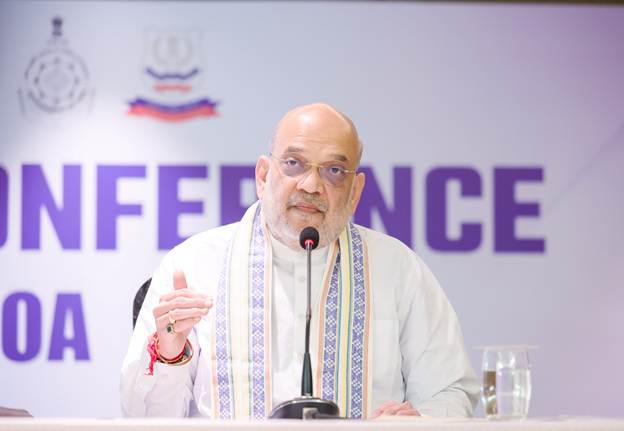
Union Home Minister and Minister of Cooperation Shri Amit Shah addresses a press conference on narcotics control in Panaji, the capital of Goa
Under the leadership of Prime Minister Shri Narendra Modi Ji, we will fulfil the resolve of a ‘Drug-free India’ by 2029
Just as Naxalism was eliminated from the country, we will similarly eliminate the problem of drugs
A three-year roadmap from July 2026 to July 2029 is ready to create a ‘Drug-free India’, with the resolve to achieve all targets in a time-bound manner
The roadmap for a ‘Drug-free India’ is based on four pillars – intelligence and operation-based enforcement, precursor and synthetic drugs control, demand and harm reduction, and capacity building and coordination
By adopting a quadrangular strategy, we are taking the necessary steps to curb the smuggling of drugs into the country through the routes of the Death Triangle and Death Crescent
Modi government has made the fight against drugs a national security priority
Ministry of Education, Youth and Sports, along with educational institutions, are resolving to make educational institutions drug-free
Through NCC, NSS and My Bharat, lakhs of ‘Nasha Mukt Bharat Mitras’ will be prepared
Modi Government has adopted a new approach to investigations through a Bottom-to-Top and Top-to-Bottom approach, with special emphasis on financial investigations and PIT-NDPS
From 2004 to 2014, 2.6 million kilograms of drugs worth ₹40,000 crore were seized, whereas from 2014 to 2026, more than 11.9 million kilograms of drugs worth ₹1.89 lakh crore were seized
Under the ‘Nasha Mukt Bharat Abhiyaan’, 250 million citizens have been reached and administered a pledge, while 570,000 citizens have been freed from drug addiction through treatment and rehabilitation
Department of Social Justice, Health Department, and Prison Administration are jointly working to triple the number of drug de-addiction centres to 1,751
A nationwide campaign is underway against fugitives who have fled the country after committing crimes; fugitives involved in economic offences, terrorism, narcotics and gang warfare have been brought back to face justice before Indian courts
प्रविष्टि तिथि:
06 SEP 2026 6:38PM by PIB Delhi
Union Home Minister and Minister of Cooperation Shri Amit Shah today addressed a press conference on narcotics control in Panaji, the capital of Goa. On this occasion, Goa Chief Minister Shri Pramod Sawant was also present.
Addressing the press conference, Union Home Minister Shri Amit Shah said that since Shri Narendra Modi became the Prime Minister, the Government of India has taken numerous steps to strengthen the country’s internal security. He said that when Modi Ji became the Prime Minister, the country was facing three formidable problems, which included rising terrorism in Jammu and Kashmir, Naxalism, and the unrest created by several armed organisations in the Northeast. In addition, on the internal security front, the country was also greatly troubled by several bomb blasts. There were large-scale movements regarding the safety of women. It was precisely during that period that Modi Ji assumed the office of the Prime Minister of the country. Looking back from 2019 to now under his leadership, the situation has changed significantly. After the abrogation of Article 370 in Jammu and Kashmir, the feeling of separatism has reduced considerably. The figures of terrorism are gradually shrinking and moving towards zero, and Jammu and Kashmir has progressed on the path of development. Successful efforts have also been made to bridge the mental distance that existed between Jammu and Kashmir and the rest of the country. The five-decade-old problem of Naxalism has today almost become a thing of the past. Most of the people who imagined the Red Corridor have today surrendered by laying down arms and are joining the mainstream. Similarly, in the Northeast as well, around 11,000 youth have laid down arms. The Government of India has signed more than 14 agreements with them, and today the Northeast is also progressing on the path of development. After 2019, a campaign has also been launched against fugitives who fled after committing crimes. From 2019 to July 2026, 274 fugitives have been extradited from 36 countries. These include people involved in serious crimes such as economic offences, terrorism, narcotics, and gang wars. All of them have been brought before the courts of India. In the last three years, 401 Red Corner Notices have been issued. In 2026 alone, up to July, the entire process of issuing 182 Red Corner Notices has been successfully completed. For this, a new system has been created in the form of ‘BHARATPOL’. More than 14 central agencies and the police of all states are connected to ‘BHARATPOL’. A well-organised mechanism has been prepared through ‘BHARATPOL’ for the extradition of fugitives from every state. From 2019 to 2026, properties worth approximately ₹17,874 crore belonging to fugitives have been sealed or confiscated. The new criminal laws and justice codes have also made the path of legal action against fugitives easier.
Union Home Minister Shri Amit Shah said that a systematic mechanism has also been prepared for cyber crimes, which is being monitored by Prime Minister Modi Ji himself. Today, the 1930 helpline has become an effective medium for protection against cyber crimes. Success has been achieved in implementing the three new criminal laws up to the police station level through the Ministry of Home Affairs with the cooperation of the states. He said that he thanks the Chief Minister of Goa and the Goa Police for implementing the new Nayaya Sanhita and the three criminal laws in such a short time and raising the conviction rate in the state to 53.2 per cent. This means that there has been an increase of approximately 30 per cent in the rate of securing convictions in registered FIRs.
Union Home Minister and Minister of Cooperation Shri Amit Shah said that narcotics is a crime that can destroy our future generations. He said that the earnings from narcotics are also used for terrorism. The narco-terror module is active in many countries of the world, and the entire world is today grappling with this problem. He said that since 2019, we have put in place a robust system to curb it. For this, we have changed the systems, caught the networks, broken the financial chain, and also provided handholding to those addicted so as to free them from drugs. Shri Shah said that before 2014, this battle was fought in a piecemeal manner, and satisfaction was derived from making small seizures and catching small accused persons. But since 2019, the Modi government has made this subject a priority of national security. He said that the fight against drugs has moved beyond files and the actions of separate agencies and has now become a coordinated and continuous campaign at the national level.
Union Home Minister said that in 2019, a four-tier NCORD mechanism was created. A model for the formation of dedicated Anti-Narcotics Task Forces was sent to all states and Union Territories, and a Joint Coordination Committee was constituted. With the coordination of central agencies, state governments and their departments, a scientific method was adopted to address large networks, inter-state and international links, and operational gaps. The ‘1933’ Manas helpline was started for the rehabilitation of drug-addicted youth. The cadre of the Narcotics Control Bureau (NCB) was restructured. A national database of narcotics offenders was created through the NIDAAN portal. Using CCTNS data and integrated data fusion, a data-based map of hotspots, modus operandi and seizures across the country was prepared. A new concept of investigation was adopted with both Bottom-to-Top and Top-to-Bottom approaches. He said that now even if a small packet of drugs is seized, it is examined where it originated from in the country. Similarly, if a large consignment is seized at the border, it is traced how it was going to reach the youth in the form of small packets. In this way, reverse investigation of the entire network has been started.
Shri Amit Shah said that special emphasis was given to financial investigation and PIT-NDPS, and a high-level dedicated task force was constituted. Technology-based investigation was started against the dark net, encrypted communication, crypto transactions and dead drop delivery. Work began on creating a dedicated Dark Net-Crypto Cell in the ANTF. An inter-ministerial mechanism was also created for precursors and synthetic drugs. He said that these efforts have yielded good results. Shri Shah said that from 2004 to 2014, under the rule of the opposition party, 26 lakh kilograms of drugs were seized, valued at approximately ₹40,000 crore. On the other hand, from 2014 to 2026 under the leadership of Modi Ji, this seizure has increased to more than 1 crore 19 lakh kilograms, valued at approximately ₹1 lakh 89 thousand crore. He said that from 2004 to 2014, 3 lakh 36 thousand kilograms of drugs were destroyed, whereas in 2014-26, 48 lakh 68 thousand kilograms of drugs have been destroyed.
Union Home Minister Shri Amit Shah said that 10 apex meetings, 7 executive meetings, 277 state-level meetings and 16,798 district-level meetings of NCORD have been held. Agreements have been signed with 46 countries for international cooperation. Under the Nasha Mukt Bharat Abhiyan, 25 crore citizens have been contacted and administered the oath. Under treatment and rehabilitation, 5 lakh 70 thousand citizens have been made drug-free. In Goa also, action has increased approximately three times during the same period.
Shri Amit Shah said that a three-year roadmap from July 2026 to July 2029 has been prepared. A decision has been taken to achieve all targets in a time-bound manner. He said that we are advancing the fight against drugs as one of the biggest national battles of the country. He said that the goal of Prime Minister Shri Narendra Modi is that by 2047, a drug-free youth power should form the foundation of a developed India. To make this mission successful, the Ministry of Home Affairs and all state governments are working together. He said that the period from 2026 to 2029 has been declared as mission mode. Timelines have been fixed, different ministries have been made accountable, measurable outcomes have been decided, and quarterly reviews along with outcome-based accountability will be ensured. He said that this roadmap is based on four pillars. First—intelligence and operation-based enforcement; second—precursor and synthetic drugs control; third—demand and harm reduction; and fourth—capacity building and coordination. He said that all these pillars together will prepare dossiers of drug kingpins, coordinate on backward-forward linkages, and tighten the noose through financial investigation of every case involving commercial quantities. He said that the BSF, CISF, Indian Coast Guard, Customs and DRI will carry out risk-based profiling and install scanners at land borders, ports, airports and cargo for sharper surveillance. The Home Minister said that the CBI, Ministry of External Affairs and Interpol will bring back the fugitives. The Enforcement Directorate, Financial Intelligence Unit and the banking system will catch the money trail.
Shri Amit Shah said that through the NCC, NSS and My Bharat, lakhs of ‘Nashamukti Mitra’ will be prepared. He said that the Ministry of Education, Youth Affairs and Sports, along with educational institutions, are taking a resolve to make educational institutions drug-free. The Social Justice, Health Department and Jail Administration together are going to increase the number of de-addiction centres threefold to 1,751. Approximately 10,000 volunteers will serve in this campaign. For capacity building, 7 per cent central assistance will be provided to create fully equipped Anti-Narcotics Task Forces in every state by March 2027. The Ministry of Home Affairs will make arrangements for forensic reports to be received within 30 days. In these four pillars, 25 components and more than 200 action points have been fixed in a time-bound manner.
Union Home Minister Shri Amit Shah said that foreigners are welcome in India, but not with drugs. He said that by adopting the Quadrangular Approach, necessary action is being taken to curb the smuggling of drugs into the country through the routes of the Death Triangle and the Death Crescent. He said that just as Naxalism has been eliminated from the country, the problem of drugs will also be eliminated with the same resolve.
****
RK/RR/PR/PS
(रिलीज़ आईडी: 2307200)
आगंतुक पटल : 1869
इस विज्ञप्ति को इन भाषाओं में पढ़ें:
Tamil
,
Urdu
,
Marathi
,
हिन्दी
,
Assamese
,
Punjabi
,
Gujarati
,
Odia
,
Telugu
,
Kannada
,
Malayalam