Ministry of Electronics & IT
Union Minister Shri Ashwini Vaishnaw holds a high-level meeting with the industry on Revamp of the AI Curriculum
Focus on enhancing practical exposure, industry-integrated learning, faculty development and shared infrastructure
Posted On:
28 MAY 2026 4:03PM by PIB Delhi
Government of India is collaborating with the industry for a comprehensive overhaul of the AI curriculum to better equip learners for emerging technological trends. Union Minister for Electronics & IT, Shri Ashwini Vaishnaw, held a high-level meeting with the AI Curriculum Taskforce, in New Delhi in this regard.
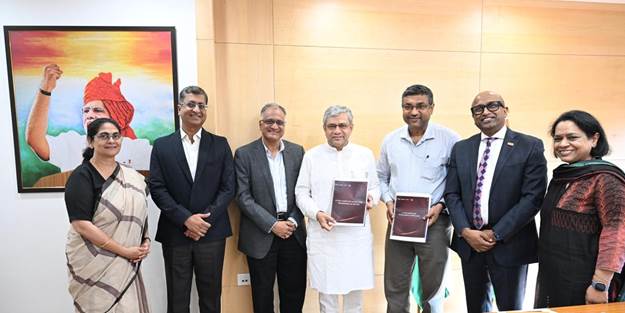
The Taskforce conducted a baseline study of the existing Bachelor of Technology (B.Tech) Computer Science and allied curricula in Indian educational institutions. The exercise was undertaken in partnership with industry experts and the National Association of Software and Service Companies (NASSCOM).
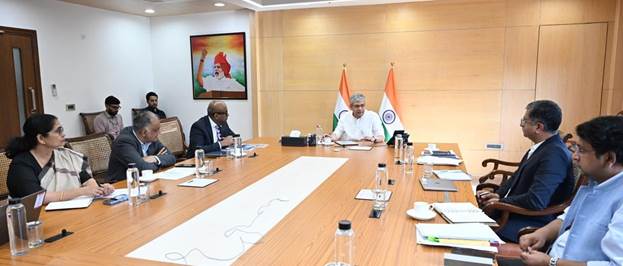
While the study acknowledged that AI coverage in Indian curriculum has expanded, it identified significant gaps. These were in pedagogy, infrastructure, and practical exposure in fields such as Generative AI, Machine Learning Operations (MLOps) and foundational model development.
Focus areas of the Taskforce:
- Application-Oriented Pedagogy: Shift from lecture-based teaching to a learning anchored in real industry use cases from the first semester.
- Credit-Linked Curriculum Integration: AI courses embedded within the formal academic credit system with a structured semester-wise rollout.
- Enhanced Practical Exposure: A shift from the current 25–30 per cent practical exposure to 40–75 per cent, depending on the nature of the degree and the chosen specialisation.
- Industry-Integrated Pedagogy: Industry exposure distributed across the programme through capstone projects, end-to-end AI solution engineering, and use of low-code and no-code tools.
- Responsible AI as a Continuous Thread: Responsible AI and AI Governance integrated across all semesters instead of standalone modules.
- Multiple Entry-Exit Options: A flexible pathway providing a Certificate after Year 1, a Diploma after Year 2, and an Advanced Diploma after Year 3.
Emphasis on faculty development
Recognising that curriculum reform must be matched by faculty readiness, the consultation placed faculty capacity building at the centre of the proposed roadmap. The recommendations include:
- Structured Train-the-Trainer programmes,
- Curated course content,
- Standardised assessment frameworks, and
- Modernised labs in-sync with current industry tools and platforms
Focused intervention was also recommended for engaging seasoned industry professionals as adjunct faculty. This draws on the proven model of premier business schools, to bring deep practitioner expertise into the classroom.
Shared Infrastructure at the core
The participants further proposed the creation of a national-level shared AI infrastructure. The triple helix model would be jointly supported by industry, the Government and academic institutions. This would ensure equitable access to Graphics Processing Unit (GPU) compute, edge devices, software stacks and subscription-based platforms across colleges and universities.
Future roadmap
The consultation concluded with consensus on four immediate next steps:
- Estimation of Requirements for compute, infrastructure, faculty and learner volumes at a national scale.
- Engagement with the All India Council for Technical Education (AICTE) for formal adoption of the revamped curriculum in semesters five through eight of ongoing batches, alongside full integration for incoming batches.
- Faculty Development Roadmap, including industry-led training, experience sharing and a structured pathway for corporate practitioners to serve as educators.
- Parallel Track for Non-STEM Disciplines, to be taken up as a separate workstream covering AI awareness, foundational AI literacy and the applied use of AI in non-technical roles.
***
MSZ
(Release ID: 2266233)
Visitor Counter : 3799
Read this release in:
Urdu
,
Marathi
,
हिन्दी
,
Manipuri
,
Bengali
,
Bengali-TR
,
Punjabi
,
Gujarati
,
Odia
,
Tamil
,
Kannada
,
Malayalam