Ministry of Electronics & IT
Defining Moment for AI: World Leaders, Big Tech CEOs Back AI Innovation with Responsibility at India AI Impact Summit 2026
The Smartest AI is Not the Most Expensive, it is the One Built by Best People for the Right Purpose: Emmanuel Macron, French President
The Future of AI Cannot be Decided by a Handful of Countries or Left to the Whims of a Few Billionaires; Calls for a Global Fund on AI: António Guterres, Secretary-General of the United Nations
We Cannot Allow the Digital Divide to Become an AI divide: Sundar Pichai, CEO of Google
We Should Put AI Tools in the Hands of the Last Person of the Country: N. Chandrasekaran, Chairman of Tata Sons
AI may Surpass Human Cognitive Capabilities in Most Domains Soon, Cautions Dario Amodei, CEO Of Anthropic
Posted On:
19 FEB 2026 3:00PM by PIB Delhi
India AI Impact Summit 2026 witnessed a global meet of world leaders and Big Tech CEOs centred around the high level Opening Ceremony of the Summit at Bharat Mandapam. The ceremony was inaugurated by Prime Minister Shri Narendra Modi. The ceremony set the tone for the ongoing Summit’s focus on responsible innovation, scientific advancement, and international collaboration in shaping the future of Artificial Intelligence.
Shri Ashwini Vaishnaw, Union Minister of Electronics & Information Technology, positioned India’s AI strategy as one rooted in democratisation, scale, and sovereignty. He outlined India’s comprehensive approach across the five layers of the AI stack - applications, models, compute, talent, and energy, emphasising on their real-world deployment in healthcare, agriculture, education, and public services.
Chairman of Tata Sons N. Chandrasekaran described AI as the next foundational infrastructure- “the infrastructure of intelligence”, with transformative potential comparable to steam engines, electricity, and the internet. He highlighted India’s digital public infrastructure achievements and positioned AI as a strategic national capability built across the full stack, from chips and systems to energy and applications. Emphasising the immense opportunity for industry, he said “AI is the next big infrastructure. It is the infrastructure of intelligence. Our mission should be to make AI work for every individual and every citizen in this country. We should put AI tools in the hands of the last person of the country, and in fact on the earth. We are standing at a defining moment, it is the age of abundant intelligence, where the scarce resources are trust, stewardship and human capability.”
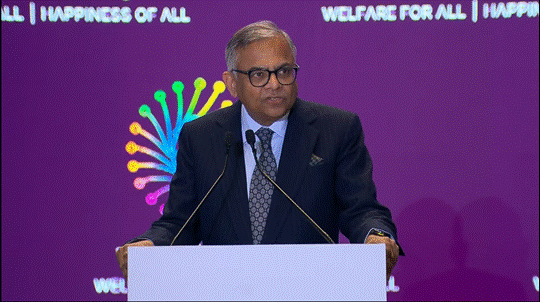
Dario Amodei, CEO of Anthropic, reflected on the extraordinary pace of AI advancement since the first global AI Safety Summit at Bletchley Park in 2023, describing progress over the past two-and-a-half years as “staggering.” He argued that AI has been advancing along an exponential curve for nearly a decade and is rapidly approaching a point where systems may surpass human cognitive capabilities across most domains. “AI has been on an exponential trend for the last 10 years, and we are now well advanced on that curve. We are increasingly close to what I’ve called a ‘country of geniuses in the data centre’, a set of AI agents more capable than most humans at most things, coordinating at superhuman speed. That level of capability brings extraordinary opportunities, to cure diseases, lift billions out of poverty, and create a better world, but it also brings serious risks. Because this is happening so fast, we must work together, companies and governments, to manage disruption and ensure that prosperity is shared smoothly and responsibly,” he stated.
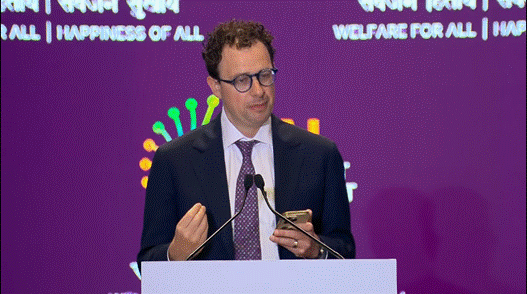
In his address, Sundar Pichai, CEO of Google, described AI as “the biggest platform shift of a lifetime,” highlighting its potential to accelerate scientific discovery, he said “AI is the biggest platform shift of a lifetime. We are on the cusp of hyper progress and new discoveries that can help emerging economies leapfrog legacy gaps. But that outcome is neither guaranteed nor automatic. To build AI that is truly helpful for everyone, we must pursue it boldly, approach it responsibly, and work through this defining moment together. We cannot allow the digital divide to become an AI divide.”
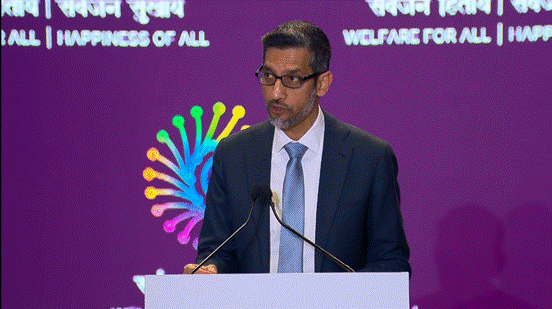
António Guterres, Secretary-General of the United Nations, welcomed India’s leadership in hosting the first AI Summit in the Global South and emphasised that the future of artificial intelligence must not be determined by a small group of countries or private interests. He highlighted two major steps taken by the UN General Assembly: the creation of an independent international scientific panel on AI comprising 40 global experts, and the launch of a Global Dialogue on AI Governance to ensure inclusive, multistakeholder participation. Calling for guardrails that preserve human agency, he said “The future of AI cannot be decided by a handful of countries or left to the whims of a few billionaires. We need guardrails that preserve human agency, human oversight and human accountability. AI must be accessible to everyone. That is why I am calling for a Global Fund on AI to build basic capacity in developing countries. Real impact means technology that improves lives and protects the planet, so let’s build AI for everyone, with dignity as the default setting.”
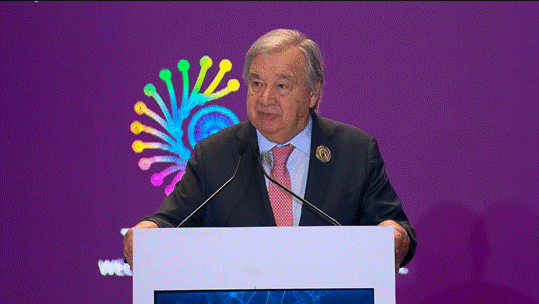
Delivering a keynote address, French President Emmanuel Macron, emphasised the importance of sovereign, independent, and collaborative AI development in an era of accelerating technological competition. Drawing parallels between India’s digital public infrastructure revolution and the current AI transformation, he described AI as a strategic domain shaping geopolitics, economic power, and global balance. He highlighted complementary paths taken by India and Europe, he said “The smartest AI is not the most expensive. It is the one built by the best people and for the right purpose. The future of AI will be built by those who combine innovation and responsibility, technology with humanity. No country is bound to serve only as a market where foreign companies sell models and download citizens’ data. There is a path for innovation, independence and strategic autonomy, and India and France will help shape this future together.”
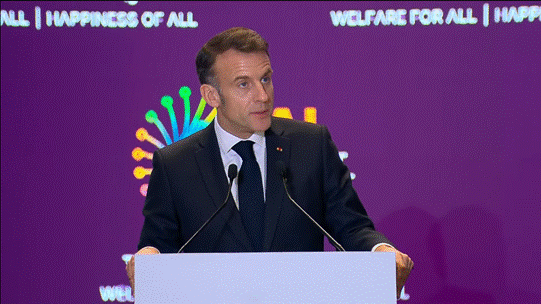
The participation of global political leaders, multilateral institutions, and technology pioneers at the Summit inaugural session underscored the Summit’s stature as a defining platform for shaping the trajectory of Artificial Intelligence in an increasingly interconnected and rapidly evolving world.
*****
Mahesh Kumar/ Pawan Singh Faujdar/ Anil Dutt Sharma/ Onkar N. Pandey
(Release ID: 2230198)
Visitor Counter : 1121