Ministry of Finance
FROM STABILITY TO STRENGTH: GROWTH ACCELERATES ALONG WITH LOWER INFLATION
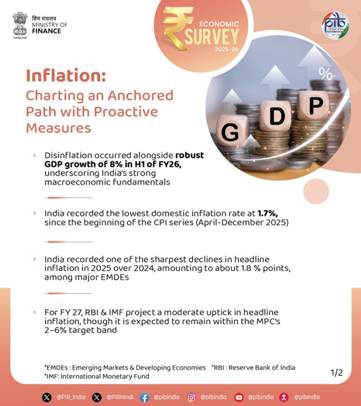
INDIA RECORDS SHARPEST DECLINE IN HEADLINE INFLATION; DOMESTIC INFLATION AVERAGED 1.7 % FOR THE FIRST THREE QUARTERS (APRIL TO DECEMBER 2025)
INFLATION TO BE BENIGN IN 2026-27 SAYS ECONOMIC SURVEY 25-26
Posted On:
29 JAN 2026 2:16PM by PIB Delhi
The Economic Survey 2025-26 tabled in the Parliament today by the Union Minister for Finance and Corporate Affairs, Smt. Nirmala Sitharaman has stated that India recorded lowest inflation rate since the beginning of the CPI series, with April-Dec 2025 average headline inflation coming in at 1.7%. The moderation in retail inflation is primarily attributed to the general disinflationary trend in food and fuel prices, which together account for 52.7% of India’s Consumer Price Index (CPI) basket.
The Survey notes that notably, among major Emerging Markets & Developing Economies (EMDEs), India has recorded one of the sharpest declines in headline inflation in 2025, amounting to about 1.8 percentage points. Importantly, this disinflation has occurred alongside robust GDP growth of 8% in H1 FY 2026, underscoring India’s strong macroeconomic fundamentals and its ability to sustain growth, while effectively managing price pressures, or, in other words, without overheating.
While upgrading India’s sovereign rating, global rating agencies have also acknowledged the credibility and effectiveness of India's inflation management. S&P observed that “Monetary policy reform to switch to inflation targeting has reaped dividends. Inflationary expectations are better anchored than they were a decade ago. Between 2008 and 2014, India's inflation reached double-digits on numerous occasions. In the past three years, despite volatility in global energy prices and supply-side shocks, CPI growth averaged 5.5 per cent. In recent months, it stayed at the lower bound of the Reserve Bank of India's (RBI) target range of 2-6 per cent. These developments, coupled with a deep domestic capital market, reflect a more stable and supportive environment for monetary settings.”
GLOBAL INFLATION DEVELOPMENTS
The world has seen a broad-based and sustained moderation in inflation across advanced, emerging, and developing economies this year. The global headline inflation has declined from a peak of 8.7 per cent in CY 2022 to 4.2 per cent in CY 2025.
The United States and Euro region, experienced a slight moderation in its headline inflation, with declining trends driven largely by moderating core services inflation, along with continued negative inflation in major commodity prices, easing energy and food prices, despite the Russia- Ukraine war.
Global inflationary pressures were contained due to general decline in oil and food prices alongside easing inflation in key commodities. While economic growth in a majority of EMDEs remained below the EMDE average of 4.2%, inflation outcomes varied widely across countries. In Brazil, headline inflation rose to 5.2% in 2025. Russia experienced subdued GDP growth alongside persistently high inflation. In contrast, inflation moderated in several major Southeast Asian economies, including Malaysia, Indonesia, and the Philippines, supported by lower imported commodity costs. Notably, China experienced significant deflation during the year, driven by weak domestic demand, export pressures arising from tariff regimes.
Among major EMDEs, India has recorded one of the sharpest declines in headline inflation, amounting to about 1.8%. Importantly, this disinflation has occurred alongside robust GDP growth of 8 % in the first half of 2025-26, underscoring India’s strong macroeconomic fundamentals and its ability to sustain growth while effectively managing price pressures.
DOMESTIC INFLATION
Over the past four years, average retail inflation, as measured by CPI has followed a clear downward trajectory, declining steadily from 6.7% in 2022–23 to 1.7% up to December 2025.
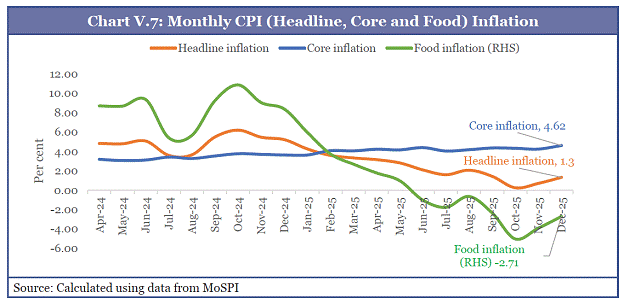
During the first half of 2025–26 headline inflation declined sharply from 3.2% per cent in April 2025 to 1.4 % in September 2025, averaging 2.2% over the period. Inflation eased further to
0.3% in October 2025—the lowest reading in the current CPI (2012=100) series. This disinflation was driven primarily by the food items, reflecting favorable weather conditions and higher production that boosted supply. In contrast, core inflation—which excludes volatile components such as food and fuel—remained relatively stable and has shown a modest uptick during this period, rising from 3.8% in October 2024 to 4.62% in December 2025.
The increase in average core inflation is largely driven by sharp increases in the prices of precious metals—gold and silver—which have touched lifetime highs amid heightened global uncertainty and strong safe-haven demand. When these components are excluded, core inflation exhibits a declining trajectory, broadly mirroring the moderation in headline inflation.
DRIVERS OF FOOD DISINFLATION
Food inflation experienced a steady decline throughout the year, entering deflationary territory since June 2025. The sharp moderation was driven primarily by a sustained and steep decline in vegetable prices, which remained deeply negative for much of the year, alongside a continuous fall in pulses inflation over nearly nine months. Overall, timely trade policy decisions, strategic buffer stock management, and targeted market interventions have enabled effective management of the pulses price cycle, with retail price volatility moderating over the past decade.
In the food basket, the prices of protein-rich food items such as eggs, meat and fish had declined for some months, but recovered soon in the later months. Inflation in milk products, however, remained stable at around 2.6%.
Prices of horticultural commodities declined sharply. The contraction was particularly pronounced for potatoes, onions, tomatoes, and garlic, with price fall ranging between 20 and 40hmb%.
Reduction in the basic customs duty over edible oil has moderated the pace of edible oil inflation since August 2025.
DRIVERS OF CORE INFLATION
Over the past two years, inflation has been gradually easing in clothing and footwear, housing, health while fluctuating in the transport and communication. This disinflation reflects easing input costs, improved supply conditions and competitive pressures in goods markets where prices adjust more frequently. Transport and communication inflation, by contrast, remains lower on average but exhibits episodic movements. These short-lived fluctuations are driven by specific sub-components, such as fares, fuel-linked services, and changes in telecom pricing. However, since June 2025, disinflationary trends have appeared in the transport and communication component.
INFLATION: REGIONAL PICTURE
While state level inflations have remained within the RBI’s inflation tolerance band, regional inflation patterns reveal greater volatility in rural areas due to higher food weights in consumption basket. Unlike previous years (2023, 2024), rural inflation declined and remained lower than the urban inflation, thereby further reducing rural stress.
OUTLOOK
For FY 27, both the RBI and the IMF project a moderate uptick in headline inflation, though it is expected to remain within the MPC’s 2–6 % target band. The Economic Survey similarly anticipates somewhat higher headline and core inflation (excluding precious metals) relative to FY26. Nevertheless, inflationary pressures are expected to stay contained.
The outlook of the Survey remains favourable, with projections of inflation staying within target ranges, supported by strong agricultural output, stable global commodity prices, and continued policy vigilance. However, it cautions risks from currency fluctuations, base metal price surges and global uncertainties, warranting ongoing monitoring and adaptive policy responses.
***
PC/SKS
(Release ID: 2220004)
Visitor Counter : 16816