Infrastructure
India’s Energy Journey: Expanding Capacity, Strengthening Security
प्रविष्टि तिथि:
13 AUG 2026 15:26 PM
India’s Energy Landscape
India’s energy landscape is evolving to meet rising demand while strengthening energy security and supporting a cleaner future. The transformation spans renewable energy, nuclear power, petroleum, natural gas, coal and emerging technologies.
Policy support, infrastructure development, domestic production, manufacturing expansion and wider energy access are shaping this transformation. India is simultaneously expanding non-fossil energy capacity, strengthening domestic energy resources and developing new technologies for the future.
Numbers At a Glance:
- Total installed power capacity: Around 552 GW in July 2026, up from 249 GW in 2014.
- Non-fossil capacity: 300.50 GW as of 31 July 2026, accounting for over 54% of total installed capacity.
- India ranks third globally in renewable energy installed capacity.
Powering Energy Security with Coal
Coal continues to play a major role in India's energy security and electricity supply. It meets nearly 55 per cent of the country’s primary energy needs and supports over 70 per cent of its electricity generation. India has about 4,00,715 million tonnes (MT) of coal reserves and is the world's second-largest coal producer and consumer.
- India produced 1,047.52 MT of coal in FY2024-25 and 1,040.08 MT in FY2025-26, compared with 609.18 MT in FY2014-15.
- Captive and commercial mining: Production from captive and commercial mines reached 210.46 MT in FY2025-26, registering 10.22% growth over the previous year.
- Reducing import dependence: Coal imports by thermal power plants fell to 45.4 MT in FY2025-26, from 62.5 MT in FY2024-25, a decline of about 27.4%.
Promotion of Surface Coal/Lignite Gasification Projects (2026)
The Government approved a ₹37,500 crore scheme in May 2026 to promote surface coal/lignite gasification.
- Expected to utilise approximately 75 MTPA of coal, contributing to the national target of 100 MT of coal/lignite gasification by 2030.
- Expected to mobilise ₹2.5–3 lakh crore in investment.
- Projected to generate around 50,000 direct and indirect jobs across 25 projects.
Solar Power: Scaling Up, Reaching More People
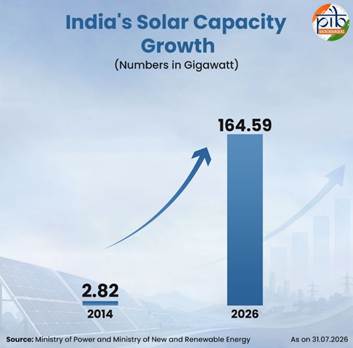
India’s installed solar capacity has reached 164.59 GW (as of 31 July 2026), rising from 2.8 GW in 2014. Solar is now the largest component of India’s renewable energy capacity. India became the world’s second-largest solar growth market in 2025, adding more than 37 GW of solar capacity, compared with 34 GW added by the United States.
PM-Surya Ghar: Muft Bijli Yojana
Launched with a total outlay of ₹75,021 crore for 1 crore households in February 2024.
- 51.58 lakh households are now benefiting from rooftop solar installations across the country (As of 12.08.2026).
- Approximately ₹28,024 crore in subsidy has been transferred to the beneficiaries.
- Nearly 19 lakh households are now receiving zero electricity bills.
- Cumulatively, 14.8 GW of rooftop solar capacity has been commissioned under the scheme so far.
Pradhan Mantri Surya Sarovar Yojana
The government approved the Pradhan Mantri Surya Sarovar Yojana (PM-SSY) on 31 July 2026 with an outlay of ₹5,070 crore. It adds a new dimension to India's solar expansion with the development of Floating Solar Photovoltaic Projects with Energy Storage Systems.
- Target: 5,000 MW of Floating Solar PV projects.
- Co-located storage with a minimum two-hour duration, equivalent to 10,000 MWh.
- Projects to be sanctioned from FY 2026–27 to FY 2030–31.
Wind Energy
Wind energy continues to be an important pillar of India’s renewable energy expansion. India ranks fourth globally in installed wind power capacity. The sector is also seeing stronger annual additions and growing domestic manufacturing
- Installed capacity: 58.14 GW as of 31 July 2026.
- India added 6.05 GW in FY 2025–26, its highest-ever annual wind capacity addition and 46% higher than FY 2024–25.
- Around 28 GW of additional wind capacity is under implementation.
- Wind turbine manufacturing capacity reached about 24 GW (March 2026), up from 10 GW in 2014. The sector has achieved 70–80% indigenisation across key components.
- The Union Cabinet approved a ₹7,453 crore VGF scheme on 19 June 2024 for 1 GW of offshore wind projects.
Bio-Energy
Bio-power capacity stands at 11.75 GW as of 31 July 2026. The CBG ecosystem has also expanded, with 1,929 CBG/Bio-CNG plants registered as of 13 August 2026. Of these, 217 have been commissioned and 357 are under construction.
- Biomass cogeneration: 9821.32 MW of bagasse-based and 1048.84 MW of non-bagasse capacity as of 31 July 2026.
- Waste-to-Energy: As of 31 July 2026, grid-connected waste-to-energy capacity stood at 324.24 MW. Off-grid plants contributed another 554.16 MW.
- National Bioenergy Programme: The programme supports Waste-to-Energy, Biomass and Biogas projects through financial assistance. Phase-I covered FY 2021–22 to FY 2025–26, with an outlay of ₹858 crore.
GOBARdhan: Turning Waste into Energy Growth
- Galvanizing Organic Bio-Agro Resources Dhan (GOBARdhan)– National Circular Bioenergy Scheme: Approved by the government on 6 August 2026, with an outlay of ₹23,731 crore for FY 2026–27 to FY 2035–36.
- The scheme aims to nearly ten-fold domestic CBG production and create a national circular bioeconomy. Lobal Solar Cooperation
Hydro
Hydropower remains an important source of renewable electricity, providing reliable and flexible power generation. It also supports grid stability as solar and wind capacity expand. Cumulative capacity of hydro power is 57.24 GW ( as of 31 July 2026), including large and small hydro.
Small Hydro Power Development Scheme
- The government has approved the Small Hydro Power (SHP) Development Scheme in March 2026 for FY 2026–27 to FY 2030–31, with an outlay of ₹2,584.60 crore.
- The scheme aims to add approximately 1,500 MW of small hydro capacity through projects of 1–25 MW. It particularly supports projects in hilly and North-Eastern regions.
Green Hydrogen
Green hydrogen has emerged as a clean fuel option for hard-to-abate sectors. It can also support energy security and industrial growth.
National Green Hydrogen Mission:
The government launched the National Green Hydrogen Mission (NGHM) in 2023 as an umbrella programme to establish a Green Hydrogen ecosystem and catalyse a systemic response to the opportunities and challenges in this sector.
- Approved in January 2023 with an outlay of ₹19,744 crore, targeting 5 MMT (Million Metric Tonne) of green hydrogen production by 2030.
- Production capacity: Around 8,000 tonnes per annum of green hydrogen production capacity had been commissioned by February 2026.
- Transport: In July 2026, the Government launched 12 pilot projects under the Mission for 70 hydrogen-powered vehicles across 21 routes.
- India's first indigenous hydrogen fuel cell-powered train began operations on the Jind–Sonipat section in July 2026.
Nuclear Energy
India’s nuclear energy sector has witnessed significant expansion and modernisation over the past decade. With a focus on clean energy, indigenous technology, and performance excellence, the country has scaled up both its operational capacity and future potential.
- Installed capacity: 8.78 GW of nuclear power capacity as of 31 July 2026.
- Nuclear Energy Mission: India aims to increase nuclear power capacity to 100 GW by 2047.
- Planned Expansion: With the indigenous 700 MW and 1000 MW reactors being developed through international cooperation, the capacity is projected to rise to 22.38 GW by 2031–32.
- Small Modular Reactors: The Nuclear Energy Mission provides ₹20,000 crore for the design, development and deployment of Small Modular Reactors, with a target of at least five indigenous SMRs by 2033.
- Fast Breeder Reactor: The 500 MWe Prototype Fast Breeder Reactor at Kalpakkam achieved first criticality on 6 April 2026, marking an important milestone in India's three-stage nuclear power programme.
SHANTI Act, 2025
The Sustainable Harnessing and Advancement of Nuclear Energy for Transforming India (SHANTI) Act, 2025 enables private-sector participation for setting up a nuclear facility, or to carry out activities for the production, use and disposal of nuclear energy under a license.
- Civil liability: The maximum liability for each nuclear incident is the rupee equivalent of 300 million Special Drawing Rights (SDR) or an amount specified by the Central Government.
- The Act gives the Atomic Energy Regulatory Board (AERB) statutory status, strengthening its regulatory and safety functions.
Geo Thermal
Geothermal energy offers a reliable renewable source that can complement variable sources such as solar and wind. Geothermal energy uses heat stored within the Earth to generate electricity or provide direct heat.
National Policy on Geothermal Energy (notified on 15 September 2025)
- The policy provides a framework for the exploration, development and utilisation of geothermal resources.
- The Geological Survey of India has estimated India's geothermal potential at around 10,600 MW, based on exploration across 381 hot springs, with 42 geothermal manifestations identified as promising areas.
- The policy promotes technology partnerships, knowledge transfer and joint R&D. India has cooperation mechanisms with Australia, Iceland, Saudi Arabia and the United States for geothermal energy.
- Five projects sanctioned during July–August 2025, including a pilot production plant, resource assessment projects and a solar–geothermal hybrid plant. These aim to establish the techno-economic viability of geothermal applications.
India’s Evolving Fuel Landscape
Clean cooking has moved from being an access challenge to a widely available household energy option. The expansion of LPG connections and rising consumption reflect its growing reach across Indian households.
- National LPG coverage increased from 55.9% in 2014 to 107.2% in 2026.
- LPG consumers increased from 14.51 crore to 33.18 crore from 2014 to 2026.
- Under Pradhan Mantri Ujjwala Yojana, refill delivery reached around 49.21 crore cylinders in FY2025–26.
- 25 lakh additional LPG connections approved under PMUY in FY2025–26, of which 24.84 lakh connections have been released as on 5 August 2026.
- India is the world’s fourth largest crude refiner, with an installed capacity of 258.1 million tonnes per annum across 22 operational refineries.
'Samudra Manthan' – National Offshore Exploration Scheme
Approved on 31 July 2026 with an outlay of ₹84,084 crore to boost offshore oil and gas exploration and strengthen energy security, covering seismic surveys, deepwater exploratory drilling, and offshore production/evacuation infrastructure.
Looking Ahead: Building India’s Energy Future
India is building an energy system that combines security, sustainability and innovation. Expanding non-fossil capacity is being supported by stronger domestic resources, infrastructure, manufacturing and emerging technologies.
As energy demand grows, India’s diversified energy mix will support reliable power, greater energy security and a cleaner future. Continued policy support and technological progress will help build an energy system that is resilient, self-reliant and future-ready.
References
Cabinet
https://www.pib.gov.in/PressReleasePage.aspx?PRID=2241799®=3&lang=1
https://www.pib.gov.in/PressNoteDetails.aspx?ModuleId=3&NoteId=158349®=48&lang=2
https://www.pib.gov.in/PressReleasePage.aspx?PRID=2292445®=48&lang=1
Ministry of New and Renewable Energy (MNRE)
https://www.pib.gov.in/PressReleasePage.aspx?PRID=2296782®=48&lang=1
https://www.pib.gov.in/PressReleasePage.aspx?PRID=2250039®=48&lang=2
https://www.pib.gov.in/PressReleasePage.aspx?PRID=2293256®=48&lang=1
https://www.pib.gov.in/PressReleasePage.aspx?PRID=2244667®=48&lang=2
https://www.pib.gov.in/PressReleasePage.aspx?PRID=2245157&lang=2®=48
https://www.pib.gov.in/PressReleasePage.aspx?PRID=2250039&lang=1®=3
https://www.pib.gov.in/PressReleasePage.aspx?PRID=2291541®=48&lang=1
https://www.pib.gov.in/PressReleaseIframePage.aspx?PRID=2026700®=48&lang=2
https://www.pib.gov.in/PressReleasePage.aspx?PRID=2200435®=48&lang=2
https://pmkusum.mnre.gov.in/#/landing
https://mnre.gov.in/en/physical-progress/
https://mnre.gov.in/en/bio-energy-overview/
https://mnre.gov.in/en/new-technologies-overview/
https://www.pib.gov.in/PressReleasePage.aspx?PRID=1777364®=48&lang=2
https://www.pib.gov.in/PressReleasePage.aspx?PRID=2268992®=48&lang=2
https://pmsuryaghar.gov.in/#/
https://www.pib.gov.in/PressReleasePage.aspx?PRID=2249408®=3&lang=1
Ministry of Petroleum & Natural Gas
https://www.pib.gov.in/PressReleasePage.aspx?PRID=2266034®=48&lang=2
https://www.pib.gov.in/PressReleasePage.aspx?PRID=2295494®=3&lang=1
https://ppac.gov.in/download.php?file=rep_studies/1785837484_LPG_Profile_Report_Q1_FY_2026-27_Final_Web.pdf
https://www.pmuy.gov.in/index.aspx
https://gobardhan.eil.co.in/
Ministry of Coal
https://www.pib.gov.in/PressReleasePage.aspx?PRID=2293366®=48&lang=1
https://www.pib.gov.in/PressReleasePage.aspx?PRID=2289973&lang=2®=48
https://www.pib.gov.in/PressReleasePage.aspx?PRID=2260621&lang=2®=3
https://www.pib.gov.in/PressReleasePage.aspx?PRID=2286591®=48&lang=1
Department of Atomic Energy (DAE)
https://www.pib.gov.in/PressReleasePage.aspx?PRID=2198951®=3&lang=1
https://www.pib.gov.in/PressNoteDetails.aspx?NoteId=156593&ModuleId=3®=3&lang=2
https://www.pib.gov.in/PressReleasePage.aspx?PRID=2294814®=48&lang=1
https://www.pib.gov.in/PressReleasePage.aspx?PRID=2249537®=48&lang=2
https://www.pib.gov.in/PressReleasePage.aspx?PRID=2247971&lang=2®=48
Ministry of Railways
https://www.pib.gov.in/PressReleasePage.aspx?PRID=2285240®=48&lang=1
PIB Backgrounders
https://www.pib.gov.in/FactsheetDetails.aspx?Id=150630®=3&lang=1
https://www.pib.gov.in/FactsheetDetails.aspx?Id=149232®=48&lang=2
https://www.pib.gov.in/PressReleasePage.aspx?PRID=2270740®=3&lang=1
https://www.pib.gov.in/PressNoteDetails.aspx?NoteId=156593&ModuleId=3®=3&lang=2
https://www.pib.gov.in/PressNoteDetails.aspx?NoteId=155990&ModuleId=3®=48&lang=2
Click here to see PDF
PIB Research
(तथ्य सामग्री आईडी: 150868)
आगंतुक पटल : 1706
Provide suggestions / comments