|
PIB Backgrounder
Strengthening India’s Space Sovereignty
Driving Innovation and Development
Posted On:
14 AUG 2026 4:13PM by PIB Delhi
India’s Leap Towards Space Leadership
India’s space journey has evolved from building basic capabilities to delivering advanced, globally competitive space technologies. Over the past decade, reforms have opened the sector to private enterprise, startups and global partnerships. India is now expanding its capabilities across launch systems, satellites, space applications and human spaceflight. As India marks its 80th Independence Day, its space ambitions reflect a confident and self-reliant nation shaping the future of space.
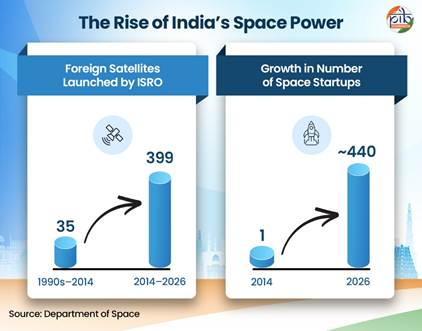
- India’s space ecosystem has expanded rapidly, with registered space start-ups rising from 1 in 2014 to around 440 in 2026 (till August).
- This expanding ecosystem is strengthening India’s space economy, valued at USD 9 billion, as of August 2026. It is projected to reach USD 40–45 billion over the next decade.
- Private investment in India's space sector surged nearly six-fold, climbing from USD 100.5 million in 2021–22 to USD 618.5 million by March 31, 2026, with USD 187 million recorded during 2026 alone.
- By mid-2026, 113 authorisations had been granted to 52 Non-Government Entities (NGEs) out of which 18 are start-ups for satellite operations, payload establishment and launch services.
|
The Earth Observation Public-Private Partnership (EO-PPP)
EO-PPP is a pioneering public–private framework launched by IN-SPACe. It brings government oversight and private industry together to develop India’s first privately owned Earth observation satellite constellation, backed by around ₹1,200 crore in private investment commitments.
|
- India’s growing launch capabilities are attracting global demand, with foreign satellite launches increasing from 35 before 2014 to 399 as of January 2026.
- India’s global partnerships reinforce its growing space leadership, with 300+ space cooperation agreements across 61 countries and 5 multilateral organizations, covering research, technology, joint missions and capacity building.
Catalysing Reforms through Strategic Action
India’s space reforms have created an enabling environment for private participation, investment, innovation and technology-led growth. These measures have broadened the sector beyond traditional government-led space activities.
- India opened its space sector to private participation in 2020, enabling industry and start-ups across satellites, launch systems and space applications. This marked a major shift towards a broader national space ecosystem.
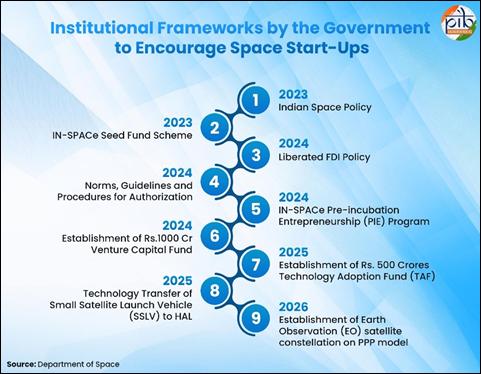
- The Indian Space Policy 2023 further expanded private participation across the space value chain. It also defined the roles and responsibilities of NewSpace India Limited (NSIL) and Indian National Space Promotion and Authorisation Centre (IN-SPACe).
- NSIL, the commercial arm of ISRO, provides launch, satellite and space-based services and transfers ISRO technologies to Indian industry. Its revenue rose from ₹321.77 crore in FY 2021–22 to over ₹3,000 crore in FY 2024–25, reflecting the growing commercialisation of India’s space programme.
- As on date, NSIL has signed 118 Technology Transfer Agreements for transferring 83 technologies developed at ISRO/ Department of Space to Indian Industry.
- IN-SPACe enables private space activities through a single-window mechanism. It facilitated 71 ISRO’s technology transfers to industry and start-ups as on 31 January 2026.
- Foreign Direct Investment (FDI) rules in February 2024 were liberalised for the space sector. Up to 74% FDI is permitted automatically for satellite manufacturing and operations, 49% for launch vehicles and spaceports, and 100% for satellite and ground-segment components.
- The Norms, Guidelines and Procedures (NGP) 2024 established transparent authorisation and compliance requirements. The framework enhances regulatory predictability and ease of doing business.
- Targeted financing is strengthening India’s private space ecosystem. The IN-SPACe Seed Fund Scheme supports early-stage space start-ups, the ₹1,000 crore Venture Capital Fund provides growth capital, and the ₹500 crore Technology Adoption Fund enables wider deployment of space technologies. Further, The Satellite Bus as a Service (SBaaS) Scheme has been allocated ₹75 crore to support the development of satellite bus capabilities.
These reforms are creating a more competitive and dynamic space ecosystem. They are enabling Indian industry and start-ups to contribute across the space value chain.
Space Capability Reaching Beyond Earth
India’s space programme has progressed from satellite development to complex missions across the Moon, Mars and solar system. Achievements demonstrate growing capabilities in exploration, navigation, science and advanced space operations.
Self-Reliant Space Transportation
- India has operationalised four indigenous launch vehicles: Polar Satellite Launch Vehicle (PSLV), Geosynchronous Satellite Launch Vehicle (GSLV), Geosynchronous Satellite Launch Vehicle Mark III (GSLV Mk III), and Small Satellite Launch Vehicle (SSLV).
- These launch vehicles support Earth observation, communication, navigation, space science and exploration, besides commercial launches for national and international customers.
- Over the last three years (July 2023 to June 2026), India successfully completed 12 launch vehicle missions, carrying 11 national satellites and nine satellites for international customers.
India is Expanding Its Launch Capacity
India is strengthening its launch infrastructure to meet growing national and commercial space demand. Sriharikota currently has two operational launch pads, with a third being established for next-generation launch vehicles. Kulasekarapattinam, Tamil Nadu, is also emerging as India’s second rocket launch site for Small Satellite Launch Vehicles (SSLVs) and private-sector launches. Together, these facilities will expand launch capacity, frequency and operational flexibility, reinforcing India’s position as a competitive global space-launch hub.
|
Lunar Exploration — Chandrayaan Programme
- Chandrayaan-1 (2008) was India’s first Moon mission and detected water molecules and hydroxyl on the lunar surface. It established India as a contributor to global lunar science.
- Chandrayaan-2 (2019) operated from 100 km altitude and captured lunar images at up to 30 cm resolution, the highest resolution optical images ever from a lunar orbiter platform.
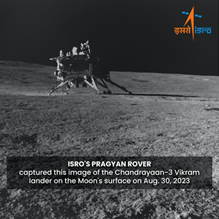
- Chandrayaan-3 (2023) made India the first country to soft-land near the Moon’s south pole and the fourth nation to soft-land on the Moon.
|
Future Lunar Missions
- Chandrayaan-4, the mission will demonstrate lunar sample collection, ascent from the lunar surface and sample return to Earth. The planned timeline for the mission is 2027.
- Chandrayaan-5/LUPEX, a joint ISRO-JAXA mission, will study lunar volatiles, including lunar water, near the Moon’s south polar region.
|
Beyond the Moon: Mars, Sun and Deep Space
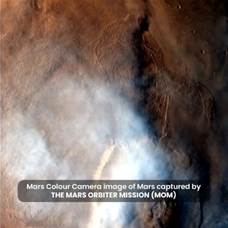
- Mars Orbiter Mission (Mangalyaan) was inserted to the Martian orbit on 24 September 2014, making it India’s maiden interplanetary mission. The spacecraft operated for over 8 years, far exceeding its planned six-month mission.
- AstroSat, India’s first dedicated Indian astronomy mission aimed at studying celestial sources in X-ray, optical and UV spectral bands simultaneously.
- Aditya-L1 (2023) is India’s first space-based mission to study the Sun, positioned nearly 1.5 million km from the Earth at the Sun-Earth L1 point. More than 27 TB of solar data has been released publicly.
- XPoSat launched in January 2024 expanded India’s capabilities in X-ray polarization astronomy. It enables detailed studies of extreme cosmic sources.
- Space Docking Experiment (SPADEX), January 2025, made India the fourth nation to demonstrate autonomous space docking and undocking.
Axiom-4: Advancing Human Spaceflight Capabilities
- Group Captain Shubhanshu Shukla, India’s first astronaut to have journeyed to the ISS in the Axiom-4 mission which was launched on 25 June 2025. His participation provided India with valuable experience in human spaceflight and microgravity research.
- Axiom-4 concluded successfully on 15 July 2025, strengthening India’s operational experience for future crewed missions, including Gaganyaan.
NavIC — India’s Indigenous Navigation System
- Navigation with Indian Constellation (NavIC) provides positioning, navigation and timing across India and up to 1,500 km beyond its boundary. It strengthens India’s navigation autonomy and supports strategic and civilian applications.
- NVS-01 and NVS-02, the first two second-generation NavIC satellites, were launched in May 2023 and January 2025, respectively.
- While NVS-03 is ready for launch and NVS-04 and NVS-05 are under advanced realization. The second-generation satellites will enhance system reliability and continuity.
- NavIC is being integrated into power-grid synchronisation, real-time train tracking, Aadhaar geo-tagging and mobile chipsets.
- Its adoption is expanding satellite-based positioning across critical infrastructure and everyday services.
India’s expanding capabilities are opening new frontiers in space science and exploration.
They also strengthen the country’s technological capabilities and global standing in space.
India’s Space Journey Ahead
India is entering a new phase of human spaceflight, deep-space exploration and advanced space infrastructure. Upcoming missions will build capabilities for sustained human presence and complex orbital operations.
- The Gaganyaan human spaceflight programme was approved in January 2019. Its scope was expanded and revised in September 2024 to a total outlay of ₹20,193 crore encompassing 8 total missions—including precursor flights for the Bharatiya Antariksh Station (BAS-01).
- It aims to launch a crew of 3 Indian astronauts to a 400-km orbit for a three-day mission.
- The first uncrewed experimental mission to validate various technologies including Vyommitra half-humanoid is targeted in Q4 of 2026. The crewed mission is targeted by 2027.
- India’s planned five-module space station Bharatiya Antariksh Station (BAS). It is targeted for operationalisation by 2035, with BAS-01 planned for launch by 2028. It will support long-duration human spaceflight, microgravity research and advanced space operations.
- SPADEX-2 and SPADEX-3: The missions are being studied to advance orbital docking technologies for future Chandrayaan-4, Gaganyaan and BAS missions. They will enable capabilities such as spacecraft docking, sample transfer, crew transfer and power, fluid and propellant transfer.
- Venus Orbiter Mission: Targeted for launch in March 2028, the mission will study Venus’ geology, atmosphere and ionosphere. It will demonstrate advanced aerobraking and thermal-management technologies.
Advanced Technologies Shaping India’s Next Generation of Space Capabilities
- ISRO is developing a 200-tonne thrust semi-cryogenic engine. It will enable more powerful launch vehicles and higher payload capacity.
- A semi-cryogenic booster stage is being developed for the Launch Vehicle Mark-3 (LVM3). It will significantly enhance LVM3’s payload-carrying capability.
- ISRO is demonstrating booster recovery using Vertical Take-off and Vertical Landing (VTVL) technology. This will enable rocket-stage reusability and reduce future launch costs.
- ISRO is developing a partially reusable Next Generation Launch Vehicle (NGLV) using LOX-Methane propulsion. It will provide greater payload capability and support frequent, cost-effective launches.
- ISRO is developing a winged Winged Orbital Re-entry Vehicle for the Reusable Launch Vehicle (RLV) programme. It will demonstrate orbital re-entry and runway landing for reusable space transportation.
- ISRO is developing air-breathing propulsion and a technology demonstrator vehicle. This technology could enable more efficient atmospheric flight and advanced reusable launch systems.
|
The next phase will deepen India’s role in human spaceflight, planetary exploration and advanced space technology. These efforts will support India’s ambition to become a leading global space power.
References
Department of Space
Ministry of Science & Technology
PIB Backgrounder
Lok Sabha
Indian Space Research Organisation
Vice President's Secretariat
Prime Minister's Office
Click here for the pdf file.
****
PIB Research
(Release ID: 2299421)
|