PIB Backgrounder
The Making of a Sporting Nation
Khelo India and the Road to International Excellence
Posted On:
27 JUL 2026 5:01PM by PIB Delhi

The Spirit of a Sporting India
As the Commonwealth Games return to Glasgow from 23 July to 2 August 2026, India begins another chapter in its sporting journey. This is India's 19th Commonwealth Games (CWG) appearance, continuing a legacy that began in 1934. Weightlifter Mirabai Chanu has already opened India's gold medal account in Glasgow, securing her third consecutive CWG title.
Such moments capture something larger than medals alone. Sport carries immense power to transform a nation, shaping individuals and elevating countries onto the world stage. It builds character and confidence in citizens, while announcing a nation's arrival as a sporting superpower. Victory on the field brings immense national pride, uniting people beyond caste, creed and religion. This shared pride helps build a happier, healthier and more cohesive society.
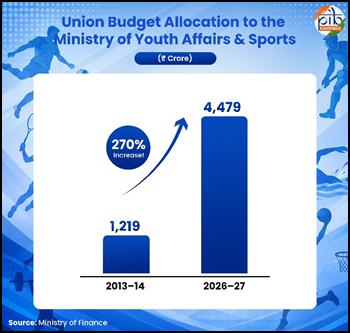
India's greatest sporting asset is its youth. Around 65 per cent of the population is below 35 years of age. Recognising this immense potential, the Ministry of Youth Affairs and Sports continues to strengthen youth development and promote sporting excellence across the country. The Union Budget 2026–27 allocated a record ₹4,479.88 crore to the Ministry, up from ₹1,219 crore in 2013–14.
At the heart of this transformation stands the Khelo India programme, complemented by several other key initiatives. Together, they promote mass participation and sporting excellence across rural and urban India alike. They provide crucial infrastructure and financial support to identify, train and nurture talent at every level. These efforts are shaping a generation ready to carry India's colours with pride on the world's biggest stages.
The Khelo India Vision

Launched in 2017 to create a strong foundation for Indian sport, the Khelo India Scheme brought together three existing programmes. It merged the Rajiv Gandhi Khel Abhiyan, Urban Sports Infrastructure Scheme and National Sports Talent Search Scheme into a unified framework for sports development.
The scheme follows a comprehensive approach to strengthen every stage of the sporting ecosystem. Its five key pillars are:
- Establishing training centres at different levels to identify talented athletes and guide them towards professional excellence.
- Building the capacity of coaches and support staff through dedicated development programmes.
- Expanding the use of sports science and advanced technology to improve athlete performance.
- Organising competitions and leagues to promote a vibrant sporting culture and provide competitive opportunities.
- Developing sports infrastructure to support both training and competitive events.
The Mission envisions one Khelo India Training Centre in every district through State and Union Territory plans. It also promotes structured athlete pathways supported by sports science, psychology and nutrition. Data driven platforms enable real time athlete tracking. This integrated approach aims to position India among the world's leading sporting nations by 2036.
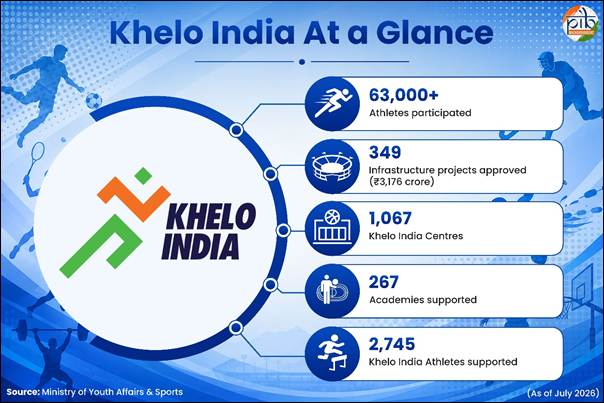
Key achievements of the Khelo India Scheme include (As of July 2026):
- 349 new sports infrastructure projects approved, with a total investment of ₹3,176 crore.
- 1,067 Khelo India Centres (KICs) established to strengthen grassroots training and athlete support.
- 267 academies supported to nurture sporting talent across disciplines.
- 2,745 Khelo India Athletes (KIAs) supported with coaching, equipment, medical care and a monthly out of pocket allowance.
Through sustained investment and a clear long-term vision, Khelo India is creating a strong pipeline of champions for India.
Khelo India Games: A Stage for Future Champions
The Khelo India movement entered a new phase with the launch of the Khelo India School Games in 2018. Held in New Delhi, the event brought young sporting talent from across the country onto one platform.
Later that year, the Indian Olympic Association joined the initiative. From 2019, the event was renamed the Khelo India Youth Games (KIYG). It continues to serve as the flagship competition under the Khelo India umbrella.
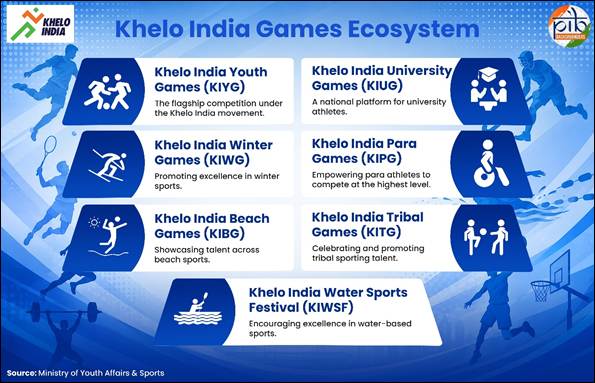
The Khelo India Games have steadily expanded to create more opportunities for athletes across disciplines. Annual competitions now bring together participants representing their States and universities, helping them compete, excel and prepare for higher levels. Since 2018, more than 63,000 athletes have participated in the Khelo India Games.
The Khelo India University Games (KIUG) and the Khelo India Winter Games (KIWG) were introduced in 2020. The Khelo India Para Games (KIPG) followed in 2023. The expansion continued in 2025 with the launch of the Khelo India Beach Games (KIBG) and the Khelo India Water Sports Festival. The Khelo India Tribal Games (KITG) made their debut in 2026.
The Khelo India Games continue to strengthen India's sporting culture by giving young athletes a national stage to pursue excellence.
Enabling India's Sporting Success
India's sporting rise extends beyond infrastructure and competitions. Several focused initiatives strengthen athlete development, identify emerging talent and build long term sporting capacity. Collectively, these efforts are creating a stronger pathway from grassroots participation to global success.
Target Olympic Podium Scheme (TOPS)
The Ministry of Youth Affairs and Sports launched the Target Olympic Podium Scheme (TOPS) in September 2014 to improve India's performance at the Olympic and Paralympic Games. The scheme was revamped in April 2018 with a dedicated technical support team to provide holistic assistance to athletes.
TOPS supports athletes through foreign training, international competitions, coaching camps, specialised equipment and a monthly stipend of ₹50,000. A Development Group was also introduced to support junior athletes with a monthly stipend of ₹25,000.
As of April 2026, the scheme currently supports 51 Core Athletes, 52 Para Core Athletes and 130 Development Athletes. TOPS played an important role in India's medal winning performances at the Tokyo 2020 and Paris 2024 Olympic Games.
The Khelo India Rising Talent Identification (KIRTI) initiative identifies and nurtures sporting talent among children between 9 and 18 years of age. It uses Talent Assessment Centres, standardised assessment protocols and advanced IT tools, including Artificial Intelligence and data analytics, to ensure transparent and merit-based selection.
At present, 174 Talent Assessment Centres operate across 3 States and Union Territories, with 1,87,921 assessments completed. KIRTI aims to build a sustainable talent pipeline to help India become a top 10 sporting nation by 2036 and a top 5 sporting nation by 2047.
Sports Goods Manufacturing
The Union Budget 2026–27 announced a dedicated initiative for sports goods manufacturing with an allocation of ₹500 crore. The initiative seeks to strengthen India's position as a global hub for high quality and affordable sports goods.
Its key objectives include expanding domestic manufacturing capacity, promoting research and innovation in equipment design, advancing material sciences, strengthening India's presence in global sports supply chains and generating employment across manufacturing and allied sectors.
These initiatives are strengthening India's sporting ecosystem and preparing athletes to compete with confidence on the global stage.
India's Rise on the Global Sporting Stage
The investments made in India's sporting ecosystem are delivering results on the global stage. India's performances at major international sporting events reflect the country's growing strength across Olympic, Paralympic and multi-sport disciplines. Stronger athlete development, better training support and sustained investment have translated into consistent improvements on the world stage. The steady rise in participation and medal tallies highlights India's emergence as an increasingly competitive sporting nation.
India's Olympic journey witnessed a remarkable transformation between 2016 and 2024. The country progressed from two medals at Rio 2016 to seven at Tokyo 2020. India maintained this momentum with six medals at Paris 2024. Neeraj Chopra became India's first Olympic athletics gold medallist at Tokyo 2020. Mirabai Chanu also emerged as one of India's most consistent Olympic medallists.
|
Year
|
Host City
|
Indian Athletes
|
Medals Won
|
|
2016
|
Rio de Janeiro
|
117
|
2
|
|
2020
|
Tokyo
|
119
|
7
|
|
2024
|
Paris
|
117
|
6
|
India's Paralympic performances have witnessed exceptional growth over the last three editions. The medal tally increased from four at Rio 2016 to 19 at Tokyo 2020. Paris 2024 marked India's best ever Paralympic campaign with 29 medals. Avani Lekhara, Sumit Antil and Pramod Bhagat have been among the country's standout performers. Programmes such as TOPS and the Khelo India Para Games have strengthened support for para-athletes.
|
Year
|
Host City
|
Indian Athletes
|
Medals Won
|
Gold
|
Silver
|
Bronze
|
|
2016
|
Rio de Janeiro
|
19
|
4
|
2
|
1
|
1
|
|
2020
|
Tokyo
|
54
|
19
|
5
|
8
|
6
|
|
2024
|
Paris
|
84
|
29
|
7
|
9
|
13
|
India has consistently raised its performance at the Asian Games through larger contingents and stronger medal winning displays. The country won 57 medals at Incheon 2014 and improved to 69 at Jakarta 2018. Hangzhou 2023 became a landmark edition as India recorded its highest ever medal tally of 107. Neeraj Chopra, Lovlina Borgohain, Satwiksairaj Rankireddy and Chirag Shetty were among the leading contributors.
|
Year
|
Host City
|
Indian Athletes
|
Medals Won
|
Gold
|
Silver
|
Bronze
|
|
2014
|
Incheon
|
541
|
57
|
11
|
9
|
37
|
|
2018
|
Jakarta
|
570
|
69
|
15
|
24
|
30
|
|
2023
|
Hangzhou
|
655
|
107
|
28
|
38
|
41
|
India has remained one of the strongest performers at the Commonwealth Games. The country won 64 medals at Glasgow 2014 and improved to 66 at Gold Coast 2018. India followed this with 61 medals at Birmingham 2022. Wrestling, weightlifting, table tennis, badminton and athletics have consistently contributed to India's success. PV Sindhu, Vinesh Phogat and Achinta Sheuli have been among the country's notable performers.
|
Year
|
Host City
|
Indian Athletes
|
Medals Won
|
Gold
|
Silver
|
Bronze
|
|
2014
|
Glasgow
|
215
|
64
|
15
|
30
|
19
|
|
2018
|
Gold Coast
|
218
|
66
|
26
|
20
|
20
|
|
2022
|
Birmingham
|
210
|
61
|
22
|
16
|
23
|
India's growing global success reflects the strength of its sporting ecosystem and the determination of its athletes to excel on the world stage.
Commonwealth Games 2026
The Commonwealth Games 2026 are being held in Glasgow from 23 July to 2 August 2026. The Games have brought together athletes from 74 countries across a 10-sport programme, including six fully integrated Para Sports, hosted at four venues.
India is represented by a 124-member contingent, comprising 78 male and 46 female athletes. The contingent reflects the country's growing depth of talent across multiple sporting disciplines.
As of 27 July 2026, India has won four medals, comprising one gold, two silver and one bronze. Jhandu Kumar opened India's medal account with a bronze in para powerlifting. Rishikanta Singh became the first able bodied Indian medallist after winning silver in the men's 60 kg weightlifting event. He also set a new Commonwealth Games record in the snatch.
Mirabai Chanu delivered another historic moment by winning India's first gold medal in Glasgow. The victory marked her third consecutive Commonwealth Games title. Muthupandi Raja also added to India's medal tally with a silver in the men's 65 kg weightlifting event.
With several events still to be contested, Indian athletes continue to compete with determination and confidence. The nation looks forward to more memorable performances as the Tricolour flies high in Glasgow.
The Pursuit of Sporting Excellence
India's sporting journey continues to gather momentum. Sustained investment, stronger support systems and focused athlete development are creating a lasting foundation for success. Rising participation and improved performances at international competitions reflect the impact of these efforts. With the Commonwealth Games 2026 still underway, Indian athletes continue to compete with determination and pride. Every performance inspires the next generation to dream bigger and aim higher. As India looks to the future, the nation remains committed to building champions and strengthening its place among the world's leading sporting nations.
References:
PIB Backgrounders:
Ministry of Youth Affairs and Sports
Ministry of Textiles
Commonwealth Sport:
The Making of a Sporting Nation
*****
PIB Research
(Release ID: 2289962)
Visitor Counter : 3649