Ministry of Finance
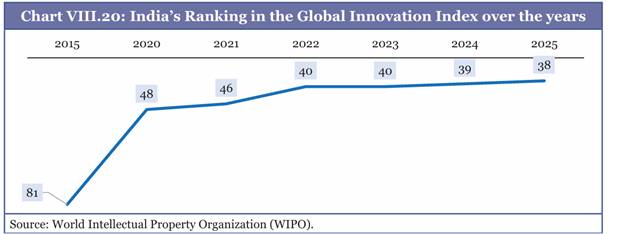
INDIA’S INNOVATION PERFORMANCE STRENGTHENS STEADILY, GLOBAL INNOVATION INDEX RANK IMPROVES TO 38TH IN 2025 FROM 66TH IN 2019: ECONOMIC SURVEY 2025-26
PLI SCHEME ENCOURAGES MAJOR SMARTPHONE COMPANIES TO RE-LOCATE THEIR PRODUCTION TO INDIA
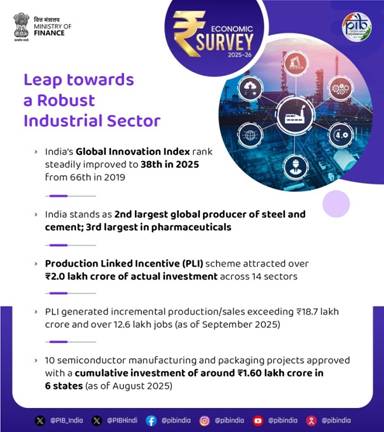
UNDER PLI SCHEME, INVESTMENT OF OVER ₹2.0 LAKH CRORE REALISED; RESULTS INCREMENTAL PRODUCTION/SALES OF OVER ₹18.70 LAKH CRORE AND EMPLOYMENT GENERATION OF OVER 12.60 LAKHS
INDIA’S RANK IN “GLOBAL INNOVATION INDEX” IMPROVES FROM 66TH IN 2019 TO 38TH IN 2025
BENGALURU, DELHI AND MUMBAI FEATURE AMONG TOP 50 MOST INNOVATION INTENSIVE CLUSTERS WORLD OVER
TEN SEMICONDUCTOR MANUFACTURING AND PACKAGING PROJECTS HAVE BEEN APPROVED WITH A CUMULATIVE INVESTMENT OF ₹1.60 LAKH CRORE IN 6 STATES
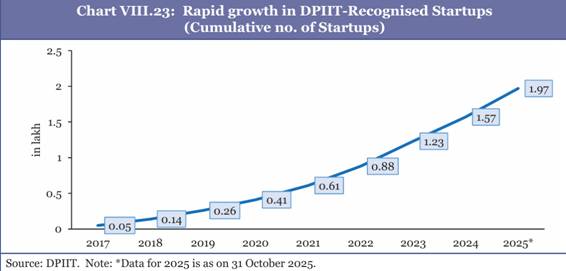
UNDER START-UP INDIA INITIATIVE, RISE IN DPIIT RECOGNISED START-UPs FROM 500 TO MORE THAN 2 LAKHS IN 2025
Posted On:
29 JAN 2026 2:11PM by PIB Delhi
“The PLI Scheme has encouraged major smartphone companies to re-locate their production to India. As a result, India has become a major mobile phone manufacturing hub”, states the Economic Survey 2025-26 tabled in Parliament today by Union Minister for Finance and Corporate Affairs, Smt. Nirmala Sitharaman.
As per the Economic Survey, in alignment with India’s vision of ‘Aatmanirbhar Bharat’, the Production Linked Incentive (PLI) Scheme was launched in 2020 and now spanning 14 key sectors, with an outlay of ₹1.97 lakh crore. Till September 2025, under the PLI scheme, an actual investment of over ₹2.0 lakh crore has been realised, leading to incremental production/sales of over ₹18.70 lakh crore and employment generation of over 12.60 lakhs (direct and indirect).
According to the Economic Survey 2025-2026, Cumulative incentives of ₹23,946 crore have been disbursed across 12 sectors, with 806 applications approved across all 14 sectors. The PLI Schemes have witnessed exports surpassing ₹8.20 lakh crore, driven significantly by sectors like electronics, pharmaceuticals, and telecom & networking products, the survey added. Complementing PLI, the National Manufacturing Mission (NMM), was announced in Union Budget 2025–26.
According to the Economic Survey, “The National Mission on Manufacturing (NMM), announced in the Union Budget 2025-26, represents the foundational policy blueprint for accelerating India's industrial growth and global competitiveness over the next decade.”
To finance innovation at scale, the Government also announced a new Research, Development and Innovation (RDI) Fund with a total outlay of ₹1 lakh crore over six years and ₹20,000 crore allocated for FY26. A major institutional reform driving India’s R&D and aimed at addressing the challenges highlighted above is the establishment of the Anusandhan National Research Foundation (ANRF) under the ANRF Act, 2023. The ANRF is intended to provide strategic direction, competitive funding opportunities and collaboration pathways across industry, academia and government.
According to the Economic Survey 2025-26, India’s research and innovation ecosystem has, over the years, strengthened significantly. The country's ranking in the Global Innovation Index (GII) improved from 66th in 2019 to 38th in 2025. This places India at the top of the rankings within the lower middle-income country group and first in the Central and Southern Asia region”. Furthermore, Bengaluru, Delhi and Mumbai feature among the top 50 most innovation intensive clusters in the world and the country’s innovation output as a whole, has recorded a marked growth.
The Economic Survey states, emerging as a significant global player in Intellectual Property (IP), India ranks 4th in trademarks, 6th in patents, and 7th in industrial designs in global filings in 2024. From FY20 to FY25, patent applications filed nearly doubled, and trademark registrations grew 1.5 times. Designs registered increased by 2.5 times. The World Intellectual Property Organization (WIPO) ranks India 12th globally, for its entrepreneurship policies and entrepreneurship culture. Since the launch of the Startup India Initiative in 2016, the number of DPIIT-recognised startups has increased from approximately 500 to over 2 lakh as of 2025.
The Economic Survey 2025-26 states, as of August 2025, ten semiconductor manufacturing and packaging projects have been approved with a cumulative investment of around ₹1.60 lakh crore in 6 states. In addition, State Governments have also begun complementing the national framework, with initiatives such as Odisha’s Semiconductor Manufacturing and Fabless Policy offering additional incentives and institutional support.
Under the India Semiconductor Mission for a Resilient India to address structural vulnerabilities and build resilience, the Government of India has undertaken a series of coordinated measures to develop an end-to-end domestic semiconductor system.
The India Semiconductor Mission and the Semicon India programme together form the core of this strategy, supported by a ₹76,000 crore incentive framework to catalyse investment in fabrication, assembly, testing, marking and packaging facilities. Under these programmes, four targeted schemes have been launched, each extending fiscal support of 50 per cent of project cost/capex for semiconductor and display fabs, compound semiconductor facilities, and outsourced semiconductor assembly and testing units, alongside a dedicated Design Linked Incentive scheme to encourage domestic chip design.
****
NB/Samrat/Pankaj
(Release ID: 2219992)
Visitor Counter : 6595