Social Welfare
National Academic Depository (NAD)
प्रविष्टि तिथि:
07 JUL 2026 19:17 PM
Advancing Digital Governance in Education
Current Landscape of Academic Record Management
India has one of the world’s largest and most diverse education systems. It comprises approximately 14.71 lakh schools (as of 2024-25), 1420 universities, 53,583 colleges, 16,795 standalone educational institutions and 280 Research & Development institutes. Together, these institutions generate millions of academic records every year, including degrees, diplomas, certificates, mark sheets, and evaluation reports.
Managing such a vast volume of paper-based academic records is time-consuming, costly, and inefficient. Physical documents are vulnerable to loss, damage, and forgery, while manual verification processes create delays for students, educational institutions, employers, and other stakeholders.
The National Education Policy (NEP) 2020 envisions a more flexible, learner-centric, and multidisciplinary education system. Through initiatives such as Multiple Entry-Multiple Exit (MEME), the National Credit Framework (NCrF), and the Academic Bank of Credits (ABC,) NEP 2020 enables flexible learning pathways and lifelong education. As students increasingly accumulate learning outcomes across multiple institutions and stages of education, the need for a secure, interoperable, and easily accessible academic records system has become critical.
To support these reforms, the Government introduced the National Academic Depository (NAD)—a nationwide framework for the digital storage, verification, and authentication and issuance of academic awards. By maintaining academic records in a secure digital repository, NAD enables students to access their credentials anytime, anywhere, without the need to obtain physical copies from issuing institutions. It also simplifies verification for employers, educational institutions, and other organisations while significantly reducing the risk of fraud through authenticated digital records.
Since 2020, the NAD ecosystem has been implemented through DigiLocker. Digilocker launched on 1st July 2015 under the Digital India programme, DigiLocker serves as the operational digital platform for issuing and accessing academic credentials, within which NAD operates. There is a third component in this ecosystem - the Automated Permanent Academic Account Registry (APAAR) and the Academic Bank of Credits (ABC), that manage the credit scores of students and facilitates academic mobility. Together the three components create a unified ecosystem for secure academic record management. NAD is also integrated with the Government’s e-Sanad service, enabling electronic verification, attestation, and apostille of educational and other official documents. This integration simplifies document authentication for Indian nationals seeking higher education, employment, or other opportunities abroad.
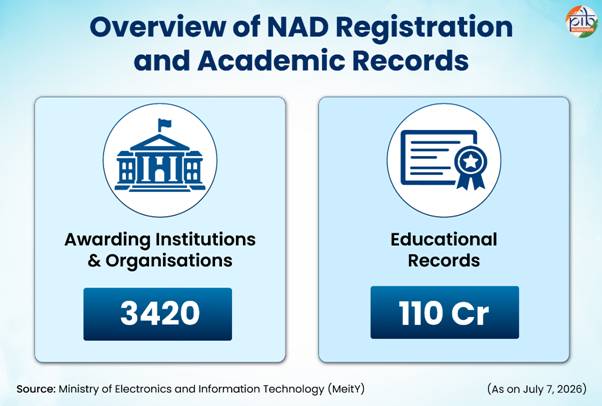
NAD registers Central, State, Private, deemed-to-be Universities, CBSE and other school boards, Institutions of National Importance and other higher education institutions. Its stakeholders include students and other academic award holders, Academic Institutions/Boards/Eligibility assessment bodies, Verifying Entities like banks, domestic & overseas employer companies, Government entities etc.
Governance Structure of NAD
The Ministry of Education is the parent ministry responsible for the NAD. It has designated the University Grants Commission (UGC) as the nodal agency for implementing the NAD through DigiLocker. The system works through a coordinated governance framework supported by a robust legal and regulatory structure. Educational institutions issue verified digital academic records, which can be securely accessed and shared by students, and other organisations can verify them quickly and reliably. All digital credentials are legally valid and hold the same legal status as physical documents under the Information Technology Act, 2000.
|
Legal and Regulatory Framework
The system operates under a strong legal foundation, including:
- Information Technology Act, 2000 – Gives legal recognition to electronic records and digital signatures.
- Digital Locker Rules, 2016 – Ensures documents are shared only with explicit user consent.
- National e-Authentication Framework (NeAF) – Provides secure identity verification and authentication mechanisms.
|
National Academic Depository (NAD): Process Flow
The functioning of NAD follows a structured digital workflow:
- Academic Award Creation: Educational institutions (schools, universities, boards, and other authorised bodies) generate academic awards such as degrees, diplomas, certificates, and mark sheets after completion of a course or examination.
- Digital Upload to Digi Locker/NAD: The institution securely uploads or issues these verified academic records into the National Academic Depository (NAD) through the DigiLocker platform.
- Students Access via DigiLocker: Once issued, the digital academic documents are automatically linked to the student’s DigiLocker account, where they can be securely accessed anytime.
- Consent-Based Sharing: Students can share their academic records with employers, higher education institutions, or government agencies only after giving explicit consent through DigiLocker.
- Verification by Authorities:Authorised organisations can verify the authenticity of documents directly through NAD/DigiLocker, ensuring that the records are genuine and unaltered.
- Secure and Permanent Storage: All records remain safely stored in digital form, reducing the need for physical certificates and eliminating risks such as loss, damage, or forgery.
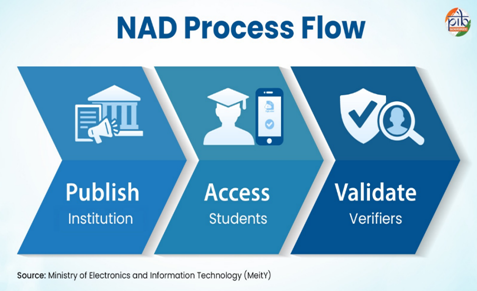
This process ensures a seamless transition from physical documentation to a fully digital academic record ecosystem.
Key Benefits of NAD
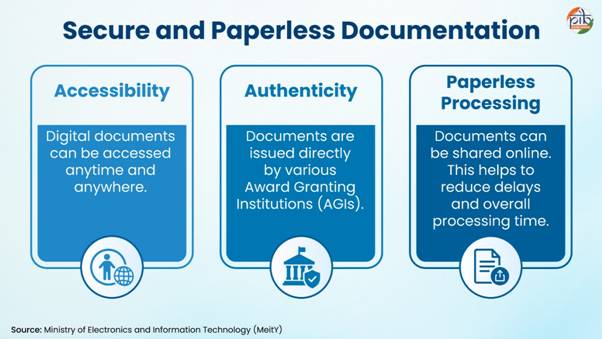
The National Academic Depository (NAD) provides a secure, trusted, and paperless framework and enables lifelong access to digital academic credentials, allowing students and academic award holders to retrieve and share their records anytime and from anywhere. By facilitating instant verification of authentic credentials, NAD enhances transparency, improves service delivery, reduces the risk of document fraud. It also streamlines admission, recruitment, and other credential verification processes. The framework also aligns India with global best practices in digital academic credential management.
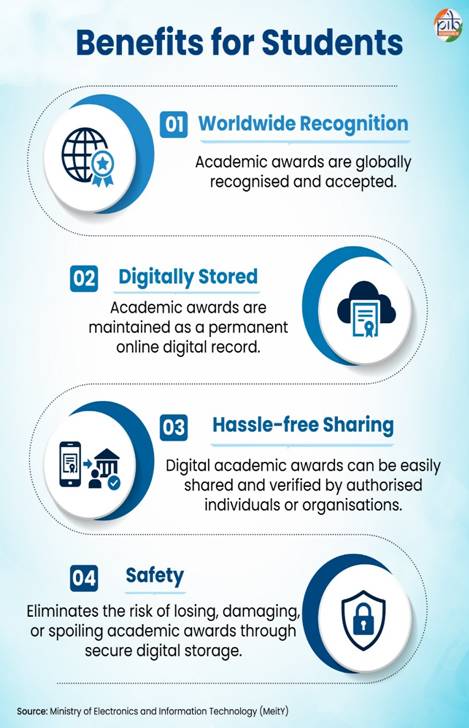
Students and Academic Award Holders: Access, store, retrieve, and securely share their digital academic credentials throughout their lifetime.
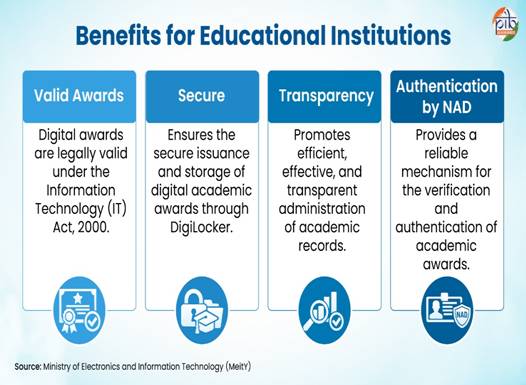
Educational Institutions and Assessment Bodies: Universities, school boards, examination authorities, and certification agencies issue authentic digital academic records and awards through the NAD framework.
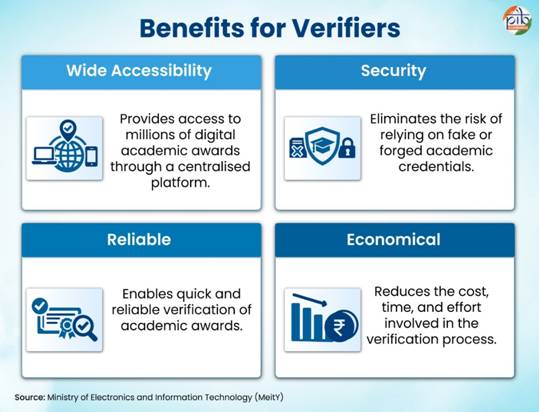
Verifying Entities: Employers, school and higher education institutions, government departments, banks, licensing authorities, can instantly verify the authenticity of academic credentials, reducing verification time and administrative burden.
NAD in India’s Digital Future
The National Academic Depository is a cornerstone of India's digital governance framework for education, enabling the secure, standardised, and interoperable management of academic records. By facilitating consent-based access and real-time verification of credentials, it enhances efficiency, transparency, and trust while reducing reliance on physical documents. As an integral part of the DigiLocker ecosystem, NAD advances India's vision of a secure, citizen-centric, and digitally empowered education system.
References
- Ministry of Electronics and Information Technology (MeitY)
https://negd.gov.in/blog/digilocker-the-digital-briefcase-for-indias-authentic-e-documents/
https://nad.digilocker.gov.in/
https://www.digilocker.gov.in/web/case-study
- Ministry of Education
https://nad.gov.in/
https://dashboard.aishe.gov.in/hedirectory/#/hedirectory
https://www.pib.gov.in/PressNoteDetails.aspx?NoteId=154950&ModuleId=3®=3&lang=1
- Ministry of External Affairs
https://esanad.nic.in/home
Click here to see PDF
******
PIB Research
(तथ्य सामग्री आईडी: 150733)
आगंतुक पटल : 1729
Provide suggestions / comments