AYUSH
Ayush Emerges as One of India’s Fastest-Growing Service Sectors, RIS Study Estimates US$36.92 Billion Economy
Ayush services sector records 16.91% CAGR since FY23; supports 1.76 million livelihoods and generates US$1.77 billion in Medical Value Travel revenue
Ayush services sector projected to scale to US$216–318 billion by 2047, emerging as a major contributor to Viksit Bharat
Posted On:
30 SEP 2026 12:38PM by PIB Delhi
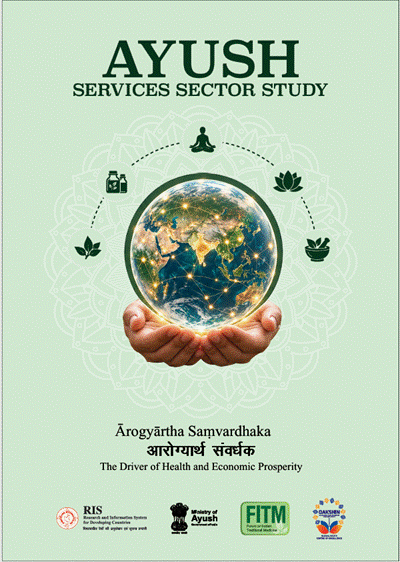
The Ayush services sector has emerged as one of India’s fastest-growing service sectors, with its economic contribution estimated at US$36.92 billion in FY2024-25, according to a new study by the Research and Information System for Developing Countries (RIS). Registering a 16.91 per cent CAGR since FY2022-23, the sector is increasingly contributing to India’s economic growth through healthcare, wellness, employment generation and Medical Value Travel. The study projects that the Ayush services economy could scale to US$216–318 billion by 2047, underlining its significant potential to contribute to the Viksit Bharat @2047 vision. The Report was formally released during the 11th Ayurveda Day celebrations in Nagpur on 23rd September.
Shri Prataprao Jadhav, Union Minister of State (IC) for Ayush and Minister of State for Health & Family Welfare, emphasised that the findings mark a significant milestone in recognising the Ayush sector's economic potential. The Minister stated, “The findings of this landmark study affirm that Ayush is not merely a cultural inheritance but a dynamic and high-growth engine of India’s economy. The Ayush sector is poised to play an increasingly important role in healthcare, wellness, employment and global economic engagement, while contributing to our vision of a healthy and self-reliant India.”
Secretary, Ministry of Ayush Vaidya Rajesh Kotecha stated, “For the first time, the economic contribution of the Ayush services sector has been measured through a nationally scaled, establishment-level survey covering all major Ayush systems. The report provides a robust evidence base to guide future investment, policy planning and reforms.”
Professor Sachin Kumar Sharma, Director General, RIS, highlighted, “This study marks an important step in building an evidence-based understanding of India’s Ayush services economy. Based on a nationally scaled survey of 15,914 establishments across all six Ayush systems, the findings show that an economy of US$36.92 billion, growing at close to 17 per cent annually and supporting 1.76 million livelihoods, is no longer a peripheral sector but a dynamic, knowledge-based service economy.”
According to the study, the Ayush services economy was estimated at US$36.92 billion in FY25, registering a Compound Annual Growth Rate (CAGR) of 16.91 per cent since FY23. The findings underline the emergence of Ayush services as a significant and rapidly growing segment of India’s services economy, with substantial potential for further expansion through organised healthcare delivery, wellness services, quality infrastructure and global outreach.
The study shows that clinics and day-care centres constitute the core of the Ayush services economy, together accounting for more than 71 per cent of total sectoral revenue. Standalone clinics generated an estimated US$16.21 billion, while day-care centres contributed US$10.13 billion. Ayurveda remained the largest individual system, accounting for US$17.73 billion, or nearly 48 per cent of the sector’s total revenue.
The report also highlights the growing economic significance of the Ayush-based wellness segment, including yoga centres, spas and resorts offering Ayush-based services. The segment recorded a 21.29 per cent CAGR, with yoga centres registering around 75 per cent growth in revenue over two years, reflecting rising demand for preventive health, wellness and holistic care services.
The study finds that Ayush services sector has emerged as a significant source of employment. Sector directly supports 1.76 million livelihoods, with more than one million jobs concentrated in local and standalone clinics. Women account for 43 per cent of the overall Ayush services workforce, with female participation exceeding 50 per cent in several organised segments. Women constitute over 60 per cent of the workforce in wellness settings (spas and resorts) offering Ayush-based services, 58 per cent in educational institutions, 57 per cent in day-care centres and 53 per cent in hospitals.
The study further points to the growing potential of Ayush in Medical Value Travel (MVT). The sector generated an estimated US$1.77 billion in MVT revenue in FY25. While international patients account for only around 5 per cent of patient volumes, they contribute an estimated 15–25 per cent of hospital-segment revenues. The study notes that Ayush therapeutic programmes, including Panchakarma and residential Yoga, are associated with longer patient stays, with an average length of stay ranging from 5 to 11 days.
Digital visibility and quality accreditation are also emerging as important factors in attracting international patients. According to the study, establishments with a dedicated functional website have 3.6 times higher odds of attracting international patients, while recognised quality accreditation such as NABH or ISO is associated with a doubling of such odds.
Looking ahead, the study projects significant growth potential for the sector as India advances towards Viksit Bharat @2047. The Ayush services economy could expand from the estimated US$36.92 billion in FY25 to US$216 billion–US$318 billion by 2047, subject to the strengthening of infrastructure, quality systems, skills, digital capabilities and international market access.
The study outlines a strategic pathway backed by an analysis through four pillars: — knowledge value chain of Ayush; enterprise and institutional capabilities; global competitiveness and Medical Value Travel; innovation through digital technologies and Artificial Intelligence. It also emphasises the need for wider quality accreditation, digital health records, workforce skilling, international readiness and responsible adoption of emerging technologies.
The findings reinforce the expanding role of Ayush not only as a healthcare and wellness ecosystem but also as a contributor to employment generation, entrepreneurship, services-led economic growth and India’s growing global engagement in traditional and complementary medicine.
The RIS study provides an evidence-based assessment of the evolving Ayush services landscape and identifies opportunities for strengthening the sector’s contribution to India’s healthcare, wellness and economic development priorities in the years ahead.
***
SR/SV/SG
(Release ID: 2316869)
Visitor Counter : 325