Ministry of Jal Shakti
Union Minister of Jal Shakti Launches Sujal Gaon ID, Unique IDs for mapping Rural Piped Water Supply Schemes
Hon’ble Union Minister chaired a virtual meeting with Ministers of PHED/RWS and Panchayati Raj Departments of States/UTs on Jal Jeevan Mission
Cabinet approves extension of Jal Jeevan Mission 2.0 till December 2028 with total outlay enhanced to ₹8.69 lakh crore focusing on sustainability, service delivery and sectoral reforms
Posted On:
13 MAR 2026 4:18PM by PIB Delhi
The Union Minister of Jal Shakti, Shri C. R. Paatil, chaired a meeting with Ministers of Public Health Engineering Department (PHED)/Rural Water Supply (RWS) and Panchayati Raj Departments of States and Union Territories to discuss the implementation roadmap of Jal Jeevan Mission 2.0. Shri V. Somanna, Minister of State, Ministry Jal Shakti also attended the meeting.
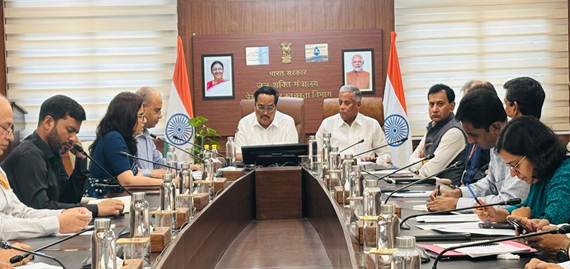
The meeting was convened in the backdrop of cabinet approval for the extension of Jal Jeevan Mission 2.0 up to December 2028 with enhanced outlay and structural reforms.
Shri C.R. Paatil, Union Minister of Jal Shakti released the Sujal Gaon ID, a scheme‑based unique digital identifier that enables complete digital mapping of rural piped water supply assets. For the first time in the country, every rural drinking water scheme is being assigned a digital identity, bringing the rural water supply system onto a unified national platform. So far, 1.64 lakh Sujal Gaon IDs across 31 States/ UTs have been created, linked to 67,000 Sujalam Bharat IDs. Each Sujalam Bharat ID integrates the scheme’s infrastructure ID and service area ID, creating a comprehensive digital footprint of rural water service delivery. This initiative marks a significant digital reform a transformative, system‑changing step that strengthens transparency, monitoring and contributes to the vision of a technologically empowered Viksit Bharat @2047.
While addressing Minister of Jal Shakti urged States to ensure timely completion of schemes and strengthen on‑ground monitoring. As water is a state subject, the success of the Mission rests on the accountability of State Governments in delivering reliable tap water supply to rural households.
He highlighted that delays in some States have arisen due to technical shortcomings and emphasized that any expenditure resulting from oversized or technically non-compliant works will have to be borne by the respective State Governments, noting that State funds are also public money and must therefore be used with the highest standards of vigilance and accountability.
He stressed strict adherence to approved technical specifications, expenditure limits and proper source assessment to ensure long‑term sustainability of rural water supply systems. He encouraged States to expand water conservation and recharge efforts in regions facing seasonal shortages.
He further underlined that quality of work is as critical as quality of water. Therefore, States must give special attention to maintain quality of work and focus on completing all sanctioned works and prepare time‑bound plans for their early completion. He reiterated that the conditions in the MoU are a way forward for bringing in the structural reforms and should be followed in letter and spirit.
Shri V. Somanna, Minister of State, Ministry of Jal Shakti highlighted the pivotal role of State/UTs in driving a citizen‑centric service delivery model, supported by structural reforms that strengthen sustainability of sources, improve operations and maintenance, and ensure long‑term functionality of rural water supply systems. Emphasizing the importance of Panchayati Raj Institutions in asset management and accountability, he said that in JJM 2.0 Jan Bhagidari will remain the central focus through Jal Arpan and Jal Utsav. He stated that the Mission will yield significant socio‑economic benefits reducing women’s drudgery, improving public health, and creating rural employment and remains central to achieving universal tap water coverage by December 2028 aligning with the broader vision of Viksit Bharat @2047.
Shri Ashok K. K. Meena, Secretary, DDWS, stated that the approval of Union Cabinet for extension and restructuring of JJM up to December 2028, marks governments commitment. He emphasized that JJM 2.0 will prioritize decentralized, Gram Panchayat‑led water governance, supported by robust operation and maintenance (O&M) systems and strengthened accountability. Implementation will be anchored through State/UT‑specific MoUs, with central funding made conditional and milestone‑based.
Highlighting the Mission’s digital and governance reforms, he said that the “Sujalam Bharat” national digital architecture will provide source to tap mapping of the entire rural water supply chain through unique Sujal Gaon IDs/ Service Area ID for every village, enabling real‑time monitoring, transparency and evidence‑based decision‑making. He underscored that Jal Seva Aankalan will serve as the principal instrument for village‑level service assessment, while citizen oversight will be strengthened through the Meri Panchayat application.
He emphasized that Gram Panchayats will certify ‘Har Ghar Jal’ status only after ensuring that sustainable operation and maintenance arrangements are fully in place, making long‑term functionality a mandatory requirement under JJM 2.0. Stressing a whole‑of‑government approach, he called for deeper convergence across departments to reinforce source sustainability, secure water availability and strengthen long‑term rural water security.
Shri Kamal Kishore Soan, AS&MD, NJJM presented on reforms in JJM 2.0 and modalities for fund release. The Mission’s total financial outlay has been increased from ₹3.60 lakh crore to ₹8.69 lakh crore, reaffirming the Government’s commitment to strengthening rural drinking water services across the country. The focus of the next phase will be on the quality of infrastructure and the effective operation and maintenance of rural piped water supply schemes. Emphasizing “Jan Bhagidari”, the Mission will strengthen community participation and local ownership to ensure long‑term functionality.
The AS&MD also emphasized the need for States and Districts to actively participate in the Jal Mahotsav activities, including celebrating Jal Arpan, conducting DWSM meetings, preparing service improvement plans, formation of DTUs, making Rajya Jal Utsav Calendar, organizing Lok Jal Utsav calendars at the GP level and DM/CEO Zila Parishad to attend at least 2 Jal Arpan in their respective districts.
He informed that release of central funds under JJM 2.0 will be strictly conditional upon States/UTs meeting four mandatory compliance requirements. These include:
• Signing the MoU,
• Creation of Sujal Gaon IDs to ensure complete digital mapping of all rural water supply schemes,
• Timely financial reconciliation, and
• Notification of State O&M Policies.
The modalities for central assistance under the Mission includes, Upfront Payment Mode for SVSs, MVSs in quality‑affected areas and Non‑PWS systems; Reimbursement Mode for ongoing MVSs and BWSs; and VGF (Viability Gap Funding) Mode for annuity‑based PPP models in BWSs. He clarified that no central assistance will be provided for retrofitting schemes.
The MoU lays out clear commitments for States and UTs across key areas of governance and service delivery. These include:
• Policy, Institutional and Governance Reforms
• Asset Ownership, Management and Technical Support
• Planning, Financing and Programme Implementation
• Digital Systems, Data Governance and Monitoring
• Skilling and Capacity Building of Rural Water Workforce
• Water Quality Monitoring and Surveillance
• Communication, Community Engagement and Public Confidence
Adherence to these MoU commitments is essential for ensuring service‑level delivery standards, long‑term sustainability, and transparent governance under JJM 2.0.
AMK
***
(Release ID: 2239620)
Visitor Counter : 2901