Ministry of Finance
INDIA SHOULD PRIORITISE DECENTRALISED, APPLICATION-DRIVEN SYSTEMS OVER CAPITAL-INTENSIVE FRONTIER MODELS TO AVOID FRAGILE DEPENDENCIES IN ARTIFICIAL INTELLIGENCE: ECONOMIC SURVEY
ECONOMIC SURVEY 2025-26 ADVOCATES AIMING FOR FRUGAL, REAL-WORLD DEPLOYMENT AT SCALE
INDIA’S APPROACH INTENDS TO ALIGN AI ADOPTION WITH STRUCTURAL REALITIES-CAPITAL, ENERGY, INSTITUTIONAL CAPACITY AND MARKET DEPTH
THE NATIONAL AI MISSION CAN SCALE DIVERSE AI-SOLUTIONS BY PROVIDING SHARED INFRASTRUCTURE, STANDARDS, GOVERNANCE FRAMEWORKS AND FUNDING WITHOUT DILUTING LOCAL CREATIVITY
LOCAL INNOVATORS, MUNICIPAL BODIES, START-UPS, AND COMMUNITY INSTITUTIONS DEPLOYING AI TO SOLVE IMMEDIATE AND CONTEXTUAL PROBLEMS
LANGUAGE AND VOICE-FIRST AI SYSTEMS EXTENDING REACH OF DIGITAL SERVICES TO POPULATIONS HISTORICALLY EXCLUDED
THE ECONOMIC SURVEY 2025-26 ENVISIONS THE WAY FORWARD FOR INDIA’S AI ECOSYSTEM
Posted On:
29 JAN 2026 2:06PM by PIB Delhi
The Economic Survey 2025-26 tabled by the Union Minister of Finance and Corporate Affairs, Smt. Nirmala Sitharaman in the Parliament today, recognizes Artificial Intelligence (AI) as an economic strategy rather than a prestige technology race. The Survey examines the way AI is reshaping global economy and outlines a pragmatic strategy for India in an environment marked by rapid technological change and persistent uncertainty.
The Economic survey in its dedicated chapter highlights that AI deployment in India to be economically grounded and socially responsive. It makes a case for a bottom up, multiple sector-specific approaches grounded in open and interoperable systems to promote collaboration and shared innovation. This aligns with India’s strengths in human capital, data diversity and institutional coordination.
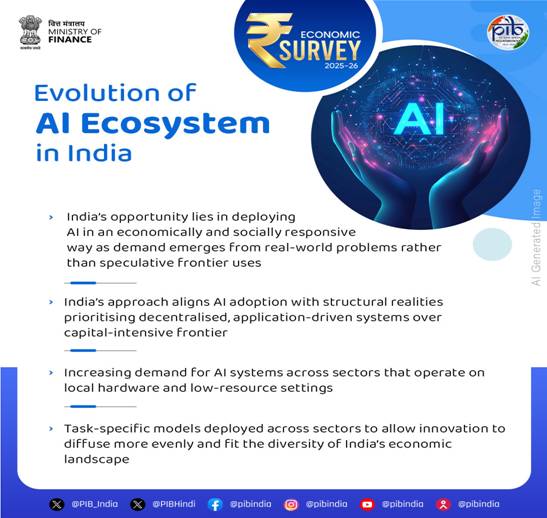
India’s demand for AI is emerging from real-world problems rather than speculative frontier uses. Citing examples across healthcare, agriculture, urban management, education, disaster preparedness, and public administration, the survey highlights the growing appetite for AI systems that work on local hardware and operate in low-resource settings. From early disease screening and precision water management to farmer market access, classroom analytics, and regional language interfaces, adoption is emerging where AI lowers costs and compensates for structural shortcomings. These uses signal a large and scalable market for frugal, application-focused AI solutions tailored to India’s economic and social landscape.
The Survey focuses on aligning AI adoption with India’s structural realities, such as capital availability, energy constraints, institutional capacity, and market depth, so that technology choices reinforce long-term growth instead of creating fragile dependencies.
As the Global AI development is being shaped by structural asymmetries in access to compute, finance, data, and standards-setting power, the Survey recognizes these imbalances as essential for crafting realistic policy. In this context, the preferred pathway emphasizes decentralized and application-driven AI rather than large, centralized systems. Smaller, task-specific models deployed across sectors allow innovation to diffuse more evenly, reduce entry barriers for firms, and better fit the diversity of India’s economic landscape. The Survey calls Open and interoperable AI systems as a force multiplier.
Further elaborating upon the Education and training priorities in the AI-era, the survey underscores the need to shift away from narrow technical specialization towards essential foundational capabilities such as reasoning, reading, judgment, communication, and adaptability. This shall integrate AI into workplaces and public systems.
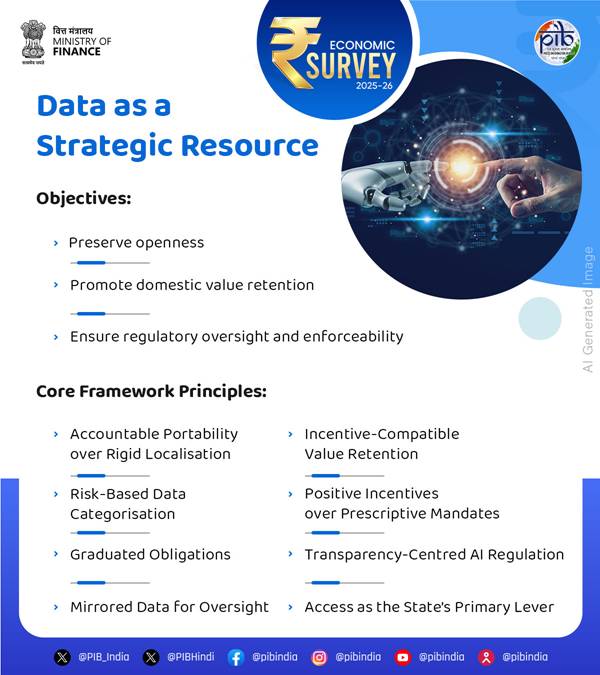
Adding on the Data governance of AI, the survey emphasizes over the need for it to be framed around accountability and value creation rather than isolation. Trusted data flows, combined with transparency and auditability, are seen as more effective than rigid localization in ensuring that economic benefits accrue domestically while maintaining global interoperability. The regulatory design favors proportionate, risk-based approaches over prescriptive control. Obligations scale with potential harm and systemic importance, allowing innovation to continue while aligning private incentives with broader economic and social objectives.
The survey reiterates that the India’s AI strategy must be sequenced carefully to avoid premature lock-in or regulatory overreach so that to build coordination first, capacity next and binding policy leverage last, allowing institutions and markets to co-evolve.
The survey in this chapter further elaborates upon Artificial Intelligence in India’s economic context, a development-oriented approach to AI, role of human capital for AI, AI-safety and risks along with the governance, institutional architecture and data as a strategic resource, followed with a phased roadmap for India’s AI Future.
ARTIFICIAL INTELIIGENCE ECOSYSTEM
The Survey deliberates upon asymmetries and trade-offs in the AI ecosystem across countries, firms, capabilities, and stages of the value chain. These asymmetries do not imply structural disadvantage but identifies the constraints within which a viable and sustainable AI strategy must be formulated to maximize economic and social returns from AI while remaining mindful of the trade-offs.
Capability Asymmetries between frontier model development and application-led development calls for India to deploy resources more effectively towards domain-specific AI systems aligned with domestic economic priorities. The capital-labour tradeoff elaborates upon the debate between scale versus inclusion which recognizes challenge - how to pace diffusion of AI to facilitate labour augmentation, choosing inclusive approach over scaling.
The cost, control, dependence of open or proprietary models ponders upon the ownership and governance of AI models. The survey underscores the need to strike a balance between openness and stewardship, leveraging shared innovation while ensuring that the economic value created from domestic data and intellectual property accrues within India rather than being captured abroad. The tradeoff between centralized scale and distributed efficiency strengthens the case for smaller, task-specific models that can run on limited hardware and decentralized compute networks. It lays emphasis on strategic autonomy and continued integration with global innovation networks to preserve openness where it enhances capability while insulating critical functions from external shocks.
LOCAL INGENUITY AND FRUGAL AI IN INDIA
India’s AI story is already evolving from the bottom-up. Local innovators, municipal bodies, start-ups, and community institutions are deploying AI to solve problems that are immediate and contextual to the communities they reside in. AI has multi-sectoral applications in health, agriculture, education, urban management, and disaster preparedness.
- Non-invasive AI-enabled thermal imaging tools in southern India are enabling early breast cancer screening in low-resource settings.
- Portable and low-cost AI-assisted oral cancer screening devices are bringing early detection to primary healthcare centers in eastern India.
- AI-enabled agricultural networks are improving market access, price discovery, and logistical efficiency for 1.8 million farmers across 12 States.
- India’s approach to AI adoption also includes initiatives such as Bhashini under MEiTY, and AI4Bharat developed by IIT Madras. Language and voice-first AI systems are extending the reach of digital services.
Furthering interactions in native languages and functioning effectively on low-cost devices, such frugal AI pathways align scale with inclusion along with being decentralized, problem-driven, and embedded in local needs.
The National AI Mission can help scale diverse AI-solutions by providing shared infrastructure, standards, governance frameworks and funding without diluting local creativity.
|
|
A DEVELOPMENT-ORIENTED APPROACH TO AI
The Survey highlights the necessity of India’s own indigenous AI development. The AI ecosystem remaining sufficiently young creates an opening for India to shape a more value-creating and dignified employment opportunity for its workforce.
Further, the Survey highlights developments in global GPU supply chains to play a meaningful role in shaping the long-run pace of AI infrastructure expansion. The measures that enhance supply-side resilience in access to advanced compute need to complement the conventional policy levers to expand access to finance and incentivize domestic development of AI. India needs to rely on diversified and resilience access to global compute.
A government hosted, community-curated platform under IndiaAI Mission umbrella would provide secure and transparent space where developers, researchers and enterprises collaborate. Private sector participation may also to be encouraged promoting indigenous development of sector specific AI and transforming India from world’s IT sector back office to one of the AI front offices. The Bottom-up approach can be spearheaded under ‘AI-OS’ initiative. India ranks among the top global contributors to AI research output and possess a deep pool of technical talent in the field of artificial intelligence, the country also has a highly AI-literate labour force.
The heterogeneity and scale of the country suggests the possibility of curating diverse domestic datasets across various sectors, including health, agriculture, finance, education, and public administration.
GOVERNANCE, INSTITUTIONAL ARCHITECTURE AND DATA
AN AI ECONOMIC COUNCIL FOR INDIA
The AI Economic Council, separate from the Governance Council, is intended to operate, not just with a technological imperative, but with moral imperatives, but with imperatives that are sensitive to India’s socio-economic realities. They will operate as a coordinating authority that is responsible for aligning technology deployment with the evolution of India’s education and skilling infrastructure, while navigating resource constraints and development priorities. The core governance principles for such an institution would involve the following:
- Human Primacy and Economic Purpose
- Labour-Market Sensitivity by Design
- Sequencing over Speed
- Co-evolution of Technology and Human Capital
- Public Interest Safeguards and Ethical Non-Negotiable
By embedding labour realities and social stability priorities into AI policy, the institution will ensure that AI advances productivity without eroding employment and the dignity of work.
|
|
As innovations and applications are rapidly outpacing regulatory developments, the Survey calls upon a measured and swift response from policymakers. The regulatory design for AI adoption in India must seek to integrate AI within the broader socio-economic context of India, with special consideration for our labour market realities. It must ensure that AI serves humanity, rather than supplanting it.
HUMAN CAPITAL FOR AI
The Survey emphasizes experiential learning, early exposure to experience building, flexible education pathways and strengthening human-centric skills. The survey calls upon that ‘formal education and work experience’ need not be seen as mutually exclusive setup. To nurture India’s demographic dividend into a competent workforce, need for institutionalizing systems such as ‘Earn and Learn Initiative’. This pathway can be co-designed by the private sector and academic institutions. The National Education Policy 2020 aligns with the above vision.
Furthermore, a comprehensive sectoral mapping of jobs outside the white-collar workspace needs to be undertaken. For instance, nursing and geriatric care being understaffed highlights the potential for additional demand for skilled labour in the sectors.
AI SAFETY AND RISKS
The survey highlights an ‘AI Safety Institute’ as proposed under MeitY Governance Guidelines which shall analyze emerging risks, potential regulatory gaps, coordination on AI safety issues, and conducting training programmes to build awareness, among others. A Periodic, scenario-based testing and red-teaming of AI models must become institutionalized.
The survey suggests that International cooperation of institutes such as United Kingdom’s AI Security Institute and USA’s National Institute Standards and Technology shall enable joint evaluations of high risk models and shared access to completing infrastructure which will enhance global interoperability AI Safety Standards. The survey further acknowledges that no conception of safe or human-centric AI is credible without placing the protection of individual rights at its core.
ROADMAP FOR INDIA’s ‘AI’ FUTURE
The survey describes a central challenges for India - what it builds domestically, what it sources globally, what it regulates early, and what it deliberately allows to evolve. The benefit of hindsight allows India to design AI systems that are more resource-efficient and aligned with public objectives from the outset, sequencing regulation alongside deployment. It offers the country the opportunity to pursue a more resilient and inclusive AI trajectory.
India’s strengths lie in application-led innovation, the productive use of domestic data, human capital depth and the ability of public institutions to coordinate distributed efforts. A bottom-up strategy anchored in open and interoperable systems, sector-specific models, and shared physical and digital infrastructure offers a more credible pathway to value creation than a narrow pursuit of scale for its own sake.
Regulation, data governance and safety will have to evolve in parallel with deployment, not in its aftermath. Depending on the choices made, AI can be a tool for broad-based productivity and dignified work. India’s task is to ensure that AI development remains aligned with its developmental priorities and its long-term ambition to achieve economic resilience.
*****
NB/RT/PK/VA
(Release ID: 2219975)
Visitor Counter : 3514