PIB Backgrounder
One District One Product (ODOP)
A Journey from Local Streets to Global Shelves
प्रविष्टि तिथि:
23 JAN 2026 9:55AM by PIB Delhi
Key Takeaways
- ODOP empowers local artisans, reviving traditional skills and creating livelihoods.
- The initiative has scaled nationwide, transforming over 770 districts into economic hubs.
- Started in Uttar Pradesh, it is now India’s most celebrated initiative in local economic transformation.
- E-commerce onboarding initiatives such as the Government e-Marketplace (GeM)-ODOP Bazaar showcase and feature some of India’s finest ODOP offerings.
|
|
Introduction: Where Local Craft Sparked a National Revolution
|
In the heart of Uttar Pradesh lies Moradabad, a city where generations of artisans have shaped molten metal into fine brassware. For decades, these artisans honed their skills in family run workshops, often unknown to the world beyond their towns.
2018 marked the beginning of a new chapter. As part of an innovative state led experiment, Moradabad’s brassware was selected to be the district’s signature product under a bold new initiative: One District One Product (ODOP).
The idea was simple, yet revolutionary - identify one unique product in every district of the state, provide it with branding, market access, institutional support, and visibility, and empower the community behind it. Today, these crafts are showcased at international trade exhibitions. Local pride swelled, incomes rose, and a district that once toiled in economic obscurity became a model of self-reliant prosperity.
Moradabad was not an exception; it became the first chapter in a much larger story. As on December 2025, ODOP has been adopted at the national level and scaled to over 770 districts, touching the lives of millions of entrepreneurs, artisans, and farmers. What started in Uttar Pradesh is now India’s most celebrated initiative in local economic transformation.
|
ODOP Fuelling Growth and Development
- Balanced Regional Development
- Empowerment of Artisans and Producers
- Export Promotion
- Preservation of Heritage
- Economic Impact
- Job Creation
- Global Recognition
|
ODOP seeks to promote balanced regional development by identifying and branding a unique product from each district, while strengthening market access for artisans and local producers through coordinated institutional support. The initiative has delivered tangible economic impact by strengthening incomes, expanding market access, and creating livelihood opportunities across district-level value chains. Through branding, exhibitions, and global platforms, ODOP has enhanced global recognition of Indian products, while supporting sustainable practices and cultural exchange.
|
Districts as Growth Engines
|
The ODOP initiative, spearheaded by the Department for Promotion of Industry and Internal Trade (DPIIT), aims to unlock each district’s unique economic potential, drive balanced regional growth, and equip local artisans and entrepreneurs to compete in national and global markets.
By aligning cultural heritage with India’s broader development priorities, it transforms traditional skills into a sustainable economic engine.
The initiative aims to:
|
Promote Balanced Regional Growth
|
Unlock the economic strengths of every district to reduce regional disparities and ensure inclusive development.
|
|
Enable Jobs & Rural Entrepreneurship
|
Create livelihoods by empowering farmers, artisans, weavers, and local producers, advancing the goals of Aatmanirbhar Bharat.
|
|
Align with National Manufacturing Missions
|
Integrate with initiatives like Make in India, Vocal for Local, and Districts as Export Hub to boost domestic capabilities and global competitiveness.
|
|
Increasing Market Access
|
Expansion of market linkages through digital platforms, including a dedicated ODOP storefront on the Government e-Marketplace (GeM), and State-level e-commerce platforms to boost sales and outreach.
|
|
Institutional Governance and Product Selection Framework under ODOP
|
The success of ODOP lies in its flexible yet structured governance model. It is implemented through the collaborative efforts of central ministries, state governments, and district administrations.
Under the ODOP initiative, products are selected by States and Union Territories based on the existing ecosystem on the ground and the final list is communicated to the Department for Promotion of Industry and Internal Trade (DPIIT).
Over 1,200 ODOP products have been listed on the DPIIT’s digital portal, covering sectors from textiles and food to handicrafts and minerals.
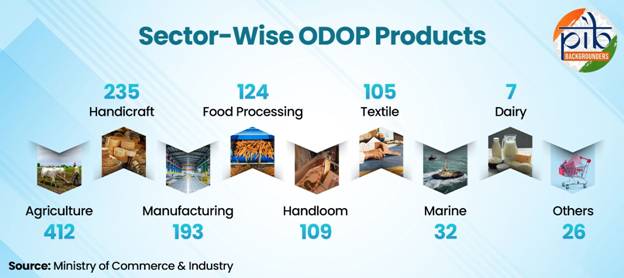
Through e-commerce initiatives like the Government e-Marketplace (GeM)-ODOP Bazaar, India’s finest ODOP products are being showcased to wider markets, empowering artisans and expanding market access.
|
Uttar Pradesh: A Model for the Nation
|
Uttar Pradesh, the pioneering state behind the ODOP initiative, has experienced significant economic transformation under the programme. At the Uttar Pradesh International Trade Show (UPITS) 2025, ODOP gained unprecedented national and global visibility, with Prime Minister Narendra Modi highlighting how the initiative has enabled district-specific products from UP to reach international markets. The ODOP Pavilion, at UPITS 2025, featured 466 stalls generating business leads and deals worth ₹20.77 crore.
Similarly, during Mahakumbh 2025 in Prayagraj, ODOP emerged as a flagship platform for traditional craftsmanship. A dedicated 6,000 sq. metre exhibition zone brought together artisans from across the country, displaying signature crafts including Banarasi brocade, Kushinagar carpets, Firozabad glassware, Varanasi wooden toys, metal handicrafts, and a wide collection of 75 GI-tagged products from Uttar Pradesh, including 34 from the Kashi region.
|
IMPACT IN UTTAR PRADESH
- The Exports have increased by 76%, significantly rising from ₹ 88,967 Cr in 2017-18 to ₹ 1.71 Lakh Cr in 2023-24)
- Projects worth ₹ 6,000 Crore have been sanctioned under ODOP Margin Money scheme.
- More than 1.25 Crore ODOP artisans have been trained and provided with modern ODOP toolkits under the ODOP Skill Development & Toolkit Distribution Scheme.
|
|
PM Ekta Malls: Iconic Gateways to India’s Artisanal Heritage
|
PM Ekta Malls (Unity Malls) are envisaged as dedicated retail and display hubs for promoting and selling ODOP, GI and handicraft products. Each mall is planned to provide earmarked space for every State and Union Territory to showcase its products, enabling wider market access, stronger visibility, and improved consumer reach for district-level specialities.
|
HIGHLIGHTS
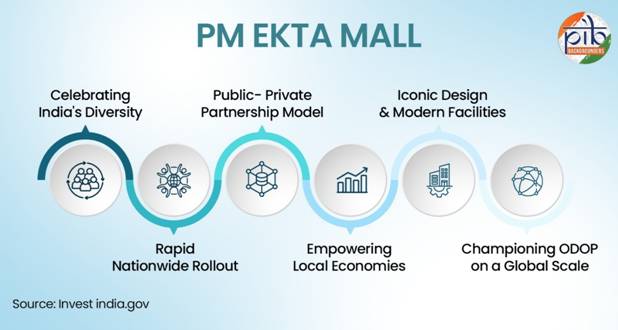
- Celebrates India’s diversity with dedicated spaces for all States/UTs and district showcases under one roof.
- Provides ₹5,000 crore interest-free support, including at least ₹100 crore per state, to empower artisans and entrepreneurs.
- Rapid rollout with 29 Unity Malls approved across 27 states.
- Features iconic architecture with national branding, multilingual signage, and modern amenities like experience zones, theatres, and food courts.
- Operates through a Public-Private Partnership model with state ownership and professional management.
- Elevates ODOP and local crafts into national cultural hubs and global market destinations.
|
These flagship hubs are not only marketplaces but temples of craftsmanship, places where the dreams of rural artisans take flight, where every product tells a story of heritage, and the vision of a self-reliant, culturally confident India finds a tangible, vibrant expression.
|
ODOP is also helping India’s districts emerge as powerful contributors to the global economy by showcasing unique, high-quality, and sustainable products on international platforms.
DID YOU KNOW? 💡
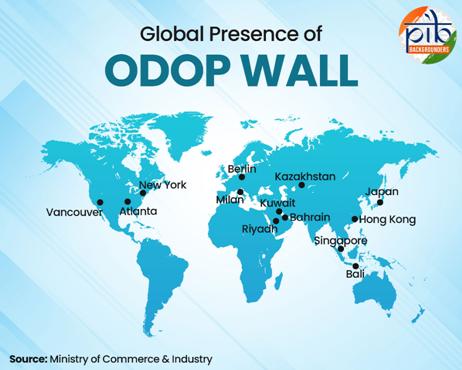
The ODOP Wall serves as a curated display of district-specific indigenous products at platforms such as SARAS Aajeevika Stores, aimed at enhancing market access and visibility for rural artisans and women Self-Help Groups
|
Key highlights:
- 80+ Indian Missions have promoted products abroad through exhibitions, showcases, ODOP walls or diplomatic gifting.
- In order to popularize ODOP products internationally, they were included as part of gifting during G-20 meetings.
- Three international stores are selling ODOP products (02 in Singapore- in Mustafa Centre and in Kashmir Heritage and One in Kuwait-Hakimi Centre) to strengthen sustained overseas market presence.
|
|
|
Conclusion: District’s story shining on the world stage
|
The story of ODOP is the story of India, of crafts that survived on resilience, artisans who kept traditions alive, and a nation that finally placed them on the global stage. From Moradabad’s glowing brass to the shelves of PM Ekta Malls and international gift hampers, ODOP has transformed local skill into national pride and global opportunity. No longer just about “one district, one product,” it now represents millions of aspirations finding recognition far beyond their villages. As new markets open and PM Ekta Malls rise, India’s local streets are stepping confidently onto the world’s stage, and every artisan is closer to seeing their craft shine as it always deserved.
PIB Research
References:
Prime Minister's Office:
Ministry of Development of North-East Region:
Ministry of Commerce & Industry:
Ministry of Micro, Small & Medium Enterprises:
Others:
Click here to see pdf
***
PIB Research
(रिलीज़ आईडी: 2217539)
आगंतुक पटल : 8428