NITI Aayog
Shri. Rajiv Gauba Calls for Deregulation as the Defining Feature of India's Next-Generation Reforms at Global Fintech Fest 2026
प्रविष्टि तिथि:
10 SEP 2026 12:08PM by PIB Delhi
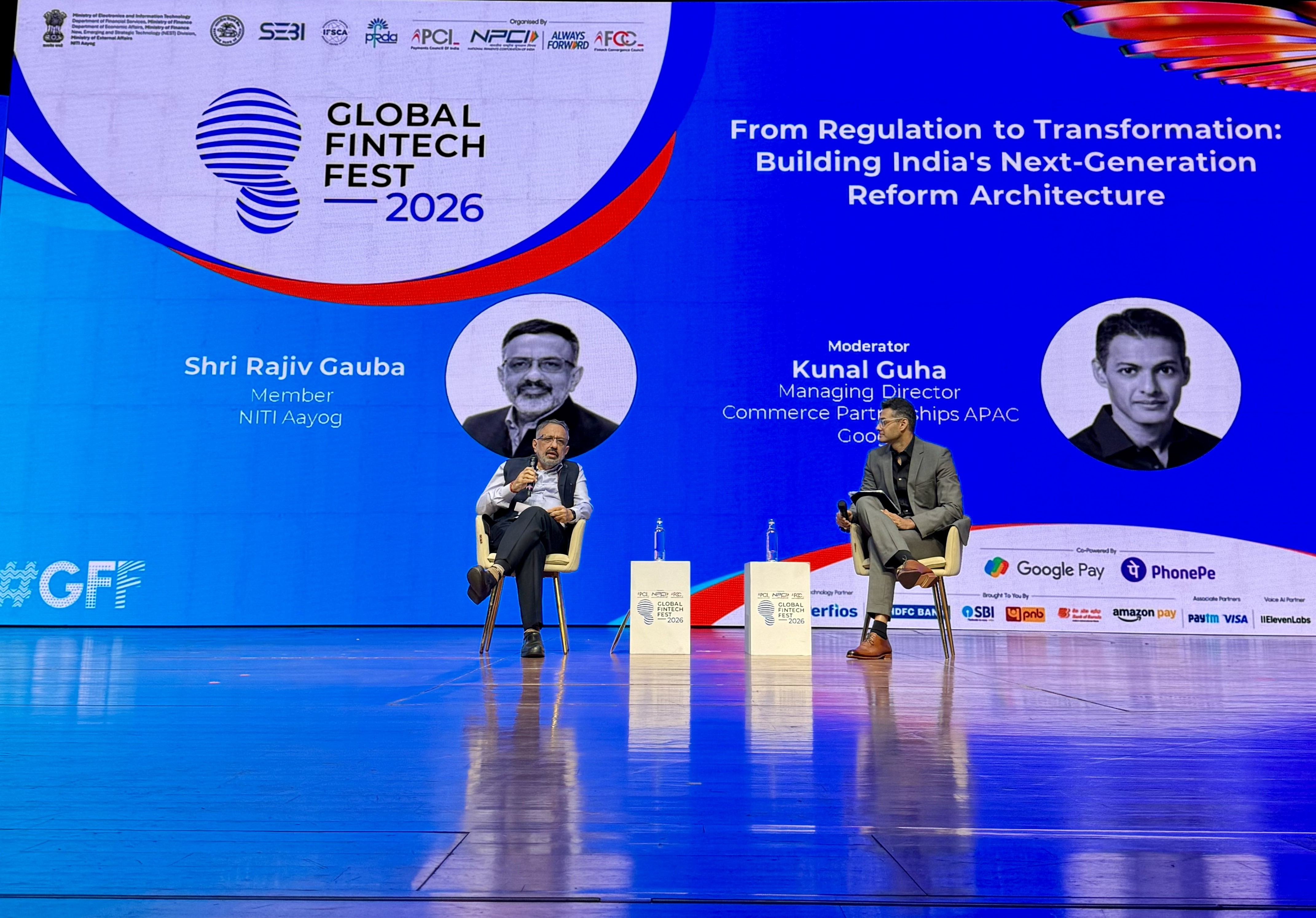
Shri Rajiv Gauba, Member, NITI Aayog, participated in a fireside chat on "From Regulation to Transformation: Building India's Next-Generation Reform Architecture" at the Global Fintech Fest 2026, a conversation spanning India's regulatory journey, the need for balance between innovation and oversight in fintech, and the institutional changes needed to sustain growth to achieve the Viksit Bharat vision.
Reflecting on the reforms of the past decade, Shri Gauba noted that measures such as the Goods and Services Tax, the Insolvency and Bankruptcy Code, and a liberalized foreign investment regime had reshaped the economy and opened up sectors once considered off-limits to private enterprise, including defence, space and now nuclear energy.
He said the next-generation reform architecture should be defined by “deregulation”, with the focus on “nuts-and-bolts” reform, on doing away with the license – approval –permission and frequent renewals regime that prevails in different avatars. He emphasised the need to systematically review laws, regulations and administrative processes. This work, he said, is being carried out by a High-Level Committee, guided by the philosophy of Trust Based Governance espoused by the Prime Minister.
Many important reforms, he noted, fall in the domain of States and municipal governments and pointed to the work being done by the Deregulation Task Force, carrying the Trust-Based Governance principles down to the State and city level. Citing the scheme for Special Assistance to States for Capital Investment and the Urban Challenge Fund, he characterized the Center Governments approach as "cooperative federalism with a competitive edge", where scheme incentives are linked to reform milestones and projects are selected through challenge mode.
On fintech, Shri Gauba highlighted India’s phenomenal growth in the sector and how it has contributed to financial inclusion and access. He cited India's digital public infrastructure - from Aadhaar and UPI to DigiLocker and the account aggregator framework – as a model that the world can replicate, where Governments lays open, secure and interoperable rails on which private enterprise builds and innovates. He said regulation in technology-driven sectors should strike a dynamic balance between protecting public interest and allowing innovation to flourish. Regulatory frameworks, he added, should be principles-based, technology-neutral and proportionate to risk, while promoting competition, ensuring non-discriminatory access to underlying infrastructure and improving information symmetry. He also emphasised the need for greater coordination among financial regulators, simpler and more predictable compliance processes, and continued efforts to reduce frictions and interoperability gaps.
Shri Gauba noted the steps taken by the Government to attract long-term domestic and foreign capital, by improving investor confidence in aspects of fair treatment, predictable policy, strong data governance, cybersecurity, and adequate space for innovation.
Concluding his remarks, Shri Gauba said reform has to be an integral part of the culture of governance, supported by long-term and strategic thinking. Prime Minister’s call for Viksit Bharat by 2047 to be approached as a national enterprise, with government, industry and citizens each playing an important role in sustaining India’s reform and growth momentum.

*****
MJPS/PRK
(रिलीज़ आईडी: 2308600)
आगंतुक पटल : 1722