Ministry of Commerce & Industry
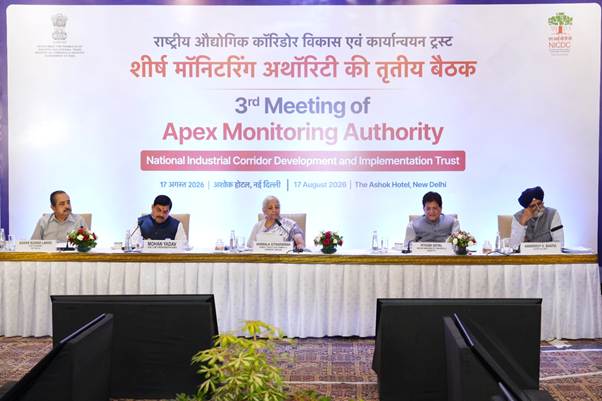
Union Minister for Finance and Corporate Affairs Smt. Nirmala Sitharaman chairs 3rd Meeting of Apex Monitoring Authority of NICDIT and reviews the progress of projects under NICDP
Smt. Sitharaman urges for faster completion of infrastructure, land allotment, investment and commencement of production
Union Minister for Commerce and Industry Shri Piyush Goyal calls for investor-ready industrial ecosystems with plug-and-play infrastructure
Shri Piyush Goyal calls for PM GatiShakti-aligned, integrated area-development approach for BHAVYA and future industrial developments
BHAVYA receives strong response from States in 1st round
प्रविष्टि तिथि:
17 AUG 2026 8:54PM by PIB Delhi
Union Minister for Finance and Corporate Affairs, Smt. Nirmala Sitharaman, chaired the 3rd Meeting of the Apex Monitoring Authority of the National Industrial Corridor Development and Implementation Trust (NICDIT) in New Delhi today. The meeting reviewed the progress of projects under the National Industrial Corridor Development Programme (NICDP) and deliberated on priorities for the next phase of industrial corridor development.
The meeting was attended by Union Minister for Commerce and Industry, Shri Piyush Goyal; Chief Minister of Madhya Pradesh, Dr. Mohan Yadav; and Vice-Chairman, NITI Aayog, Shri Ashok Kumar Lahiri.
Chairing the meeting, Smt. Nirmala Sitharaman appreciated the progress made under NICDP and said that the encouraging results on the ground indicate growing investor demand. She emphasised that the next pipeline of industrial land and infrastructure should be prepared well before the existing inventory is exhausted.
Smt. Sitharaman stated that Industrial Corridors are an important pillar of the Government of India’s strategy to expand manufacturing, strengthen logistics competitiveness and create globally competitive industrial ecosystems.
Recalling the emphasis placed at the previous Apex meeting, she said that Industrial Corridor development should be taken forward in the spirit of ‘Team India’. She also underlined the importance of convergence of Freight, Industrial Development, Railways and Expressways, the FIRE Corridors, for the success of the programme.
The Finance Minister stressed that the focus must now move beyond project approvals towards timely completion of infrastructure, land allotment, investment and commencement of production. She urged States to resolve bottlenecks relating to land, connectivity, utilities, statutory clearances and the powers of project Special Purpose Vehicles (SPVs).
She further stressed the need for integrated planning through PM GatiShakti and continued use of investor-friendly land allotment mechanisms. Worker housing, healthcare, skilling, public transport and other social amenities, she said, should form an integral part of industrial development.
Smt. Sitharaman also highlighted the Government of India’s support for infrastructure and manufacturing through enhanced public capital expenditure, support to States under SASCI, improved credit support for manufacturing MSMEs, and tax and customs measures aimed at strengthening domestic manufacturing and supply chains.
Union Minister for Commerce and Industry, Shri Piyush Goyal, called for faster and outcome-oriented implementation of Industrial Corridor projects, with greater focus on timely investment and operationalisation.
Shri Goyal stated that BHAVYA and future industrial developments should be aligned with PM GatiShakti and planned through an integrated area-development approach.
He called for focused investor outreach and stronger marketing of industrial nodes, including leveraging opportunities arising from India’s Free Trade Agreements and exploring country- and sector-specific industrial enclaves.
The Minister emphasised the need to match investor requirements with suitable locations and develop ready-to-use industrial ecosystems with plug-and-play infrastructure, flatted factories, worker housing and supporting economic and social infrastructure. Such an approach, he said, would facilitate faster investment and commencement of operations.
The National Industrial Corridor Development Programme now covers 20 approved projects across 13 States and 7 Industrial Corridors.
Four industrial smart cities — Dholera, Shendra-Bidkin, Greater Noida and Vikram Udyogpuri — have entered the production stage.
The 12 projects approved in August 2024 are also progressing, with infrastructure development, land allotment and investor engagement increasingly being undertaken in parallel.
So far, 469 plots covering approximately 5,348 acres have been allotted, with an estimated investment potential of around ₹2.21 lakh crore and employment potential of approximately 1.29 lakh persons. 134 units are already in production, while another 95 units are under construction.
Union Minister for Ports, Shipping and Waterways, Shri Sarbananda Sonowal, emphasised the integration of national waterways with Industrial Corridors and suggested examining waterways as a potential spine for corridor development.
He also stressed the need to develop industrial infrastructure in the North-Eastern States to broaden the country’s industrial base, particularly at locations offering strong connectivity, land availability, local resource advantages and market potential.
Vice-Chairman, NITI Aayog, Shri Ashok Kumar Lahiri, urged State Governments to give greater priority to empowering project SPVs with adequate planning, development and municipal powers, in line with the approved institutional and legal framework of the Industrial Corridor Programme.
He emphasised that effective delegation of these powers would enable SPVs to take timely decisions, reduce dependence on multiple State agencies and facilitate more coordinated, efficient and investor-friendly development.
The meeting commenced with the welcome address by Secretary, DPIIT and Chairman, NICDIT, Shri Amardeep Singh Bhatia, who outlined the progress since the previous Apex meeting and key implementation issues before the Authority.
This was followed by a presentation by CEO, NICDIT, Shri Rajat Kumar Saini, on the current status of Industrial Corridor projects, including progress in implementation, land allotment and investor mobilisation, as well as project-specific issues requiring coordination with States.
Representatives from participating States shared project-wise progress, key implementation challenges and areas requiring coordinated support. The discussions provided a platform for focused Centre-State engagement to resolve project-specific issues and accelerate implementation.
The Apex Authority underlined that the next measure of progress would be the speed at which completed and ongoing projects translate into active manufacturing centres, investment and employment.
The Apex Authority also reviewed the rollout of the Bharat Audyogik Vikas Yojana (BHAVYA), which envisages the development of 100 investment-ready, plug-and-play industrial parks across the country.
Against up to 20 projects proposed for approval in the first round, 87 applications have been received from States, reflecting strong interest in the scheme across the country.
It was emphasised that the planning and appraisal of BHAVYA projects should be fully aligned with PM GatiShakti, with infrastructure in and around industrial areas being planned as an integral part of industrial development.
BHAVYA will build on the experience gained from Industrial Corridor projects. The appraisal of proposals will focus on factors including availability of ready land, credible industrial demand, strong connectivity, assured utilities, realistic phasing and the ability to attract investors at an early stage.
The discussions at the meeting underlined a clear direction for the next phase of industrial infrastructure development: progress will be measured not only by the infrastructure created, but also by how quickly projects attract investment, commence production and generate economic activity and employment.
The meeting was also attended virtually by Union Minister for Ports, Shipping and Waterways, Shri Sarbananda Sonowal; Chief Minister of Maharashtra, Shri Devendra Fadnavis; Chief Minister of Bihar, Shri Samrat Choudhary; Chief Minister of Haryana, Shri Nayab Singh Saini; Chief Minister of Kerala, Shri V. D. Satheesan; Chief Minister of Uttarakhand, Shri Pushkar Singh Dhami; Ministers from participating States; senior officials of the Government of India and State Governments; and other stakeholders.
About NICDIT
The National Industrial Corridor Development and Implementation Trust (NICDIT) is a Trust constituted by the Government of India for the coordinated and unified development of Industrial Corridors across the country. It functions under the administrative control of the Department for Promotion of Industry and Internal Trade (DPIIT), Ministry of Commerce & Industry, and supports the development of trunk infrastructure in industrial nodes under the approved framework of the National Industrial Corridor Development Programme. Under BHAVYA, Government of India participation in project SPVs and equity support is routed through NICDIT.
About NICDC
National Industrial Corridor Development Corporation Limited (NICDC) is a Special Purpose Vehicle under the administrative control of DPIIT, Ministry of Commerce & Industry. NICDC undertakes project development activities and coordinates implementation of Industrial Corridor projects under the National Industrial Corridor Development Programme, working with State Governments and project SPVs to develop investment-ready industrial areas and smart industrial cities. Under BHAVYA, NICDC has been designated as the Project Management Agency for implementation and monitoring of the Scheme.
***
Abhishek Dayal/Abhijith Narayanan/Garima Singh
(रिलीज़ आईडी: 2300658)
आगंतुक पटल : 381