Infrastructure
Incentive Scheme for Promotion of Domestic PNG Connections
प्रविष्टि तिथि:
13 SEP 2026 11:05 AM
Clean and Affordable Piped Cooking Gas for Every Home
Overview
Piped Natural Gas (PNG) expansion is an important part of India’s transition towards cleaner household energy and energy security. Supplying PNG to homes is part of City Gas Distribution (CGD) network development. Such a network comprises pipelines and allied facilities that serve households, commercial establishments, and industrial units. Entities authorised by the Petroleum and Natural Gas Regulatory Board (PNGRB) develop it. PNGRB has authorised entities in 309 Geographical Areas (GAs). Together, these areas span the entire mainland of the country. As of 18 August 2026, there were 1.74 crore domestic PNG connections across the country.
To expand PNG coverage further, the Incentive Scheme for Promotion of Domestic PNG Connections was launched on 18 August 2026. The Scheme came into effect from 1 September 2026.
About the Scheme
The Incentive Scheme for Promotion of Domestic PNG Connections seeks to accelerate the growth of active domestic PNG connections. It aims to enable households to access clean, safe and affordable cooking gas through piped supply. The Scheme provides incentives to CGD entities for converting unbilled connections into active, billed connections. It also incentivises the expansion of the PNG network into new areas. The Scheme will run in two tranches spread over six months.
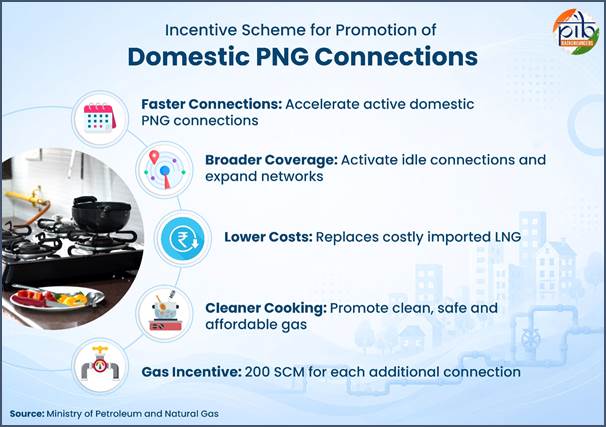
A minimum number of connections has been fixed for every Geographical Area under the scheme. During the performance period, eligible CGD entities must add billed domestic connections beyond this threshold. For each such incremental connection, the entity earns an additional allocation of 200 Standard Cubic Metres (SCM) of gas. This gas is domestically produced Administered Price Mechanism (APM) gas, which is priced lower.
The additional allocation will replace the costlier Liquefied Natural Gas (LNG). CGD entities presently buy this LNG for their Compressed Natural Gas (Transport) segment. Substituting it with cheaper APM gas brings down their overall gas sourcing cost.
The payback period on capital spent for a domestic connection is therefore expected to shrink. It is expected to fall from about ten years to nearly three years. Companies therefore gain a strong commercial reason to connect homes faster.
Benefits of PNG for Households
PNG offers several important benefits for households, including ease of use, cost savings, and uninterrupted availability. The following are the key advantages of PNG for household users:
- Safe and secure: Gas travels through underground pipelines at low pressure, so cylinders need not be stored or handled. Being lighter than air, it rises and disperses quickly in the rare event of leakage.
- Everyday convenience: No booking, storing or changing of cylinders is required. Gas remains available at home round the clock. Bills are based on metered use, much like electricity or water.
- Lower costs: A household pays only for the gas it actually uses. On a per-unit energy basis, PNG usually costs less than LPG. Monthly fuel expenses therefore come down over time.
- Cleaner environment: PNG burns cleaner and gives off fewer pollutants than conventional cooking fuels. Indoor air stays healthier and carbon emissions remain lower.
- Assured supply: Pipeline supply is continuous and free from the logistics of cylinder delivery. Homes in high-rise buildings and crowded urban colonies benefit the most.
Initiatives for PNG Expansion
PNG expansion is being supported through measures for faster approvals, rationalised taxes, and streamlined infrastructure development. Digital platforms and awareness initiatives are making household transitions to PNG simpler, quicker, and more accessible:
- Streamlined Regulatory Approvals: An Accelerated Approval Framework has been issued under the Natural Gas and Petroleum Products Distribution (Through Laying, Building, Operation and Expansion of Pipelines and Other Facilities) Order, 2026. The Order also introduces uniform charges for pipeline Right-of-Way (RoW), which cover permission to use land or public areas for laying PNG pipelines. Applications will now be processed on priority and within defined timelines.
- Reduced Value Added Tax (VAT): States are being encouraged to lower VAT on natural gas to 5 percent. Several States have already done so, making piped gas cheaper for consumers.
- National PNG Drive 2.0: The nationwide drive was held from 1 January to 30 June 2026 to accelerate DPNG connections across Geographical Areas.
- Unified PNG registration portal: A single-window digital platform is being developed. It will make applying for and tracking new connections simple and quick.
Towards Cleaner, Connected Homes
Clean cooking fuel at home adds to the comfort, health and dignity of every household. Now in effect, the new Scheme aligns the commercial interests of gas companies with this national goal. As pipelines reach more areas and more kitchens, dependence on cylinders steadily declines. Piped gas is thus set to become a natural part of everyday living in India.
References
Ministry of Petroleum and Natural Gas:
https://www.pib.gov.in/PressReleaseDetail.aspx?PRID=2301012®=3&lang=1
https://www.pib.gov.in/PressReleasePage.aspx?PRID=2252308&lang=1
https://sansad.in/getFile/lsapps/loksabhaquestions/annex/188/AU1952_UgNJ5G.pdf?source=lsapps
Incentive Scheme for Promotion of Domestic PNG Connections
*****
PIB Research
(तथ्य सामग्री आईडी: 151009)
आगंतुक पटल : 44
Provide suggestions / comments
इस विश्लेषक को इन भाषाओं में पढ़ें :
हिन्दी