Posted On:
29 OCT 2026 11:06AM by PIB Delhi
Minimum Support Price (MSP) serves as an important mechanism for providing price assurance to farmers and supporting informed decisions on agricultural planning and investment. On 30 September 2026, the Government approved increased MSPs for all mandated Rabi crops for the Rabi Marketing Season (RMS) 2027-28, with an estimated ₹90,962 crore to be paid to farmers for 324 lakh metric tonnes (MT) of produce. The expanding scale of MSP support is reflected in procurement trends and payments over the years. Procurement of six Rabi crops increased from 2,302 lakh metric tonnes (LMT) during 2004-05 to 2013-14 to 3,921 LMT during 2014-15 to 2025-26. Correspondingly, MSP payments rose from ₹2.65 lakh crore to ₹8.36 lakh crore. Meanwhile, digital platforms are enhancing the accessibility and transparency of procurement and payment processes. Together, price assurance, expanded procurement and technology-enabled delivery are strengthening farmers’ access to markets and supporting greater confidence in agricultural decisions.
Minimum Support Price: Supporting Farmers Through Price Stability
A farmer’s economic returns are shaped not only by agricultural production but also by the prices received for the harvested produce. After investing months of labour, resources, and inputs in cultivation, the market price ultimately influences farm earnings and the capacity to sustain agricultural operations. For small and marginal farmers, adverse fluctuations in market prices can introduce considerable uncertainty into farm income and affect decisions regarding future cultivation.
In this context, the Minimum Support Price (MSP) serves as an important policy instrument for supporting farmers. It provides a price assurance mechanism through which the government undertakes procurement of eligible agricultural produce at predetermined prices. MSP ensures remunerative returns to farmers while encouraging agricultural investment and production.
By providing a measure of price assurance, MSP can help mitigate farmers’ exposure to adverse market fluctuations. When market prices are low, procurement at MSP provides an avenue to sell eligible produce at the announced price. This mechanism helps reduce price uncertainty, support farm income stability, and facilitate planning for subsequent agricultural seasons. By strengthening confidence in expected returns, MSP also contributes to farmers’ decisions regarding investment in improved seeds, agricultural technology, and other productivity-enhancing inputs.
When Better Farming Meets Assured Returns
The experience of Shri K. Chikkana, a 72-year-old millet farmer from Bombrahalli village, Karnataka, illustrates how improved agricultural practices, institutional support, and price assurance can contribute to enhanced farm productivity and income.
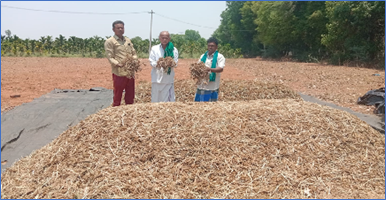
For several years, Shri Chikkanacultivated traditional finger millet varieties using conventional farming methods. Under irrigated conditions, the productivity remained at around 9-11 quintals per acre.
A significant change came during the Rabi Season of 2025, when he adopted the improved HR-13 finger millet variety. ICAR-IIMR (Indian Council of Agricultural Research-Indian Institute of Millets Research) supplied the variety through Kusumagiri Farmers Producer Organization, Kundrupi.
With technical guidance from ICAR-IIMR scientists, he also incorporated improved cultivation practices, including transplanting, balanced nutrient management, and natural farming approaches. These interventions helped increase his productivity to 22-23 quintals per acre, more than doubling his earlier yield.
The productivity gains were complemented by assured procurement through the FPO at the Minimum Support Price (MSP) of ₹4,886 per quintal (2025–26 season). This enabled him to access remunerative prices for his produce and realise higher returns. Consequently, his income from six acres increased from approximately ₹2.07 lakh to ₹6.59 lakh.
Shri Chikkana’s experience demonstrates how the convergence of improved seed varieties, scientific cultivation practices, technical guidance, farmer collectives, and MSP-based procurement can strengthen farm productivity and economic returns.
How Minimum Support Prices Are Determined
The government announces Minimum Support Prices (MSPs) annually for 22 mandated agricultural crops. These MSPs are based on recommendations from the Commission for Agricultural Costs and Prices (CACP). The recommendations consider the views of concerned State Governments and Central Ministries/Departments. Additionally, MSP for Toria and de-husked coconut are determined based on the MSPs announced for rapeseed and mustard, and copra, respectively.
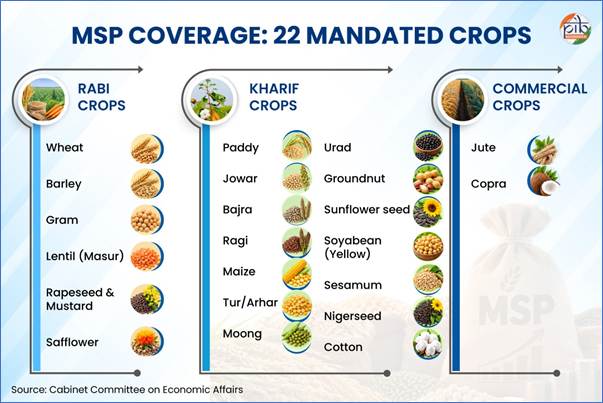
The CACP considers several factors while recommending MSPs for different crops. These include:
- cost of production
- demand and supply of crops in domestic and global markets
- domestic and international prices
- inter-crop price parity
- terms of trade between agriculture and non-agriculture sectors
- likely impact of price policy on the wider economy, and
- a minimum margin of 50 percent over the cost of production.
The cost of production used in MSP calculations includes paid-out expenses on hired human, bullock and machine labour, leased-in land, seeds, fertilisers, manure, and irrigation. It also accounts for diesel and electricity used to operate pump sets, depreciation on farm implements and buildings, interest on working capital, and other miscellaneous expenses. Additionally, the imputed value of family labour is included to recognise the contribution of family members engaged in agricultural activities. The same cost-estimation formula is applied uniformly across all 22 mandated crops and across States for calculating MSPs.
Rabi MSP 2027-28: Price Support and Crop Diversification
The government approved an increase in the Minimum Support Prices (MSP) for all mandated Rabi Crops for Marketing Season 2027-28 on 30 September 2026.
|
RABI MARKETING SEASON 2027-28
|
|
S.N.
|
Crops
|
MSP 2027-28 (₹/quintal)
|
Cost of Production 2027-28 (₹/quintal)
|
Margin Over Cost (%)
|
MSP 2026-27 (₹/quintal)
|
Increase in MSP (Absolute)
|
|
1
|
Wheat
|
2,610
|
1,264
|
106
|
2,585
|
25
|
|
2
|
Barley
|
2,286
|
1,447
|
58
|
2,150
|
136
|
|
3
|
Gram
|
5,958
|
3,751
|
59
|
5,875
|
83
|
|
4
|
Lentil (Masur)
|
7,390
|
3,854
|
92
|
7,000
|
390
|
|
5
|
Rapeseed & Mustard
|
6,613
|
3,367
|
96
|
6,200
|
413
|
|
6
|
Safflower
|
7,215
|
4,810
|
50
|
6,540
|
675
|
The highest absolute increase in MSP has been announced for safflower at ₹675 per quintal. This is followed by rapeseed & mustard at ₹413 per quintal, lentil (masur) at ₹390 per quintal, and barley at ₹136 per quintal. MSPs for wheat and gram have also been increased compared with the previous year.
In terms of returns over the cost of production, wheat records the highest estimated margin at 106%, followed by rapeseed and mustard at 96%, lentil (masur) at 92%, and gram at 59%. During the Rabi Marketing Season (RMS) 2027-28, an estimated ₹90,962 crore is expected to be paid to farmers for 324 lakh metric tonnes (MT) of produce. The enhanced MSPs for rabi crops are intended to ensure remunerative prices for farmers while incentivizing crop diversification.
Ensuring Accessible and Transparent MSP Procurement
The procurement process has evolved to make MSP benefits more direct, transparent, and accessible to farmers. For cereals and coarse cereals, the Government undertakes procurement through the Food Corporation of India (FCI) and designated State agencies. This provides price support to farmers at the announced MSP.
Procurement of pulses, oilseeds and copra is undertaken under the Price Support Scheme (PSS) of the Pradhan Mantri Annadata Aay Sanrakshan Abhiyan (PM-AASHA). State Governments may request procurement when prevailing market prices fall below the announced MSP. The National Agricultural Cooperative Marketing Federation of India Ltd. (NAFED) and the National Co-operative Consumers’ Federation of India Ltd. (NCCF) are key agencies responsible for undertaking procurement under the scheme. To promote domestic pulse production and strengthen self-reliance, tur, urad and masur are procured from pre-registered farmers through Central Nodal Agencies under the Mission for Aatmanirbharta in Pulses till 2030-31.
Pradhan Mantri Annadata Aay Sanrakshan Abhiyan (PM-AASHA)
Launched in September 2018, the scheme ensures remunerative prices for farmers while maintaining price stability for consumers. One of the key components is the Price Support Scheme (PSS). It is activated when market prices of notified pulses, oilseeds, and copra fall below MSP during peak harvest. Eligible produce meeting Fair Average Quality (FAQ) standards is procured directly from pre-registered farmers possessing valid land records via NAFED and NCCF. This eliminates intermediaries and safeguards farmers from distress sales.
To improve farmers’ access to procurement facilities, adequate numbers of procurement centres are established, with State Governments and procurement agencies publicising procurement schedules, centre locations and Fair Average Quality (FAQ) specifications for eligible produce.
The procurement process has also been strengthened through digital platforms. Under the Price Support Scheme (PSS), NAFED’s e-Samriddhi and NCCF’s e-Samyukti platforms facilitate key stages of procurement, including farmer registration, produce procurement and payment. Farmers register by providing details such as Aadhaar, land records, bank account information, and crop particulars. Registered farmers can select their nearest procurement centre, following which the portal schedules their visit for a specified date. Direct transfer of MSP payments to farmers’ bank accounts helps reduce manual intervention, reliance on intermediaries, and payment delays.
As on 19 October 2026, the e-Samyukti platform has facilitated procurement involving more than 43 lakh farmers, with over 37.45 lakh metric tonnes procured and more than ₹13,000 crore credited to farmers. Meanwhile, e-Samriddhi recorded more than 1.37croreregistered farmers, over 2.25 crore units of produce procured, and 81+ lakh payouts to farmers.
Further strengthening transparency and beneficiary verification, biometric authentication of farmers became mandatory under PSS from the 2025–26 season. Authentication is conducted through Aadhaar-enabled Point of Sale (PoS) machines or facial authentication before procurement. This measure helps verify farmer identity and ensures that procurement benefits reach genuine and eligible beneficiaries.
The Expanding Scale of Procurement and MSP Payments to Farmers
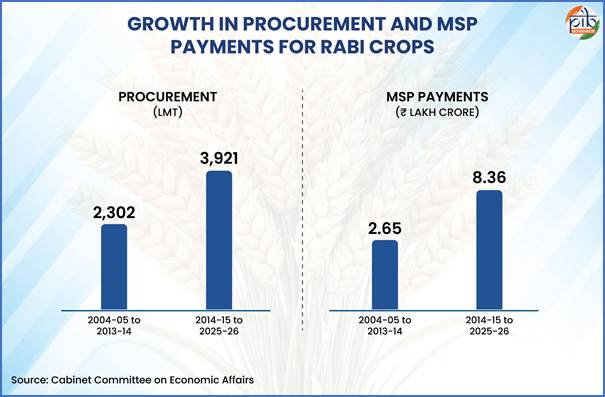
The role of MSP in supporting agricultural procurement is reflected in the substantial increase in both procurement volumes and payments to farmers over the years. During 2014-15 to 2025-26, wheat procurement totalled 3,715 lakh metric tonnes (LMT), compared with 2,254 LMT during 2004-05 to 2013-14. Similarly, procurement across six rabi crops increased to 3,921 LMT from 2,302 LMT over the corresponding periods.
This growth in procurement has been accompanied by a significant rise in MSP payments to farmers. Between 2014-15 and 2025-26, payments to wheat farmers amounted to ₹7.31 lakh crore, compared with ₹2.56 lakh crore during 2004-05 to 2013-14. For the six rabi crops, cumulative MSP payments increased to ₹8.36 lakh crore, up from ₹2.65 lakh crore during the earlier period.
In Rabi Marketing Season (RMS) 2026-27, wheat procurement stood at 357.57 LMT, with an MSP value of ₹92,432.51 crore, benefiting over 34 lakh farmers. These figures reflect the scale of government procurement and the financial support extended to farmers through MSP.
Supporting Farmers, Strengthening Agriculture
Minimum Support Price (MSP) remains an important policy instrument for supporting farmers against market price fluctuations and providing greater assurance in agricultural planning and investment. The MSP decisions for Rabi Marketing Season (RMS) 2027-28 continue to provide for a minimum margin of 50 percent over the cost of production.
The sustained growth in procurement volumes and MSP payments reflects the expanding scale of government support to farmers. Meanwhile, digital registration, biometric authentication and direct bank transfers are strengthening the accessibility and transparency of procurement processes. Overall, these measures reinforce the link between price assurance, market access and remunerative returns, supporting farmers’ income prospects and contributing to a more resilient agricultural sector.
References
Cabinet Committee on Economic Affairs
https://www.pib.gov.in/PressReleasepage.aspx?PRID=2316941®=48&lang=1
Ministry of Agriculture and Farmers Welfare
https://www.pib.gov.in/PressReleasePage.aspx?PRID=1777683®=48&lang=2
https://www.icar.gov.in/hi/node/24721?utm_
https://www.pib.gov.in/PressReleasePage.aspx?PRID=2317665®=48&lang=2
https://sansad.in/getFile/lsapps/loksabhaquestions/annex/187/AS450_OAibYg.pdf?source=lsapps
https://www.pib.gov.in/PressReleasePage.aspx?PRID=2246181®=1&lang=1
https://www.pib.gov.in/PressReleasePage.aspx?PRID=2155528&lang=2®=48&utm_
https://icar.org.in/en/dr-ml-jat-honours-progressive-millet-farmer-shri-k-chikkana-icar-iimr-hyderabad
Ministry of Consumer Affairs, Food and Public Distribution
https://sansad.in/getFile/annex/271/AU2614_KTzacI.pdf?source=pqars
https://esamyukti.in/#about
Ministry of Cooperation
https://esamridhi.in/#/
PIB Backgrounders
https://www.pib.gov.in/PressReleasePage.aspx?PRID=2177219®=3&lang=2
https://www.pib.gov.in/PressNoteDetails.aspx?NoteId=159674&ModuleId=3®=3&lang=1
Click here for pdf file.
***
PIB Research