PIB Backgrounder
India's Defence Strength
Powering National Security through Self-Reliance
Posted On:
14 AUG 2026 4:44PM by PIB Delhi
Strengthening India's Defence
India’s defence sector has undergone a remarkable transformation over the past decade. It has emerged as a stronger, more self-reliant and globally credible force. Guided by Atmanirbhar Bharat, sustained reforms, investment and indigenous innovation have strengthened defence capabilities. The domestic defence industrial base has also expanded significantly. As India marks its 80th Independence Day, this transformation reflects growing confidence in India’s ability to safeguard its sovereignty and contribute to global security.
Defence Investment Strengthening Military Capabilities
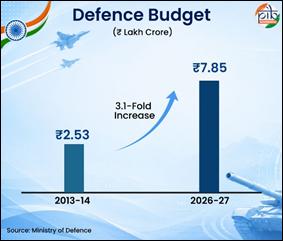
- 3.1-Fold Growth in Defence Budget: The defence budget rose from ₹2.53 lakh crore in 2013–14 to ₹7.85 lakh crore in 2026–27.
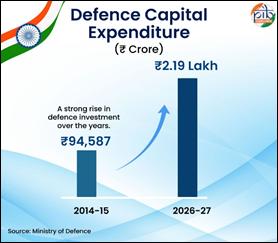
- 2.3-Fold Growth in Capital Expenditure: Capital expenditure also increased from ₹94,587.95 crore in 2014–15 to ₹2.19 lakh crore in 2026–27, enabling sustained modernisation.
Investment Driving Indigenous Defence Production
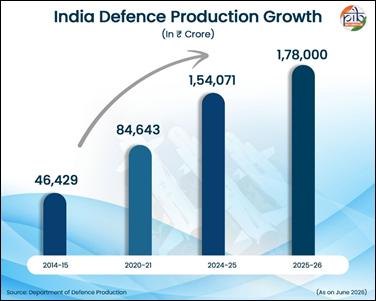
- Defence production reached a record ₹1.78 lakh crore in 2025–26.
- 76% production from public-sector entities and 24% from the private sector.
Domestic Industrial Base Expanding Exports
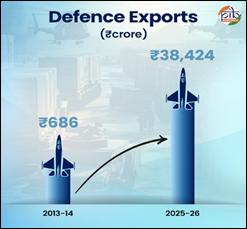
- 56-Fold Growth in Defence Exports: Exports rose from ₹686 crore in FY2013–14 to ₹38,424 crore in FY2025–26.
- Exports is reaching 80+ countries and increased to over 5,500% in twelve years.
- Private sector contributed ₹17,353 crore or 45.16% of defence exports in FY2025–26, while Defence Public Sector Undertakings contributed ₹21,071 crore or 54.84%.
- The Government targets ₹3 lakh crore in annual defence production and ₹50,000 crore in exports by 2029.
Innovation Strengthening Technological Foundation
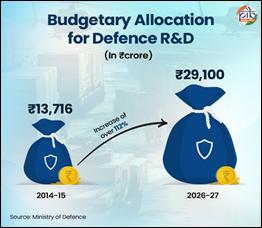
- Defence R&D allocation rose from ₹13,716.14 crore in 2014–15 to ₹29,100.25 crore in 2026–27, an increase of over 112%.
- Since 2022–23, 25% of the defence R&D budget has been opened to industry, start-ups and academia,
- Testing facilities across 24 DRDO laboratories are accessible through the Defence Testing Portal (DTP), a digital platform managed by the Ministry of Defence. This portal lets domestic manufacturers, startups, and industries request paid access to specialised government testing infrastructure to support indigenous defence production.
Key Initiatives Strengthening India’s Defence Industrial Base
India is expanding its defence industrial capacity through indigenous manufacturing, modern infrastructure and greater private-sector participation. This growing ecosystem is strengthening domestic capabilities, supporting innovation and building a resilient defence supply chain.
Defence Acquisition Reforms
- The Defence Acquisition Council (DAC), India’s apex defence procurement body, is driving Atmanirbhar Bharat through indigenous acquisitions. It has accorded Acceptance of Necessity (AoN) for over ₹6 lakh crore of DRDO-designed, Indian industry-manufactured systems.
- Major indigenous acquisitions are strengthening combat capabilities: Approvals include 97 Tejas Mk-1A fighter jets worth ₹62,000 crore and 156 LCH Prachand helicopters worth ₹62,700 crore. These procurements expand India’s domestic aerospace and defence manufacturing capabilities.
- Defence Acquisition Procedure (DAP) 2020 strengthened indigenous procurement and domestic manufacturing. It also expanded opportunities for Indian companies in defence design, development and production.
- Defence Procurement Procedure (DPP) 2016 streamlined defence acquisitions while advancing Make in India. It laid the foundation for subsequent reforms in defence procurement.
- Defence Procurement Manual (DPM) 2025 streamlined nearly ₹1 lakh crore in revenue procurement. It enabled faster approvals, relaxed penalties for indigenous projects and assured long-term orders.
|
Draft Defence Acquisition Procedure (DAP) 2026
DAP 2026 proposes simpler acquisition categories and stronger support for indigenous design and development. It also proposes indigenous content requirements of up to 60%.
|
Boosting Innovation — iDEX, ADITI & TDF
- The Innovations for Defence Excellence (iDEX) scheme, with a ₹498.78 crore outlay, engaged 676 startups, MSMEs, and innovators, resulting in 551 design and development contracts as of March 2026.
- ADITI Scheme: Approved with a ₹750 crore outlay (2023–24 to 2025–26), ADITI provides financial support through the Defence Innovation Organisation (DIO) to accelerate innovative defence technologies.
- Technology Development Fund: The scheme provides grants of up to ₹50 crore for critical defence technology development. As of June 2026, 80 projects worth ₹334 crore were under implementation, with an additional ₹500 crore corpus sanctioned for deep technology and emerging technologies.
Technology Transfer & Industry Participation
- DRDO's Development cum Production Partner framework transferred technologies to 134 partner companies.
- 2,180 technology transfer agreements signed.
- 2,780+ IPRs opened for industry use as on March 2026.
Indigenisation & Domestic Manufacturing
- Till May 2026, 10 Positive Indigenisation lists, five each of DMA & DDP, covering 5,521 items were notified, resulting in increased Aatmanirbharta in defence production.
- Srijan Defence Equipment Empowerment Platform (DEEP) is a digital repository promoting indigenous defence sourcing. As of May 2026, it listed over 41,000 vendors and 2.7 lakh products, strengthening domestic supply chains.
- By April 2026, the Uttar Pradesh Defence Industrial Corridor had attracted ₹42,057 crore in investment commitments, with ₹4,409 crore grounded.
- The Tamil Nadu Defence Industrial Corridor attracted ₹32,699 crore, with ₹6,446 crore realised, strengthening India’s defence manufacturing base.
- The BrahMos Integration & Testing Facility in Lucknow has begun manufacturing missiles.
Ease of Doing Business & Defence Trade
- Industrial licence validity was extended from 7 (+3) years to 15 (+3, up to 18) years, with lifetime validity now granted under the Arms Act.
- The revamped Defence Exim Portal enables end to end application processing, automated company verification, simplified registration, real time tracking and secure payment integration, making defence trade clear and more efficient.
- The FDI limit in the defence sector was increased to 74% under the Automatic Route and up to 100% via the Government Route, attracting ₹6,670.59 crore in inflows by March 2026.
The reforms have created a more enabling environment for defence manufacturing, with stronger institutional support and clearer pathways from innovation to deployment.
Advancing India’s Defence Self-Reliance: FY 2025–26
India’s defence landscape has undergone a significant shift towards greater domestic capability, technological sophistication and operational resilience. Indigenous development now spans ammunition, missiles, propulsion, air defence and naval platforms, supported by stronger government-industry collaboration.
Indigenisation Strengthening Operational Self-Reliance
- The Indian Army achieved roughly 91% self-sufficiency by indigenising 159 out of 175 ammunition variants in its inventory.
- India has successfully tested the Agni-4 Intermediate Range Ballistic Missile and Agni-5 Long Range Surface-to-Surface Ballistic Missile, validating their operational and technical parameters.
- The TARA Glide Weapon and RudraM-II air-to-surface missile have also demonstrated indigenous precision-strike capabilities against ground targets.
- The DRDO has advanced multiple indigenous systems, including the Kusha Long Range Air Defence Missile and Very Short-Range Air Defence System (VSHORADS). An integrated air-defence system combining missile interceptors, short-range weapons and laser technologies has also been successfully tested.
- DRDO successfully conducted a 12-minute ground test of an actively cooled scramjet combustor, supporting hypersonic missile development.
Advancing Maritime Defence And Strike Capabilities
- The Indian Navy commissioned 12 warships and submarines, including INS Surat, INS Nilgiri and INS Vaghsheer.
- INS Mahendragiri, stealth frigate, also entered service with over 75% indigenous content.
- SHACHI, the first of 11 Next Generation Offshore Patrol Vessels, launched. INS Dunagiri, INS Sanshodhak and INS Agray also commissioned, completing the indigenous Sandhayak-class survey fleet, expanding maritime surveillance and survey capabilities.
- DRDO successfully tested the Naval Anti-Ship Missile–Medium Range and demonstrated multi-layered Ballistic Missile Defence capability. It is strengthening India’s ability to counter diverse aerial and maritime threats.
India’s defence transformation has built greater depth across military preparedness, manufacturing and internal security.
Powering India’s Defence Ambition to 2047
India’s defence transformation reflects a clear shift towards greater self-reliance, technological capability and global confidence. Stronger indigenous production, research and development, innovation and industry participation are enhancing defence capacity across land, air and maritime domains. Growing exports and strategic partnerships are reinforcing India’s role as a reliable global defence partner. With continued investment in advanced technologies and domestic manufacturing, India is building the capabilities needed to meet future security requirements and strengthen its position as a technologically advanced defence power by 2047.
Reference:
Ministry of Defence
Ministry of Information and Broadcasting
Press Information Bureau
Click here for the pdf file
***
PIB Research
(Release ID: 2299449)
Visitor Counter : 2434