Ministry of Personnel, Public Grievances & Pensions
Human Intelligence Must Lead Artificial Intelligence in Governance, Says Dr Jitendra Singh; Calls AI an Essential Tool for Viksit Bharat 2047
29th National Conference on e-Governance Concludes with Adoption of Jaipur Declaration; National e-Governance Awards 2026 Presented
Technology Must Empower Citizens, Not Replace Human Accountability, Says Union Minister Dr Jitendra Singh
Dr Jitendra Singh Presents National e-Governance Awards to 17 Outstanding Digital Governance Initiatives
Posted On:
02 JUL 2026 5:54PM by PIB Delhi
Calling for a governance model where technology is guided by human wisdom, ethics and accountability, Union Minister of State (Independent Charge) for Science & Technology, Earth Sciences and Minister of State for the Prime Minister's Office, Personnel, Public Grievances, Pensions, Atomic Energy and Space, Dr. Jitendra Singh said that Human-led Artificial Intelligence will be the defining force behind India's journey towards Viksit Bharat 2047.
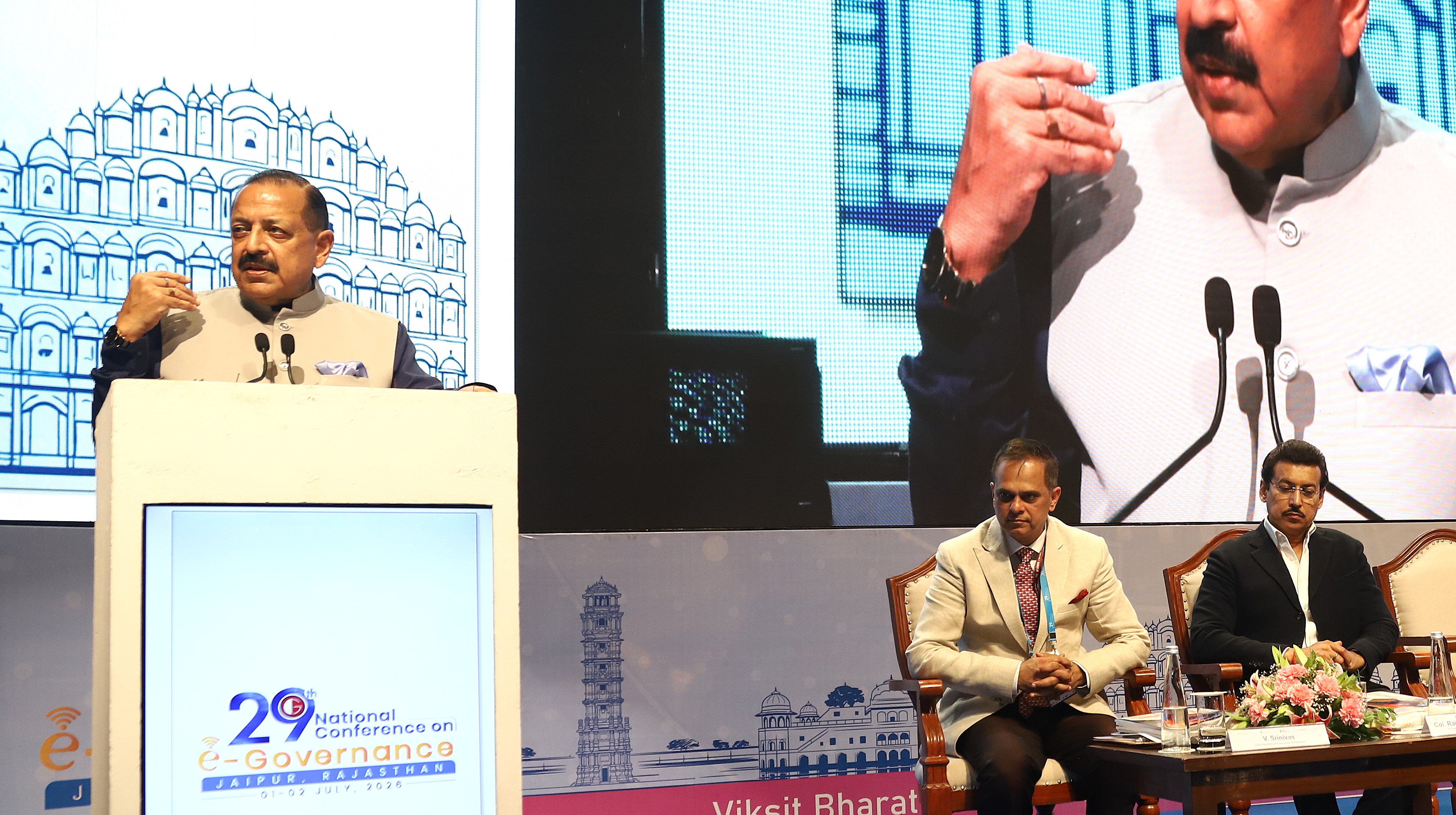
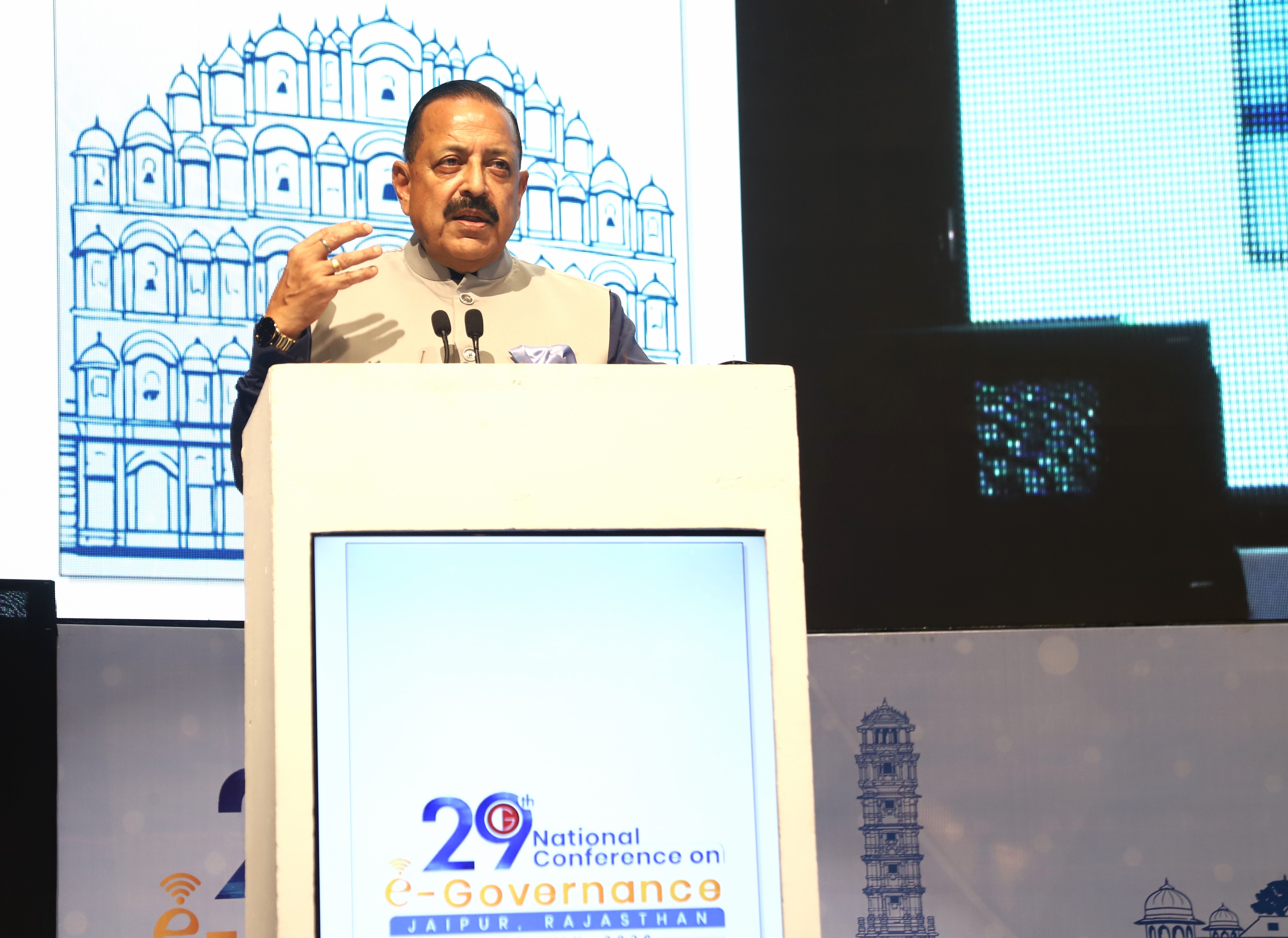
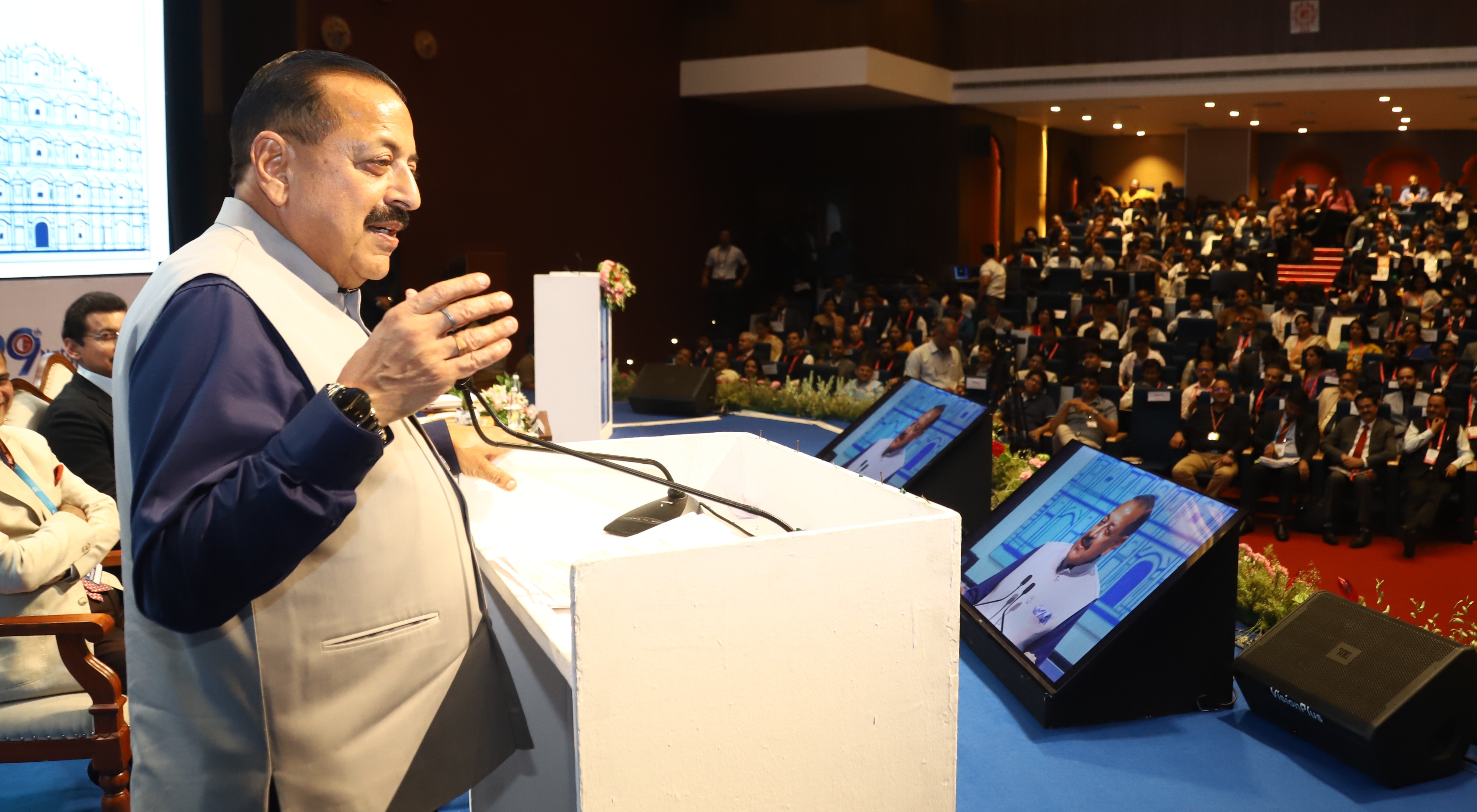
Addressing the Awards Session of the 29th National Conference on e-Governance (NCeG) in Jaipur, the Minister said Artificial Intelligence has ceased to be a matter of choice and has become an essential component of governance. The real challenge, he said, is not Artificial Intelligence itself, but whether governments possess the vision and maturity to deploy it responsibly with citizens remaining at the centre of every technological intervention.
The Minister said India's digital transformation is not driven by the objective of replacing human decision-making with machines, but by the commitment to empower public institutions with technologies that improve transparency, accountability, efficiency and service delivery. He said governance of the future must combine the speed and analytical capabilities of Artificial Intelligence with human judgement, constitutional values and democratic accountability, ensuring that technology strengthens governance without diminishing the role of public institutions or civil servants.
The Awards Session marked the culmination of the 29th National Conference on e-Governance, jointly organised by the Department of Administrative Reforms and Public Grievances (DARPG), the Ministry of Electronics and Information Technology (MeitY) and the Government of Rajasthan. Organised around the theme "Viksit Bharat 2047: AI-enabled, Data-driven and Secure Digital Governance," the conference brought together policymakers, senior administrators, technology experts, innovators, industry leaders, researchers and representatives of local governments from across the country to deliberate on the next phase of India's digital governance journey. Rajasthan Chief Secretary Shri V. Srinivas, Secretary, DARPG, Smt. Nivedita Shukla Verma, Rajasthan Cabinet Minister Col. Rajyavardhan Singh Rathore, Member of Parliament Smt. Manju Sharma, senior officers of the Central and State Governments and distinguished delegates participated in the Awards Session.
Congratulating the Government of Rajasthan for hosting the national conference, Dr. Jitendra Singh said the enthusiastic participation from every State and Union Territory reflected the growing confidence of governments in technology-enabled public administration. He appreciated the wholehearted cooperation extended by the State Government and said the conference exemplified the "Whole-of-Government" approach, where the Centre, States, academia, industry and civil society collectively contribute to shaping governance reforms for the future. He added that such collaborative platforms have become essential for building governance systems capable of responding to rapidly changing technological and societal needs.
Recalling the evolution of the National Conference on e-Governance, Dr. Jitendra Singh said the Government had consciously decided to move flagship governance conferences beyond New Delhi so that reform initiatives become truly national in character. He said holding these conferences across different regions has widened participation, strengthened ownership among States and enabled governments to learn directly from one another's experiences. Similar outreach, he added, has subsequently been adopted across several other Ministries and scientific institutions, creating stronger engagement between government, stakeholders and citizens while expanding the national ecosystem of innovation.
Referring to the conference theme, the Minister said it resonates with Prime Minister Shri Narendra Modi's vision of Viksit Bharat 2047, where technology serves as an instrument for inclusive development and good governance. He said the Government's governance reforms during the past decade have consistently been guided by the principle of "Maximum Governance, Minimum Government," with digital technologies enabling greater transparency, faster service delivery and enhanced public accountability. Artificial Intelligence, data-driven administration and secure digital platforms, he said, are now integral to creating governance systems that are responsive to citizens' aspirations.
Dr. Jitendra Singh said Artificial Intelligence should be viewed as an enabler of governance rather than a substitute for human responsibility. "The real question is not Artificial Intelligence alone; the question is how intelligent we are in using Artificial Intelligence," he remarked, stressing that India must build a governance model where Human-led AI becomes the guiding philosophy for public administration. Technology, he said, should amplify human capability, strengthen institutional credibility and improve citizens' experience while remaining firmly anchored in ethics, transparency and public trust.
The Minister also urged policymakers to view Viksit Bharat 2047 through the lens of the future rather than the limitations of the present. Drawing attention to the pace at which technology has transformed everyday life over the past two decades, he said many innovations once considered indispensable have become obsolete within a short span of time. Governance, therefore, cannot be designed solely around present-day realities. Public institutions, administrative systems and even the role of civil servants, he said, will continue to evolve alongside emerging technologies. Preparing governance for 2047 demands the ability to anticipate change rather than merely respond to it, ensuring that India's administrative framework remains agile, future-ready and capable of meeting the aspirations of a developed nation.
Over the two days of deliberations, Jaipur emerged as a vibrant platform where policymakers, administrators, technology leaders, innovators, researchers and representatives of grassroots institutions exchanged ideas on the future of governance in the age of Artificial Intelligence. Dr. Jitendra Singh said the conference demonstrated that India's digital governance journey has moved well beyond digitisation of services and is now entering a new phase where Artificial Intelligence, data-driven decision-making, Digital Public Infrastructure and secure digital ecosystems are collectively shaping the future of public administration.
The Minister said the Government's approach towards Artificial Intelligence is fundamentally different from a purely technology-driven model. India, he said, is committed to deploying AI in a manner that complements human intelligence rather than replacing it. Referring to the Prime Minister's vision of Maximum Governance, Minimum Government, Dr. Jitendra Singh said every technological intervention introduced during the last decade has sought to make governance simpler, more transparent and more accountable while ensuring that the citizen remains the central stakeholder. Technology, he said, should reduce complexity, eliminate unnecessary procedures and strengthen public trust in institutions.
Emphasising that governance reforms are meaningful only when they improve the lives of ordinary citizens, Dr. Jitendra Singh said the Department of Administrative Reforms and Public Grievances has consistently demonstrated how administrative innovation and digital technologies can together transform public service delivery. He referred to the remarkable expansion of the Centralized Public Grievance Redress and Monitoring System (CPGRAMS), which has evolved into one of the world's largest technology-enabled grievance redress mechanisms, significantly reducing disposal time while expanding accessibility across the country.
The Minister also referred to SAMADHAN DIDI, the AI-powered multilingual voice chatbot developed in collaboration with BHASHINI, as a powerful example of how Artificial Intelligence can make governance more responsive, inclusive and accessible by enabling citizens to interact with government in their own languages through secure public digital infrastructure.
Dr. Jitendra Singh said India's digital governance ecosystem has also been strengthened through initiatives such as the National e-Governance Service Delivery Assessment (NeSDA), which has emerged as an important benchmark for evaluating digital public services across States, Union Territories and Central Ministries. Coupled with the expanding Digital Public Infrastructure and the computing capabilities being developed under the IndiaAI Mission, these reforms, he said, will enable governments to deliver faster, smarter and more efficient public services while maintaining the highest standards of security, transparency and accountability.
Dr. Jitendra Singh said governance reforms cannot be confined to technology alone. Referring to Special Campaign 5.0, he said administrative efficiency is equally dependent on improving workplace practices, record management, institutional discipline and optimum utilisation of public resources. Such reforms, he said, have strengthened government institutions by creating cleaner, better organised and more productive work environments while reinforcing the principles of transparency and accountability across Ministries and Departments. Likewise, Mission Karmayogi has transformed capacity building by preparing civil servants for a rapidly evolving governance landscape through continuous learning in emerging domains such as Artificial Intelligence, cybersecurity, digital governance, leadership and evidence-based policymaking. A future-ready civil service, he said, is indispensable for building a future-ready nation.
Dr. Jitendra Singh conferred the National Awards for e-Governance 2026 upon 17 exemplary initiatives from Central Ministries and Departments, State and Union Territory Governments, District Administrations, Gram Panchayats and Academic & Research Institutions. The awards comprised 10 Gold Awards, 6 Silver Awards and one Jury Award across seven categories. Congratulating the awardees, he said the winning initiatives demonstrate how innovation, technology and public service can come together to create measurable improvements in citizens' lives.
Appreciating Rajasthan's remarkable progress in digital governance, Dr. Jitendra Singh said the State has successfully created an enabling ecosystem where governance reforms, innovation, entrepreneurship and emerging technologies reinforce one another. Referring to the Raj-Kaj integrated administrative platform, he said it has significantly strengthened administrative efficiency, transparency and accountability by enabling faster, paperless and technology-enabled governance across departments. Such initiatives, he said, contribute directly to the national vision of building an efficient, transparent and digitally empowered public administration.
Earlier, Secretary, Department of Administrative Reforms and Public Grievances, Smt. Nivedita Shukla Verma, described the Conference as a premier platform for institutionalising governance innovations, promoting inter-governmental learning and showcasing technology-driven best practices from across the country.
Concluding his address, Dr. Jitendra Singh said India's aspiration of becoming a developed nation by 2047 will depend not only on technological advancement but also on the country's ability to preserve human judgement, institutional integrity and democratic accountability while embracing emerging technologies. Artificial Intelligence, he said, must remain an instrument that empowers people rather than replacing them. Calling upon participants to carry the spirit of the conference back to their respective organisations, he urged governments at every level to convert the ideas, innovations and best practices showcased in Jaipur into measurable improvements in governance that directly benefit every citizen.
"Technology can accelerate governance, but only human wisdom can give it direction. Human-led Artificial Intelligence is the pathway through which India will realise the vision of Viksit Bharat 2047," Dr. Jitendra Singh said, expressing confidence that India's unique model of responsible, citizen-centric digital governance would continue to serve as a global benchmark in the years ahead.
The Conference concluded with the adoption of the Jaipur Declaration on e-Governance 2026, outlining a shared vision and strategic roadmap for advancing AI-enabled, data-driven, secure and citizen-centric digital governance in line with the vision of Viksit Bharat 2047.
Y5XF.jpeg)
*****
NKR/AK/AS
(Release ID: 2280427)
Visitor Counter : 1860