PIB Backgrounder
Empowered Youth, Stronger Nation: India’s Vision for Viksit Bharat @ 2047
Posted On:
13 JUN 2026 1:02PM by PIB Delhi
Between 2014 and 2026, the Government expanded youth-focused initiatives across education, skilling, entrepreneurship, sports, health, and civic participation. Anchored by the National Education Policy 2020 and a vision of youth-led development, it widened access to education, strengthened higher learning, and expanded opportunities for skill development and employment. India’s startup ecosystem also grew significantly, with over 2.3 lakh recognised startups. Through digital platforms, inclusive programmes, and community participation, the country’s youth have emerged as the Amrit Peedhi, contributing to the vision of Viksit Bharat @ 2047.
The Rise of the Amrit Peedhi
With nearly 65 per cent of its population under the age of 35, India is at a pivotal moment in its history. The Government recognises the immense potential of this demographic dividend. In the past 12 years, the nation has witnessed a fundamental shift in how the government engages with its young citizens. This period reflects a systematic and transformational effort to turn India’s youth into a powerhouse of national growth. The change is visible across every sector, including education, skilling, sports, and entrepreneurship. No longer viewed as passive beneficiaries, the youth are now recognised as the "Amrit Peedhi". They have emerged as the primary architects and co-creators of Viksit Bharat @ 2047.
Focus on Youth-led Development
India's approach to youth development has evolved significantly over the past decade, reflecting the changing aspirations and needs of a young and dynamic population.
The National Youth Policy (NYP) 2014 provided the foundational framework for youth development in the country. It defined youth as individuals aged 15–29 years and identified key areas such as education, employment, skill development, health, sports, social participation, and empowerment. The focus was on access, inclusion, and institutional strengthening.
Building on this foundation, the Government has in recent years articulated a vision of youth-led development, recognising young people not merely as beneficiaries of government programmes but as active partners in nation-building.
The recently proposed National Youth Policy 2025 framework further underscores emerging priorities such as future-ready skills, entrepreneurship, leadership, civic engagement, digital participation, and sustainable development.
Education: Quality, Access, and Empowerment for Every Young Indian
India’s approach to education has changed significantly in recent years. The focus has moved from only ‘Expanding Access’ to ‘Ensuring Quality Education’. From urban concentration, education is now reaching the last mile, so that everyone gets equal opportunities. The focus is towards ensuring holistic and future-ready education for India’s youth.
The National Education Policy 2020 (NEP 2020) anchors this transformation. It is the first comprehensive education policy shaped through extensive consultations with stakeholders across the country. The policy places the learner at the centre of the system and promotes experiential and multidisciplinary learning. NEP is playing a pivotal role towards empowering the Amrit Peedhi and realisation of ‘Viksit Bharat 2047’.
Strengthening Schools: Infrastructure, Inclusion, and Retention
Over the past decade, the Government has strengthened school education as the foundation for youth empowerment and higher learning. School education has been reimagined as an integrated continuum from pre-primary to senior secondary levels, aligned with NEP 2020.
As of 2025–26, over 1.49 lakh schools have been covered under Information and Communication Technology (ICT) and digital initiatives, with more than 1.76 lakh smart classrooms and 1.79 lakh ICT laboratories sanctioned.
Special emphasis has been placed on inclusion and retention of youth from across social and geographical backgrounds. Residential schooling facilities such as Kasturba Gandhi Balika Vidyalayas (KGBVs) and Netaji Subhash Chandra Bose Awasiya Vidyalayas (NSCBAVs) have improved access for girls and students from socio-economically disadvantaged backgrounds, particularly in remote and difficult areas. Complementing these efforts, hostel facilities under initiatives such as PM-JANMAN and Dharti Aaba Janjatiya Gram Utkarsh Abhiyan (DAJGUA) have expanded educational opportunities for tribal communities.
These interventions have contributed to improved enrolment and lower dropout rates across school levels, enabling more young Indians to complete secondary and higher secondary education.
Future-Ready Higher Education: Flexibility, Technology, and Innovation
New Education Policy has fundamentally restructured how higher education is accessed and delivered. Indian youth is now getting empowered through an education system that is more flexible, digitally enabled, and innovation-driven.
Flexibility in Learning:
NEP 2020 has introduced structural reforms that give the youth greater control over their academic journey.
- The National Credit Framework (NCrF), adopted by 170 universities, allows students to accumulate credits across academic, skill-based, and experiential learning.
- The Academic Bank of Credits (ABC) has onboarded 2,469 institutions and issued over 32 crore student IDs. It enables students to store, transfer, and redeem credits across institutions without losing academic progress.
- The Automated Permanent Academic Account Registry (APAAR ID) accumulates academic and skill credits earned throughout a student's learning journey. As of March 31, 2026, over 15.48 crore verified APAAR IDs have been generated for students.
- 153 universities now offer biannual admissions and multiple entry/exit points. This flexibility is a vital step toward achieving the target of a 50 per cent Gross Enrolment Ratio (GER) in higher education by 2035.
Technology and Innovation in Education
To expand access to quality education, the Government has built a robust digital learning ecosystem. As of June 2026, SWAYAM offers over 18,580 courses, recording more than 6.1 crore enrolments and 53.7 lakh certifications. SWAYAM PRABHA, PM e-VIDYA, and DIKSHA have further widened learning access through television, radio, digital content, and e-resources. DIKSHA alone hosts over 3.66 lakh e-content resources in 135 languages.
At the higher education level, the One Nation One Subscription initiative has expanded access to academic and research resources across 7,414 institutions, benefiting nearly 99 lakh users.
To foster innovation and entrepreneurship, the Atal Innovation Mission has established over 10,000 Atal Tinkering Labs, empowering more than 1.1 crore students and supporting the development of over 16 lakh projects in emerging technologies. Additionally, 72 Atal Incubation Centres have supported over 6,700 startups and helped create more than 32,000 jobs.
Higher Education: More Institutions, Greater Reach
The physical expansion of India’s higher educational infrastructure for youth since 2014, has been both significant and strategically driven.
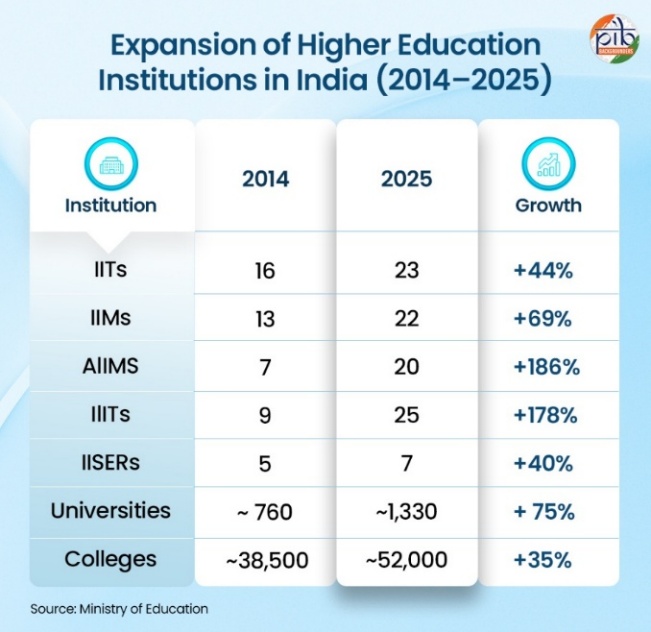
- Total enrolment in higher education has grown from 3.42 crore in 2014-15 to 4.46 crore in 2022-23.
- India now operates one of the world's largest school systems — 14.71 lakh schools serving 24.69 crore students, supported by over 1.01 crore teachers.
- Medical colleges have grown from 431 in 2014 to 818 in 2025-26. MBBS and PG seats have increased to 1,28,976 and 85,822 as of 2025-26.
- Five IITs — Tirupati, Palakkad, Bhilai, Jammu, and Dharwad — have been expanded, adding over 6,576 seats, more than doubling their collective student capacity.
- India's global academic footprint is also growing. Two international IIT campuses have been established in Zanzibar and Abu Dhabi. In September, 2025, IIM Ahmedabad also opened its Dubai Campus. 15 foreign universities are expected to set up campuses in India.
- Indian Higher Education Institutions (HEIs) now offer twinning, joint, and dual degree programmes with reputed global institutions. The number of HEIs has increased from over 51,000 in 2014-15 to over 70,000 as of June 2025.
Skilling: Building a Future-Ready Workforce
Over the past 12 years, the Government has built a multi-layered skilling ecosystem aimed at transforming the country’s youth into a driving force of the global economy. This systematic effort has shifted the focus from traditional vocational training to a demand-driven, industry-linked model that prioritises high-tech competencies and industry skills.
Skill India Mission (SIM)
Launched in 2015, the Skill India Mission provides skill, re-skill, and up-skill training through an extensive network of skill development centres. The Government has introduced numerous key schemes to ensure that the Skill India Mission programme is implemented effectively:
· Pradhan Mantri Kaushal Vikas Yojana (PMKVY)
· Jan Shikshan Sansthan (JSS)
· National Apprenticeship Promotion Scheme (NAPS)
· Craftsman Training Scheme (CTS) in Industrial Training Institutes (ITIs)
Pradhan Mantri Kaushal Vikas Yojana (PMKVY): Launched in 2015, it is a flagship short-term, industry-aligned skilling initiative, linked to employment and entrepreneurship. Over the course of its four phases, it has progressed from a pilot incentive-based certification initiative
to a large-scale, demand-driven and outcome-oriented skilling ecosystem.
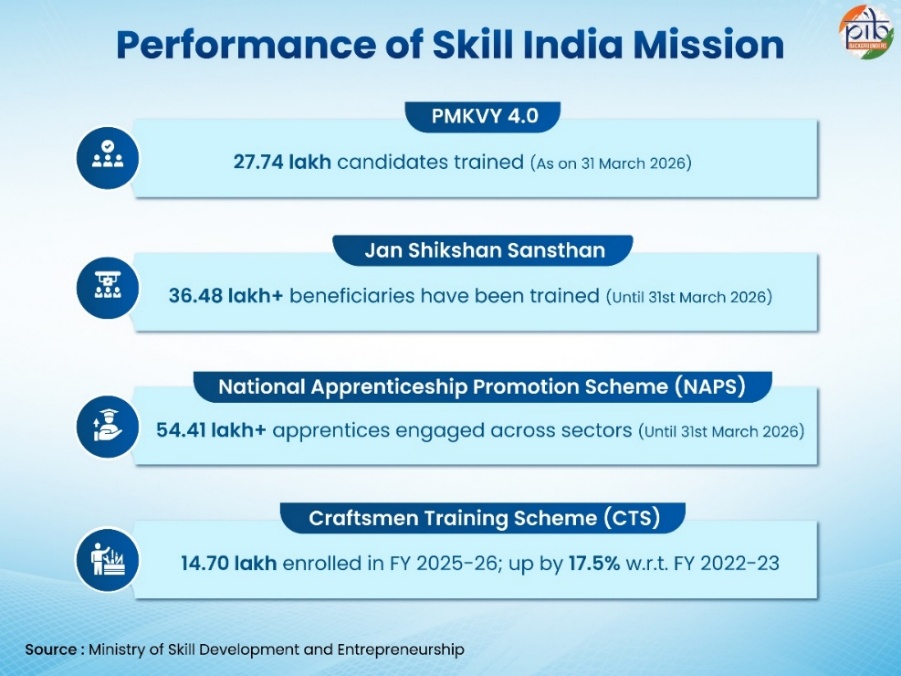
- PMKVY 1.0 (2015-16): Over 19 lakh candidates trained.
· PMKVY 2.0 (2016-20): Over 1.10 crore candidates trained/oriented.
· PMKVY 3.0 (2020-22): Over 7 lakh candidates were trained.
Under PMKVY 3.0, the Government introduced specialised initiatives such as the Customized Crash Course Programme for COVID Warriors and the Skill Hub Initiative, which promoted vocational education, industry-relevant training, and integration of skills with mainstream education in line with the National Education Policy (NEP) 2020.
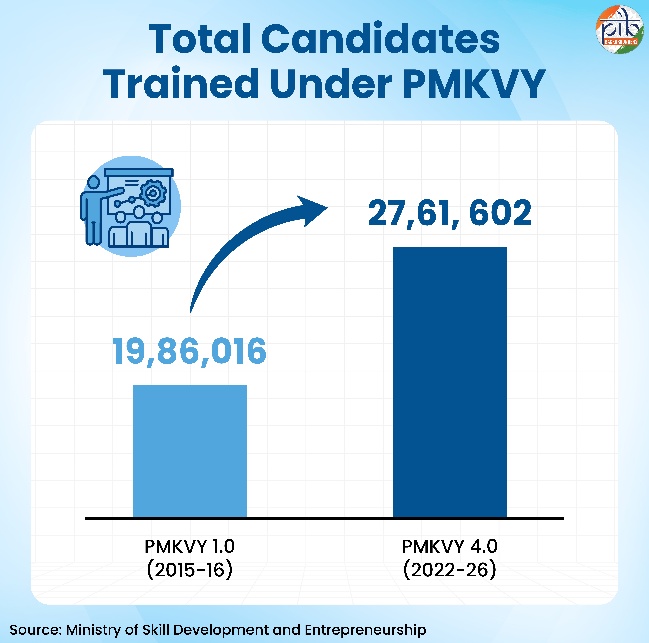
· PMKVY 4.0 (2022-26): With a focus on practical and future-ready skills, PMKVY training is aligned with the National Skill Qualification Framework (NSQF).
Training includes on-the-job exposure and covers emerging sectors such as artificial intelligence, drones, green energy, and electronics. The job roles are developed by industry-led Sector Skill Councils (SSCs).
· Over 27 lakh candidates have been trained across 40 sectors, covering 36 States and 741 districts as of June 2026.
Jan Shikshan Sansthan (JSS): Skill development in India became truly inclusive with transformation of the Jan Shikshan Sansthans since 2018. Courses are tailored to local demand including tailoring, embroidery, handicrafts, food processing and health-related services, leading to greater livelihood generation at the grassroots. Key achievements:
o A total of 36.48 lakh beneficiaries trained since 2018 till 31st March 2026.
o 26,720 tribal beneficiaries have been enrolled and 26,519 have been trained as of 31st March 2026.
o Since December 2024, JSS products are marketed on the UdyamKart portal, directly connecting artisans and micro-entrepreneurs with buyers.
National Apprenticeship Promotion Scheme (NAPS): Launched in August 2016, the scheme is currently being implemented in its second phase, NAPS 2.0.
The programme promotes apprenticeship training by providing partial stipend support to apprentices. Apprenticeship remains a key pillar for “earn while you learn” and industry-centric skill development. The Government contributes 25% of stipend (up to ₹1,500 per month) directly to apprentices’ bank accounts via NAPS portal.
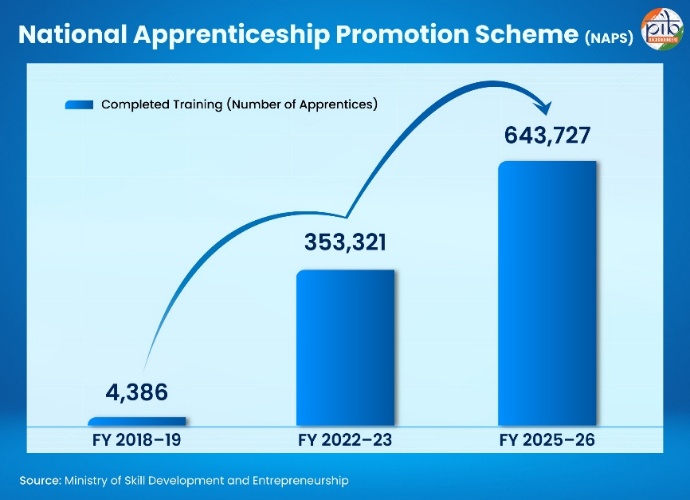
o Since 2016, more than 54.41 lakh apprentices have been engaged across sectors such as automotive, IT-ITeS, electronics, retail and manufacturing until March 31, 2026.
o CoP (Certificate of Proficiency), launched in September 2025, is an additional recognition for apprentices who complete the full duration and practical assessment. As of March 31, 2026, 67,711 CoPs were generated.
Craftsmen Training Scheme (CTS): The Craftsmen Training Scheme (CTS) ensures a steady flow of skilled workers across trades for domestic industry. It aims to improve both the quantity and quality of industrial production through systematic training. It also seeks to reduce unemployment among educated youth by providing employable skills.
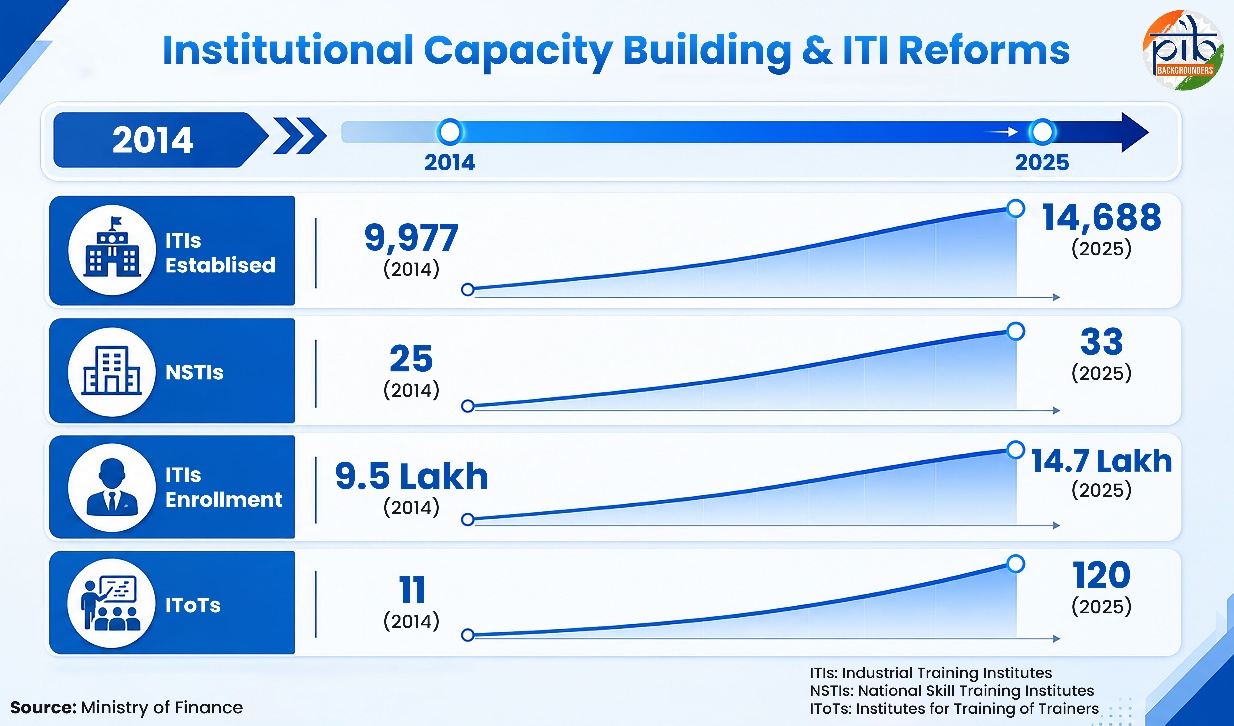
o Under CTS, training is imparted in 169 courses through 14,688 Industrial Training Institutes (Government - 3,345 & Private - 11,343) across the country.
o As of March 2026, a total of 14 new CTS courses has been developed and 22 existing courses have been revised in a span of three years. These courses align with industry requirements.
Industrial Training Institutes (ITIs)
ITIs are the backbone of long-term vocational education in India and provide a steady flow of skilled personnel to the industry. Over the past 12 years, the Government ensured this network underwent a massive expansion and modernisation.
PM–SETU (Pradhan Mantri Skilling and Employability Transformation through Upgraded ITIs) was launched in October 2025. It is a centrally sponsored scheme at an estimated cost of ₹60,000 crore.
Key features include:
- Upgradation of 1,000 Government ITIs (200 hub ITIs and 800 spoke ITIs) in a hub-and-spoke model, with state-of-the-art infrastructure and modern equipment.
- Establishment of Special Purpose Vehicles (SPVs) with Anchor Industry Partners (AIPs) to co-own and co-manage clusters.
- Introduction and redesign of courses based on labour market demand, including high-demand traditional trades upgraded with modern technology.
- Many states including Haryana, Karnataka, Tamil Nadu and others are co-creating the upgradation of 1,000 ITIs around their core strength.
- Capacity augmentation of five National Skill Training Institutes (Bhubaneswar, Chennai, Hyderabad, Kanpur and Ludhiana) as National Centres of Excellence for Skilling with global partnerships.
SOAR (Skilling for AI Readiness)
Launched in July 2025, SOAR introduces Artificial Intelligence awareness and foundational AI skills to school students from Classes 6 to 12. It also equips educators to integrate AI concepts into learning. The programme offers three 15-hour modules for students:
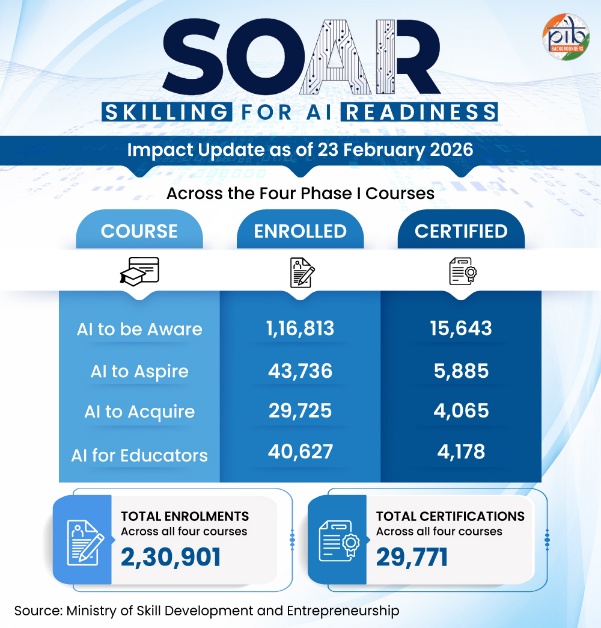
· AI to be Aware
· AI to Aspire
· AI to Acquire
It also offers a dedicated 45-hour module for educators, focusing on topics like ethical AI use and basic concepts of machine learning.
Under SOAR, short-term courses have been launched in collaboration with global technology leaders like IBM, Microsoft, and Cisco. These partnerships are equipping Indian youth with future-ready skills, ensuring they are prepared not only for the jobs of today, but also for the opportunities of tomorrow.
Prime Minister Internship Scheme (PMIS)
The Prime Minister’s Internship Scheme (PMIS) is a flagship transformative initiative to bridge the gap between academic learning and industry requirements. Launched in October 2024, this initiative aims to provide structured, paid internship opportunities to youth across the country.
Key Features include:
· Over 63 thousand internship opportunities available, as on May, 2026
· Monthly financial assistance of ₹9,000 (Government + Company contribution)
· One-time incidental grant of ₹6,000
- Joint digital certificate issued by MCA and the host company
· Interns insured under the Pradhan Mantri Jeevan Jyoti Bima Yojana and Pradhan Mantri Suraksha Bima Yojana.
· Opportunities across 25+ sectors in 730+ districts and all States/UTs.
From Opportunity to Impact: Internships Shaping Careers
Avi Rana, a 23-year-old Political Science graduate from Delhi, interned at ONGC’s Skill Development Centre and Corporate Communications division. During the internship, she worked on brand management, sponsorships, advertising, and SAP workflows, gaining practical exposure to organisational processes. A key highlight of her journey was interacting with senior leadership, including industry experts, which broadened her perspective and strengthened her confidence. The internship provided her with real-world exposure beyond classroom learning and prepared her for a professional career.
Skill India Digital Hub (SIDH): Building a Digital Public Infrastructure for Skills
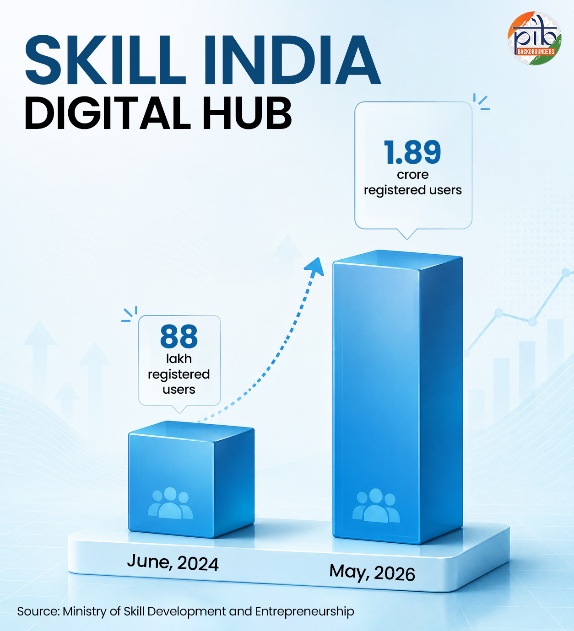
Launched in 2023, the Skill India Digital Hub (SIDH) serves as a unified Digital Public Infrastructure platform for skilling, employment, apprenticeship, and entrepreneurship. It integrates learners, training providers, employers, and Government programmes on a single digital platform. SIDH has simplified access to opportunities and services across the skill ecosystem.
As of May 2026, SIDH had over 1.89 crore registered users, facilitated about 1.38 crore e-KYC verifications, and provided access to opportunities in 23 languages. The platform also hosts 1000+ courses across disciplines. Further, the platform has been integrated with key national digital systems such as DigiLocker, e-Shram, the National Career Service (NCS), UIDAI and the Public Financial Management System (PFMS).
Strengthening the Skill Development Ecosystem through SANKALP
The Skills Acquisition and Knowledge Awareness for Livelihood Promotion (SANKALP) program was a World Bank-supported initiative launched in 2018 and concluded in March 2025. With an overall project outlay of ₹1,650 crore, SANKALP was anchored around three key objectives — institutional strengthening, quality assurance, and inclusive skilling.
Key achievements include:
- District Skill Committees (DSCs) were scaled up from 248 in 2019-20 to 776 in 2024-25, covering almost the entire country.
- District Skill Development Plans (DSDPs), crucial for hyperlocal skilling strategies, increased from 223 to 746 districts. It ensured demand-driven skill development aligned with local economies.
- The Accelerated Mission for Better Employment and Retention (AMBER) project demonstrated improved employment and retention outcomes through innovative training. By its completion in March 2025, 24,055 candidates were certified and 18,192 candidates placed.
· Entrepreneurship initiatives led to the establishment of 21,602 enterprises and facilitation of 20,875 Udyam registrations/trade licenses, creating over 20,575 wage employment opportunities.
- A Global Skill Gap Study covering 16 countries was completed under SANKALP, facilitating the deployment of over 25,000 Indian candidates to international job markets.
- Six Simulated E-Skill Labs using Augmented Reality (AR) and Virtual Reality (VR) technologies were developed to provide immersive learning experiences for solar technician and electronics mechanic trades.
Building Pathways to Employment for India's Youth
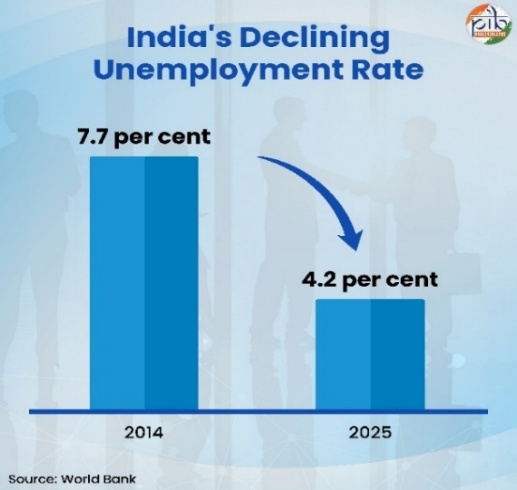
The Government has driven a systematic effort to convert India’s demographic dividend into a powerhouse of national growth. This is carried out through large-scale job creation and targeted policy interventions.
The formalisation of India's economy has been one of the most significant economic shifts of the past decade. Significant progress has been made in bringing youth into the organised sector. EPFO data reveals that over 3.45 crore youth aged 18–28 have joined the formal workforce since April 2020 to June 2025.
Direct Employment Interventions: Connecting Youth with Opportunity
Pradhan Mantri Viksit Bharat Rozgar Yojana: This scheme was announced by the Government in August 2025 with a landmark ₹1 lakh crore outlay. It provides employment-linked incentives to both employers and first-time formal-sector employees. The scheme aims to support the creation of 3.5 crore jobs within two years — one of the largest employment-linked interventions in India's history.
Rozgar Melas: Launched on October 2022, it is a key step toward boosting employment generation and strengthening the workforce across the country. It aims to empower youth by providing meaningful job opportunities and enhancing their role in national development. Since its inception, 18 Rozgar Melas have collectively issued over 12 lakh appointment letters to youth nationwide.
National Career Service (NCS) Portal: NCS functions as India's digital employment marketplace. Launched in July 2015, it connects job-seeking youth with employers across sectors, reducing information asymmetry and bringing employment opportunities to youth across all geographies.
As of January 2026, more than 78.86 lakh jobseekers and more than 12.36 lakh employers are registered on NCS portal during the FY 2025-26. Further, more than 3.43 crore vacancies have been mobilised on NCS Portal during the FY 2025-26.
Atmanirbhar Bharat Rojgar Yojana (ABRY): Launched during the COVID-19 pandemic, it was designed to protect jobs and encourage new employment. Operational from October 2020 to March 2024, the scheme covered employers' EPF contributions for new hires, reducing hiring costs during a period of acute economic uncertainty. By the time it concluded, 60.49 lakh beneficiaries had been supported under the scheme.
Youth in Defence
The Agnipath Scheme, launched in June 2022, recruits youth aged 17.5 to 21 as Agniveers into the armed forces for a four-year tenure. Beyond national service, the programme equips youth with discipline, technical skills, and leadership capabilities. On completion, these Agniveers receive a Seva Nidhi financial package from the Government, supporting their civilian careers.
By early 2025, up to 1.5 lakh Agniveers had been enrolled under the scheme. To facilitate post-service employment, the Government has provided a 10 per cent reservation for former Agniveers in recruitment to the Central Armed Police Forces (CAPFs) and Assam Rifles, along with age relaxations.
In February 2026, Indian Railways and the Indian Army also launched a Framework of Cooperation to strengthen employment opportunities for Agniveers and ex-servicemen. Under the existing policy, 10 per cent of Level-1 railway posts and 5 per cent of Level-2 and above posts are reserved for ex-Agniveers, creating structured opportunities for their transition into civilian employment.
Manufacturing and Industrial Job Creation: Make in India and PLI Schemes
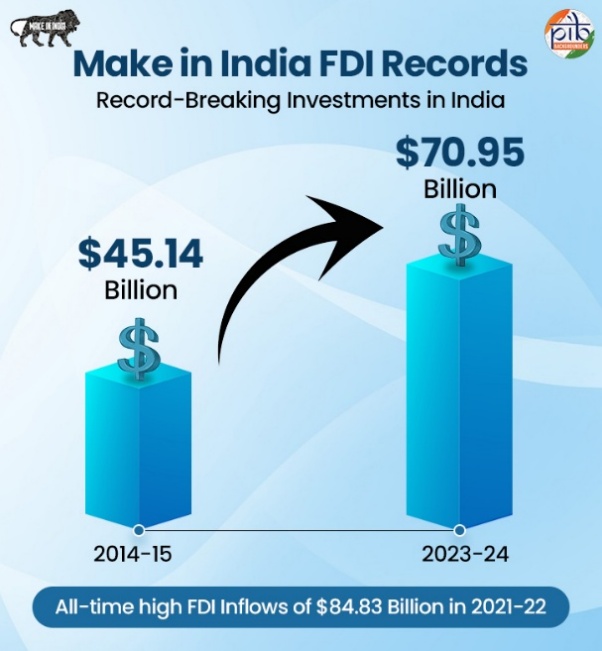
When the Government launched Make in India on 25th September 2014, the goal was clear — transform India into a global manufacturing hub and create employment at scale. Twelve years later, the results are visible in factories, supply chains, and the livelihoods of millions of young Indians.
Make in India 2.0 now covers 27 sectors — 15 manufacturing and 12 service sectors — spanning aerospace, electronics, pharmaceuticals, automobiles, food processing, textiles, drones, and IT. These are precisely the sectors where India's young, skilled workforce has the greatest competitive advantage.
At the core of this initiative is the Production Linked Incentive (PLI) Scheme. Launched by the Government in March 2020, the scheme is implemented across 14 key sectors to incentivise incremental domestic production and draw fresh investment into India's manufacturing ecosystem. Key gains under the scheme are visible in sectors like electronics, pharmaceuticals, and automobile manufacturing, strengthening India’s global manufacturing competitiveness:
· PLI-led investments have encouraged smartphone production in India, making the country a major global mobile phone manufacturing hub.
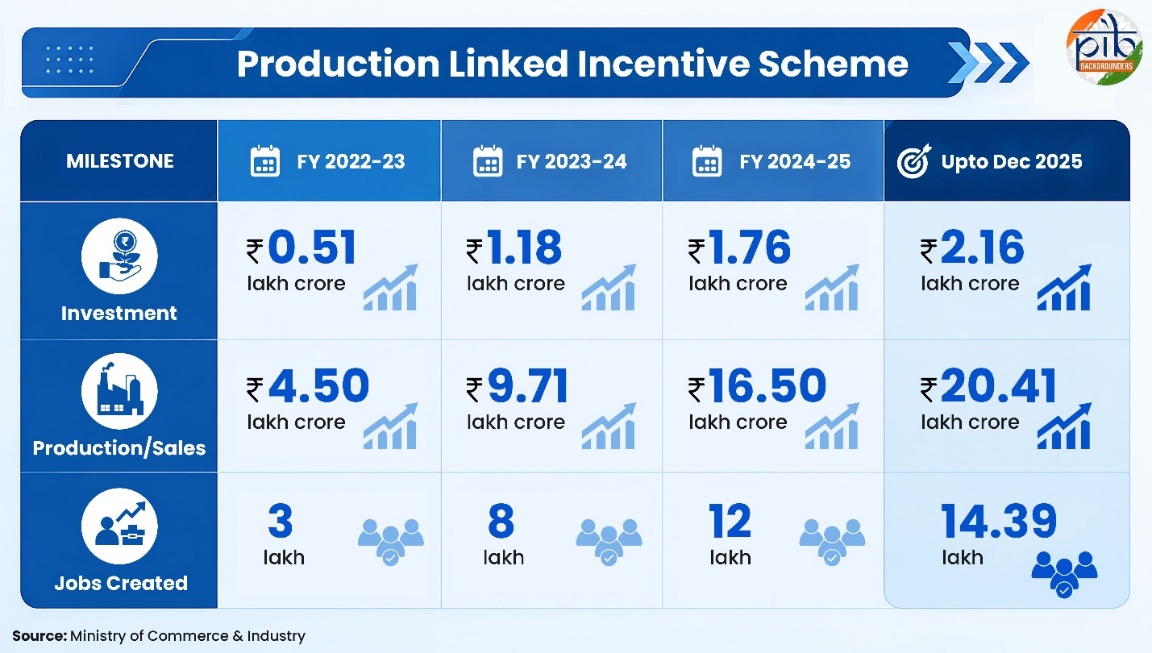
- As on 31st March, 2026, actual investment of over ₹ 2.40 lakh crore has been reported across sectors which has generated Production/ Sales of over ₹ 22.66 lakh crore and Employment of over 14.15 Lakh (Direct & Indirect).
- PLI Schemes have witnessed exports surpassing Rs.15.20 lakh crore.
PLI schemes have moved from policy to measurable impact:
Entrepreneurship: Enabling Youth-Led Enterprise and Innovation
Over the past 12 years, the Government has built a strong entrepreneurship ecosystem that enables young Indians to become job creators rather than job seekers. Through policy support, easier access to finance, digital platforms, and innovation-focused initiatives, entrepreneurship has expanded across the nation.
Startup India: Building the World's Third-Largest Ecosystem
Launched on 16th January 2016, the Startup India Initiative has emerged as the cornerstone of the nation’s innovation backbone. Over the past decade, this movement has fundamentally shifted India's economic trajectory, transforming the youth from job-seekers into bold job-creators.
The evolution of India’s startup landscape represents a systematic scaling of innovation across the country.
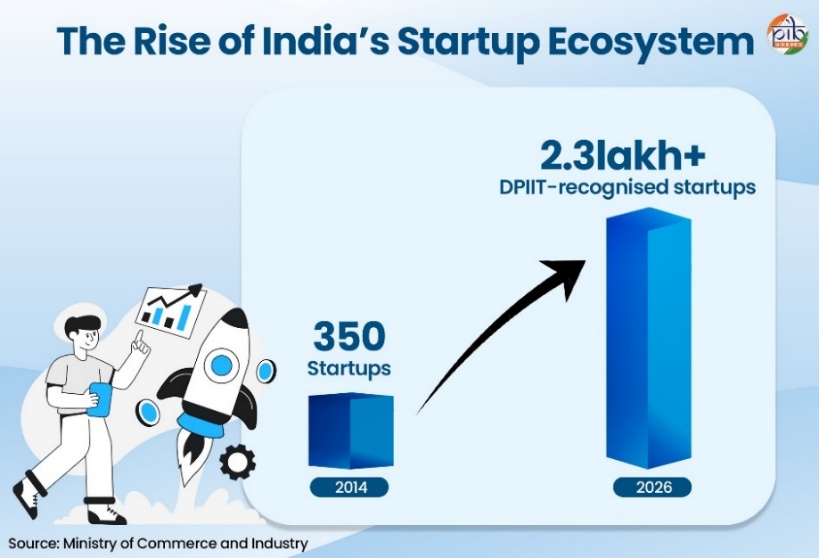
· Before 2014, India had only 350 startups. By June 2026, this number has surged to over 2.3 lakh Department for Promotion of Industry and Internal Trade (DPIIT) recognised startups, making India the third-largest startup ecosystem globally.
· India’s high-value startup ecosystem has expanded significantly over the past decade. It has grown from just 4 privately held companies valued above $1 billion in 2014 to over 120 such firms by early 2026. Their combined valuation now exceeds $350 billion. This reflects both the scale and the growing global relevance of India’s startup landscape.
· While Tier-I cities were the early leaders, the movement has now permeated small towns and villages. Today, nearly 50 per cent of recognised startups emerge from Tier-II and Tier-III cities, showcasing that innovation is no longer limited to metros.
|
Indicator
|
2026
|
|
DPIIT-Recognised Startups
|
2.3 lakh+ (June 2026)
|
|
Unicorn Companies
|
120+
|
|
Combined Unicorn Valuation
|
$350 billion+
|
|
Startups from Tier-II/III Cities
|
~50%
|
|
Startups with Women Director/Partner
|
45%+ (December 2025)
|
· Startups have emerged as a vital engine of employment for the youth, collectively creating over 23 lakh jobs as of April 2026. These ventures leverage India’s young demographic dividend to generate opportunities across technology, manufacturing, and the gig economy.
The Funding Architecture: Capital at Every Stage
One of the most consequential changes made by the PMIS in the past decade, has been the creation of a full-lifecycle funding system — ensuring that a young entrepreneur is not left without capital at any stage of their journey.
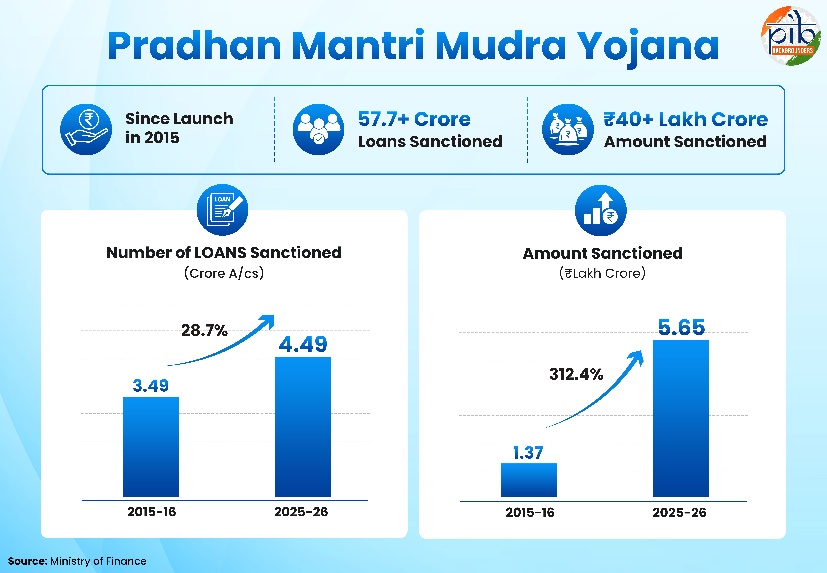
- Pradhan Mantri MUDRA Yojana (PMMY): Launched in 2015, the PMMY is the flagship programme aimed at funding the micro enterprises and small businesses. The program provides collateral-free loans up to ₹20 lakh for micro and small enterprises and young entrepreneurs.
· Startup India Seed Fund Scheme (SISFS): Operational since April 2021, the SISFS is a dedicated financial intervention under the broader Startup India framework. It aims at bridging the critical capital gap at the early stages of a startup’s journey. It aims to provide financial assistance to startups for the proof-of-concept (PoC), prototype development, product trials, market entry, and commercialisation phases. The corpus of ₹945 crore has been approved to 215+ incubators to support early-stage startups under the scheme.
· Fund of Funds for Startups (FFS): Launched in 2016, this scheme provides long-term domestic risk capital for growing enterprises. Managed by Small Industries Development Bank of India (SIDBI) with a corpus of ₹10,000 crore, FFS invests in SEBI-registered Alternative Investment Funds (AIFs). They in turn deploy capital into Indian startups. To date, the corpus has been committed to over 145 AIFs, which have collectively invested ₹25,500+ crore in 1,370+ startups across India.
- Credit Guarantee Scheme for Startups (CGSS): This scheme provides collateral-free loans to DPIIT-recognised startups through financial institutions. Over 330 loans worth ₹800+ crore have been guaranteed for startup borrowers. This has removed one of the most common barriers young entrepreneurs face when approaching banks.
- Startup India Investor Connect Portal: Launched in March 2023, it enables young entrepreneurs to reach multiple investors through a single application. It gives first-time founders access to venture capital and angel networks that were previously out of reach. As of June 2026, the platform has over 10,836 registered startups, 126 registered investors, and 44 active investment opportunities. More than 6,800 startups have responded to investor requirements, expanding access to venture capital and angel investment networks for first-time founders.
- The Stand-Up India Scheme has played a key role in promoting inclusive entrepreneurship. It enables women and individuals from Scheduled Caste (SC) and Scheduled Tribe (ST) communities to access institutional credit. The scheme facilitates bank loans ranging from ₹10 lakh to ₹1 crore for setting up enterprises across manufacturing, services, trading, and agri-allied sectors.
The Stand-Up India Scheme has shown remarkable growth over the years, with the total amount sanctioned increasing from Rs. 14,431.14 crore as of 31st October 2018 to an impressive Rs. 61,020.41 crore by 17th March 2025, since its launch.
From Unemployment to Enterprise: A Rural Youth’s Journey
Vishal Kumar, a young resident of Tanda village, Uttar Pradesh faced unemployment despite having marketing and sales skills. With no steady income, he struggled to support his family. Through the Pradhan Mantri Mudra Yojana (PMMY), he accessed a loan of ₹3 lakh to start a computer stationery business. With initial support from the bank, he began operations on a small scale and gradually expanded his stock and sales. Over time, his business stabilised and income improved. This enabled him to renovate his home and secure essential services such as electricity and water for his family.
Digital Youth Engagement: The My Bharat Ecosystem
On 31st October 2023, the Government established Mera Yuva Bharat (MY Bharat) as an autonomous Phygital (Physical+Digital) platform. It combines physical engagement with digital connectivity to create a single, unified ecosystem for India's youth aged 15 to 29. MY Bharat is an autonomous umbrella body that provides a "whole-of-government" framework for youth engagement. It offers learning, volunteering, mentorship, career services, and civic participation through a single platform.
What MY Bharat Offers Youth:
- Experiential Learning Programmes across sectors including healthcare, public administration, post offices, cybersecurity, and All India Radio — enabling youth to gain real-world exposure while still in education
- Volunteering Opportunities connected to national missions, community service, environmental drives, and cultural events
- Career Tools including a CV Builder, job linkages, and connections to the PM Internship Scheme
- Civic Engagement Platforms — from Youth Parliaments to Padyatras — connecting youth to governance and policymaking at every level
- MY Bharat Podcast and Quiz and Essay modules for intellectual engagement on themes of national importance
- MY Bharat Mobile Application launched on 1 October 2025 for wider accessibility
Platform Impact (as of 2025-26):
- Over 2.19 crore registered youth on MyBharat portal as on June 2026.
- 383010 Experiential Learning Programmes created, mobilising more than 1.03 lakh youth
- 1,45,259 Volunteering Opportunities created, mobilising 8,25,825 volunteers
- 170+ District Youth Officers recruited to strengthen ground-level presence across India
MY Bharat 2.0 integrates AI-enabled tools, mentorship networks, and career services — evolving the platform from an engagement tool into a full youth empowerment ecosystem.
Viksit Bharat Young Leaders Dialogue (VBYLD) — reimagined from the National Youth Festival in 2025 — has become the flagship platform for youth leadership and policymaking engagement:
- VBYLD 2026 witnessed participation of over 50 lakh youth in the Viksit Bharat Challenge Quiz (2026)
- 78 Indian Diaspora youth from 21 countries participated, ensuring global representation
- 6,000 young leaders identified for a district-wise national repository (2026)
- Ideas from VBYLD 2026 directly inspired the Union Budget 2026
Digital Literacy: PMGDISHA
The Pradhan Mantri Gramin Digital Saksharta Abhiyan (PMGDISHA) was launched in 2017 to ensure digital literacy amongst citizens in rural India. It trained citizens, including the youth to use digital devices, navigate the internet, access Government services online, and conduct digital financial transactions. The scheme concluded on 31st March 2024. The scheme was one of the world’s largest digital literacy initiatives. Against the target of training 6 crore people, more than 6.39 crore persons were trained nationwide.
Sports for Youth: From Grassroots to Global Excellence
Sports were never taken seriously in India, neither by families, nor by the government. However, over the past 12 years, the Government has fundamentally transformed India’s sporting landscape. It has moved from a culture where sports were often viewed as a distraction to one where they are a respected and viable professional career path. This evolution has been driven by a structured ecosystem that identifies talent starting at the village level and providing elite athletes with world-class scientific support.
Institutionalising Talent: The Khelo India Mission
Launched in 2016-17, the Khelo India – National Programme for Development of Sports is the central anchor for encouraging sports culture across nation. It aims to promote mass participation and sporting excellence in both rural and urban areas.
· A nationwide network of 1,067 Khelo India Centres and 35 State Centres of Excellence has been established. These ensure quality training facilities are accessible across districts, including remote and underserved regions.
· Talent identification has been significantly strengthened through the KIRTI (Khelo India Rising Talent Identification) programme. Launched in March 2024, it uses data-driven assessments to identify sporting potential at an early age. Over 1.8 lakh assessments have already been conducted, creating a strong pipeline of young athletes entering structured training systems.
· As on June 2026, a total of 23,080 athletes are supported under various Khelo India verticals. Each receive financial assistance of ₹6.28 lakh per annum to cover coaching, equipment, diet, and competition exposure.
- Through initiatives like the Khelo India Youth Games, Khelo India University Games, Khelo India Para Games and Khelo India Tribal Games, the Government has ensured inclusive participation by creating competitive platforms for youth, university athletes, para-athletes and tribal communities across the country.
Achieving Global Excellence: Target Olympic Podium Scheme (TOPS)
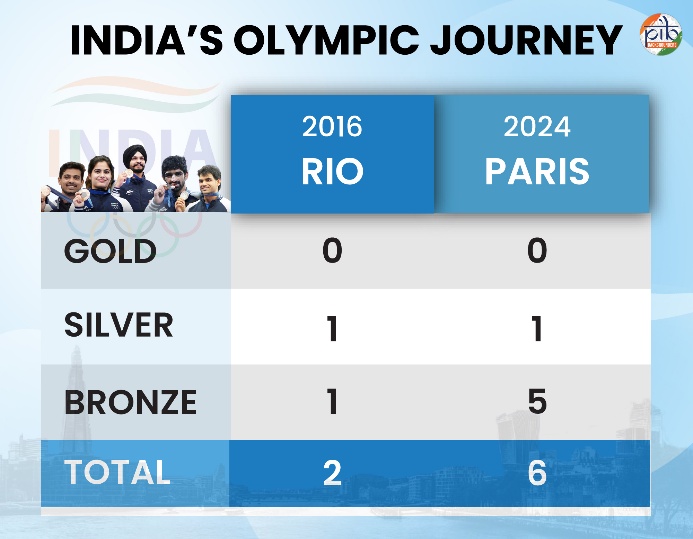
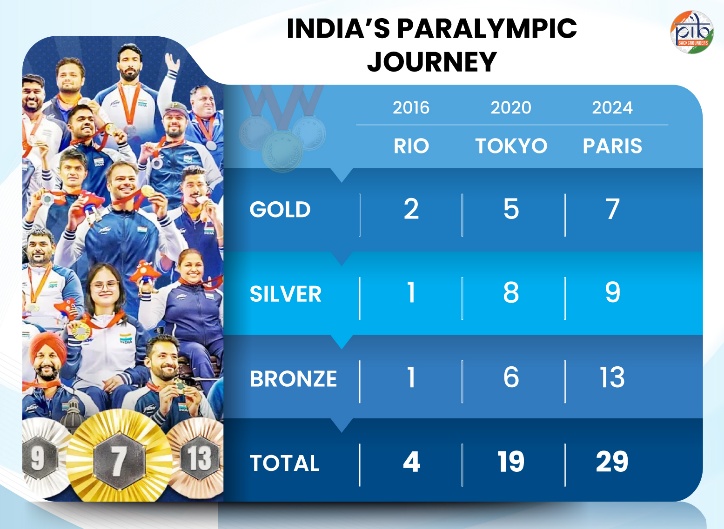
To bridge the gap between national performance and global podium finishes, the Government launched the Target Olympic Podium Scheme (TOPS) in September 2014. It represents a focused and high-performance approach to elite sports. TOPS provides customised, athlete-centric support that includes foreign coaching, international training exposure, advanced sports science, equipment, and a monthly stipend. The scheme currently supports 98 athletes in the Core Group and 165 athletes in the Development Group, covering both Olympic and Paralympic disciplines.
The impact of this long-term investment is visible in India’s international performance in the recent years:
Fitness as a Mass Movement: Building a Healthier Generation
The Fit India Movement, launched by the Government in August 2019, has transformed fitness from an individual effort into a national movement. It promotes physical activity as an essential part of daily life, particularly among young people.
Ø The initiative has witnessed large-scale participation, with over 23.68 crore individuals engaging in activities such as the Fit India Freedom Run, Fit India School Week, and the Fit India Quiz.
Ø The movement has also been institutionalised within the education system.
Ø As on June 2026, more than 4.5 lakh schools have been awarded Fit India School Flags, integrating physical fitness into daily routines and co-curricular activities. This has ensured that young Indians develop habits of fitness, discipline, and well-being from an early age.
Ø Since its launch in December 2024, Fit India Sundays on Cycle has grown into a nationwide movement. By May 2026, the movement has engaged over 30 lakh citizens across 2.8 lakh+ locations.
Health and Well-being: A Holistic Youth Approach
Recognising that a healthy "Amrit Peedhi" is the bedrock of national productivity, the Government has implemented a multi-dimensional health framework focusing on physical, mental, and preventive care.
· Rashtriya Kishor Swasthya Karyakram (RKSK): Launched in 2014, this flagship program addresses the holistic needs of adolescents aged 10–19. It has transitioned from facility-only care to a community-based model. RKSK encompasses both rural and urban populations, in-school and out-of-school youth, married and unmarried, with special attention to marginalised groups. It covers six thematic domains: nutrition, sexual and reproductive health, mental health, injuries, violence, and non-communicable diseases.
Adolescents receiving counselling and clinical services in Adolescent Friendly Health Clinics (AFHCs) have increased substantially from 39 lakh in 2014-15 to 1.7 crore in 2024-25.
· Mental Health Support (Tele-MANAS): To provide stigma-free mental healthcare, the Tele-MANAS 24/7 helpline offers professional tele-counselling services. This initiative has been a vital resource, with more than 39.52 lakh (June 2026) calls handled since its launch in October 2022.
· Combating Substance Abuse: The Nasha Mukt Bharat Abhiyaan launched in August 2020, has conducted massive sensitisation drives, reaching over 10 crore youth by June 2026. In July 2025, the Kashi Declaration was adopted as a five-year roadmap for drug-free youth action, involving local Governments, spiritual bodies, and youth-led movements.
· Universal Health Coverage: Through Ayushman Bharat, the Government has established a strong network of primary healthcare institutions across the country. As on February 27, 2026 over 1.84 lakh Ayushman Arogya Mandirs (formerly Health and Wellness Centres) are operational. They have significantly expanded access of citizens, including youth, to comprehensive primary healthcare services.
· The Ayushman Bharat Digital Mission (ABDM) launched in September 2021, helps India’s youth by making healthcare more digital, accessible and affordable. The Government is building a nationwide digital health ecosystem where young people can manage health records, access telemedicine, and benefit from new opportunities in digital innovation. From fewer than 1,000 linked records during its initial phase to over 100 crore today, ABDM has evolved into one of the world’s largest digital health ecosystems.
Environment, Leadership and Civic Participation
India's youth policy does not end with economic opportunity. It extends to the civic, cultural, and environmental responsibilities that define engaged, active citizenship. The Government has built robust institutional mechanisms to ensure that youth are active participants in the society.
NSS and NYKS: The Pillars of Community Engagement
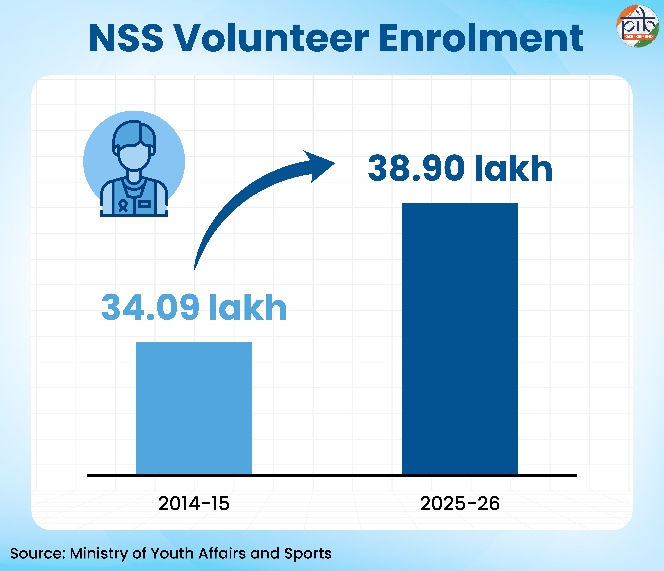
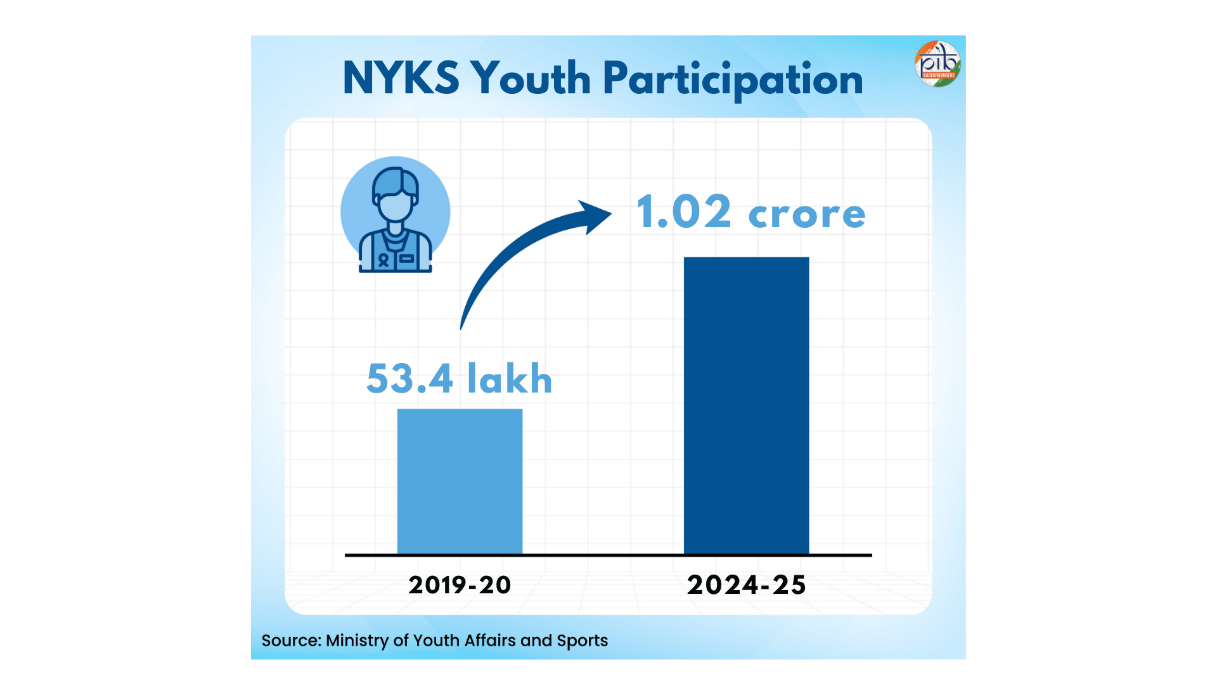
Since 2023, National Service Scheme (NSS) and the Nehru Yuva Kendra Sangathan (NYKS) are part of MY Bharat framework. It has strengthened youth participation in community service and nation-building activities. Through campaigns on health, literacy, environmental conservation, gender sensitisation, disaster response, and social awareness, these platforms continue to engage young people across the country.
NYKS and NSS has witnessed significant growth in youth participation over recent years.
International Engagement: India's Youth on the World Stage
The Department of Youth Affairs has 30 active MoUs with countries and multilateral organisations including BRICS and the Shanghai Cooperation Organisation (SCO). Youth exchange programmes are conducted on a reciprocal basis with 14 countries regularly, promoting cross-cultural understanding and building India's global youth networks.
Recent milestones in international youth engagement include:
· 1st BIMSTEC Youth Summit (February 2025, Ahmedabad) — 70 delegates from 7 member nations; theme: "Youth as a Bridge for Intra-BIMSTEC Exchange".
· Polish Youth Delegation (February 2025) — 21 members, under the Jamsaheb Memorial Youth Exchange Programme commemorating India's wartime humanitarian legacy.
· Egyptian Youth Delegation (November–December 2025) — focused on Youth Leadership in the Age of Artificial Intelligence.
· 4th Central Asia Youth Delegation (March–April 2026) — 100-member delegation exploring cultural, academic, and technological linkages.
· Viksit Bharat Run 2025 — organised across 150+ locations in 91 countries (September 2025) — a first-of-its-kind global youth initiative reflecting the reach of India's soft power.
Under Y20 during India's G20 Presidency in 2023, schools and colleges organised over 64,000 events with over 26 lakh participants. The Y20 summit in Varanasi brought together 120+ international delegates, culminating in the Y20 Communiqué — reflecting India's belief in Vasudhaiva Kutumbakam, the world is one family.
A Decade of Transformation, A Future of Possibilities
Over the past 12 years, India has built one of the most comprehensive and integrated youth development ecosystems in the world. The approach has been clear and consistent. It has moved from fragmented interventions to a structured, multi-sectoral framework that empowers youth across education, skills, employment, health, sports, and civic participation.
The impact is visible across indicators. More young Indians are in schools and colleges. Millions have been trained in industry-relevant skills. Formal employment has expanded, and entrepreneurship has scaled across cities and villages alike. Young Indians are bringing sporting laurels for the country at international events. Medical facilities are helping youth lead a healthier life. Development of leaderships skills through national and international participation is ensuring a well-rounded development for the youth. India’s youth are not only participating in the economy but now actively shaping it.
The journey from 2014 to 2026 reflects a clear shift—from access to empowerment, from participation to leadership. The Government has created opportunities, removed barriers, and built systems that have allowed youth to realise their full potential.
As India moves towards the resolve of Viksit Bharat 2047, the foundation has been firmly laid. The Amrit Peedhi is equipped with the education, skills, confidence, and opportunities needed to lead the nation forward.
References
Press Information Bureau:
https://www.pib.gov.in/PressNoteDetails.aspx?NoteId=154537&ModuleId=3®=3&lang=2
https://www.pib.gov.in/PressReleasePage.aspx?PRID=2199237®=3&lang=1
https://www.pib.gov.in/PressReleasePage.aspx?PRID=2085152®=3&lang=2
https://www.pib.gov.in/PressReleasePage.aspx?PRID=2219936®=1&lang=1
https://www.pib.gov.in/PressReleasePage.aspx?PRID=2127411®=3&lang=2
https://www.pib.gov.in/PressReleasePage.aspx?PRID=2165763®=3&lang=2
https://www.pib.gov.in/PressReleasePage.aspx?PRID=2256476®=3&lang=2
https://www.pib.gov.in/PressReleasePage.aspx?PRID=2204136&utm_source=chatgpt.com®=3&lang=2
https://www.pib.gov.in/PressReleasePage.aspx?PRID=2254498®=3&lang=1
https://www.pib.gov.in/PressReleasePage.aspx?PRID=2247750®=3&lang=2
https://www.pib.gov.in/PressReleasePage.aspx?PRID=2222120®=3&lang=1
https://www.pib.gov.in/PressNoteDetails.aspx?NoteId=156899&ModuleId=3®=3&lang=2
https://www.pib.gov.in/PressReleasePage.aspx?PRID=2264076®=48&lang=2
https://www.pib.gov.in/PressReleasePage.aspx?PRID=2223849®=3&lang=2
https://www.pib.gov.in/PressReleaseDetail.aspx?PRID=2206145®=3&lang=2
https://www.pib.gov.in/PressReleaseIframePage.aspx?PRID=2042129&utm_source=chatgpt.com®=3&lang=2
https://www.pib.gov.in/PressReleasePage.aspx?PRID=2246085®=3&lang=2
https://static.pib.gov.in/WriteReadData/specificdocs/documents/2026/jan/doc2026115757801.pdf
https://www.pib.gov.in/PressReleseDetailm.aspx?PRID=2215306®=3&lang=1
https://www.pib.gov.in/PressReleasePage.aspx?PRID=2253019®=3&lang=2
https://www.pib.gov.in/PressReleaseDetail.aspx?PRID=2235818®=3&lang=1
https://www.pib.gov.in/PressReleasePage.aspx?PRID=2119045®=3&lang=2
https://www.pib.gov.in/PressReleasePage.aspx?PRID=2241781®=6&lang=1
https://www.pib.gov.in/PressReleasePage.aspx?PRID=2264241®=3&lang=1
NITI Aayog:
https://www.niti.gov.in/sites/default/files/2025-02/Expanding-Quality-Higher-Education-through-SPUs.pdf
Parliament Question:
https://sansad.in/getFile/annex/258/AS147.pdf?source=pqars
Ministry of Youth Affairs & Sports:
https://cdn-prod.mybharats.in/mybharat/assets/img/yuva_landing/nyp%202025.pdf https://www.rgniyd.gov.in/sites/default/files/pdfs/scheme/nyp_2014.pdf
https://dashboard.kheloindia.gov.in/
https://sportsauthorityofindia.nic.in/sai_new/target-olympic-podium
Ministry of Corporate Affairs:
https://pminternship.mca.gov.in/login/
Ministry of Commerce:
https://investorconnect.startupindia.gov.in/
Ministry of Health & Family Welfare:
https://telemanas.mohfw.gov.in/telemanas-dashboard/#/
https://nhm.gov.in/New-Update-2025-26/Adolescent-Health/Name-Change%20_DO-from-AS&MD_Adolescent-Friendly-Health-Centres-reg.pdf
Ministry of Social Justice & Empowerment:
https://nmba.dosje.gov.in/
World Bank Data:
https://data.worldbank.org/indicator/SL.UEM.TOTL.ZS?locations=IN
News on Air:
https://newsonair.gov.in/indian-railways-indian-army-launch-framework-to-boost-post-retirement-jobs-for-agniveers-ex-servicemen/
https://newsonair.gov.in/mansukh-mandaviya-to-inaugurate-second-phase-of-kirti-initiative-in-new-delhi-on-july-19/
Ministry of Education:
https://aim.gov.in/atl.php
ABSS CONCEPT NOTE 2025.pdf
Click Here To See PDF
******
PIB Research
(Release ID: 2272408)
Visitor Counter : 8297