Ministry of Labour & Employment
First Day of 2nd BRICS Employment Working Group Meeting concludes in Thiruvananthapuram
BRICS members advocate for Cooperation on Social Protection, Women's Workforce Participation and Skills Development
Collective vision for incremental social security coverage gains traction; BRICS Capacity Building Forum on Social Security and skills framework proposed as voluntary, consensus-based mechanisms
Posted On:
06 MAY 2026 6:37PM by PIB Delhi
The 2nd BRICS Employment Working Group (EWG) Meeting under India’s Presidency at Thiruvananthapuram today, brought together delegations from BRICS Member States- China, Egypt, Ethiopia, Iran, Indonesia, Russia, South Africa and UAE along with knowledge partners- International Labour Organization, International Social Security Association and United Nations India. The meeting focused on advancing cooperation across three priority areas: social security and formalisation, women’s workforce participation, and skills development as the Agenda for Day 1.
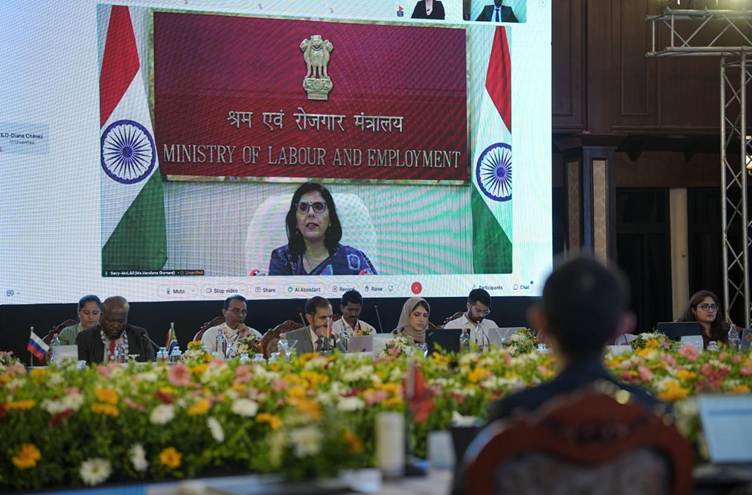
In her opening address, Secretary (Labour & Employment), Government of India, Ms. Vandana Gurnani emphasised the profound transformations reshaping the world of work. Technological acceleration, artificial intelligence, the green transition, demographic shifts, and the rapid expansion of gig and platform work are redefining labour markets across all BRICS nations. Secretary (L&E) highlighted the collective responsibility of BRICS member states to ensure that social protection systems adapt, women's participation accelerates, skills systems become responsive, and digital technologies serve inclusion.
During discussions on Priority Area I on advancing social security and labour market formalisation, it emerged clearly that a collective vision for an incremental progressive increase in social protection coverage by member states is achievable. BRICS nations together represent a significant share of the global workforce, and while notable progress has been made, coverage gaps continue to persist. The discussions reaffirmed that knowledge sharing, peer learning, and capacity building through mutual exchange of ideas, challenges, and solutions will be central to this effort.
The proposed BRICS Capacity Building Forum on Advancing Social Security was recognised as a timely and relevant mechanism. The Forum is envisaged to focus on capacity building on data architecture, technical exchanges for extending coverage to informal, self-employed, and gig workers, and exploring the possibility of developing methodological tools for addressing coverage gaps.
Turning to Priority Area II on enhancing women's participation and inclusion in the workforce, the discussions reaffirmed that while BRICS nations have made notable progress in enhancing women's workforce participation, though structural constraints remain which require sustained and coordinated action. BRICS member states advocated for strong and inclusive policy frameworks to drive women's participation in high-growth sectors and leadership pathways. Member countries called for a pragmatic, evidence-based approach, supported by voluntary cooperation and best-practice sharing, while respecting each member state's national priorities.
Deliberations on Priority Area III on employability, skills mapping, and development clearly highlighted the need for structured cooperation across BRICS. The proposed framework will focus on improving skills intelligence, enhancing comparability of qualifications, and facilitating knowledge exchange on digital, green, and care economy skills. Member states emphasised the need for collective and coordinated action on enhancing comparability of skills and qualifications. There was strong recognition that closer linkages between existing qualification frameworks, skills taxonomy, and vocational education systems are necessary to reduce skills mismatch and enhance labour mobility.
In the backdrop of rapid labour market transformations, member states proposed working towards promoting youth employability through expanded apprenticeships, internships, vocational education, entrepreneurship programmes, and targeted initiatives for youth not in education, employment, or training (NEET), with the objective of reducing the NEET rates.
During the deliberations, member states engaged in rich knowledge-sharing sessions, presenting innovative initiatives and best practices from their respective countries. The constructive spirit of collaboration, mutual learning, and South-South cooperation was widely appreciated, with delegations expressing confidence in the proposed outcomes.
*****
Rini Choudhury/Anjelina Alexander
(Release ID: 2258490)
Visitor Counter : 1040