Ministry of Panchayati Raj
Quality Gram Panchayat Development Plans and Digital Planning Tools in Focus at the Two-Day National Workshop in New Delhi
Posted On:
04 MAY 2026 5:56PM by PIB Delhi
A two-day National Workshop organized by the Ministry of Panchayati Raj on the Preparation of Panchayat Development Plans was inaugurated today in New Delhi. The inaugural session also witnessed the launch of the People’s Plan Campaign (PPC) booklet for Preparation of Panchayat Development Plan (2026-27), the Report of the Committee on Enhancing the Quality of Gram Panchayat Development Plan (GPDP) and the revamped eGramSwaraj planning portal. This workshop aims to strengthen participatory planning and improve the quality of Panchayat development plans, making them more effective, inclusive, and outcome-oriented. The workshop has brought together senior officials from Central Ministries, representatives from Panchayati Raj Departments and SIRD&PRs, Panchayat functionaries and other key stakeholders from across the country.
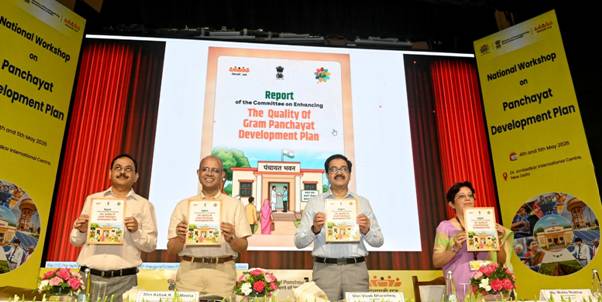
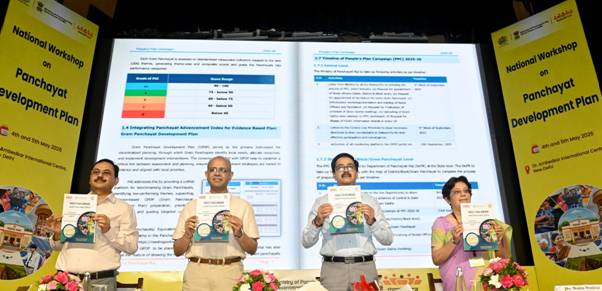
Delivering the keynote address, Shri Vivek Bharadwaj, Secretary, Ministry of Panchayati Raj stressed that preparation of the Gram Panchayat Development Plan should focus on quality outcomes that bring real change at the grassroots, rather than being treated as a mere compliance exercise. He noted that proper planning for asset creation through the GPDP would help prevent wastage of resources. Shri Bharadwaj further emphasized the need to strengthen Panchayat-led planning through sustainability, clear institutional responsibilities and effective utilization of resources. He also underlined the role of digital platforms in ensuring long-term service delivery at the grassroots level and highlighted that greater citizen participation in Gram Sabhas would make decision-making more inclusive.
Shri Ashok K.K. Meena, Secretary, Department of Drinking Water and Sanitation (DDWS), Ministry of Jal Shakti in his keynote address, noted that Jal Jeevan Mission and Swachh Bharat Mission (Grameen) have enabled large-scale infrastructure creation across the country. He stressed that the focus must now shift towards sustained operations, maintenance and effective use of these assets, with Gram Panchayats playing a central role in service delivery due to their close understanding of local needs. He highlighted that strong local planning is key to better basic services and called for GPDPs to be made dynamic and outcome-oriented, integrating resource use, asset upkeep, and digital transparency. He emphasized the importance of convergence across departments and the use of digital tools to improve accountability. Shri Meena also underlined the need to strengthen the role of Gram Panchayats and Village Health and Sanitation Committees, mobilizing own sources of revenue and embedding Operation & Maintenance in local planning (GPDPs) to ensure effective service delivery in rural areas.
In his address, Shri Sushil Kumar Lohani, Additional Secretary, Ministry of Panchayati Raj, highlighted the evolving nature of the GPDP and the need for thematic, quality-focused planning. He noted that despite the availability of funds, duplication of activities and weak convergence between Central and State schemes often leads to suboptimal outcomes. He drew attention to the 84 per cent increase in allocations to Rural Local Bodies under the 16th Finance Commission, emphasizing that Central grants are supplementary and not a substitute for State Finance Commission flows and Own Source Revenue of RLBs. He described the GPDP as a powerful tool for decentralized planning and underlined that focus will now be on quality, guided by 15 indicators developed by the Committee on Enhancing the Quality of GPDP and called for renewed emphasis on GPDP training.
Ms. Mukta Shekhar, Joint Secretary, Ministry of Panchayati Raj, presented an overview of the 16th Finance Commission grants framework, highlighting its reform-oriented approach to strengthening Panchayati Raj Institutions. She noted that ₹4.35 lakh crore has been allocated to Rural Local Bodies for 2026–31, linking funds with Panchayat Development Plans to support local priorities. She also outlined key action points for States, including onboarding on eGramSwaraj and AuditOnline, strengthening State Finance Commissions, integrating the SAMARTH platform and improving OSR reporting to ensure transparency, accountability and effective grassroots governance.
The first day of the workshop covered technical session that included presentations on strategic approaches to preparing thematic and high-quality PDPs, understanding 16th Finance Commission untied grants and their conditionalities, convergence of the Village Poverty Reduction Plan (VPRP) with GPDP through Self-Help Groups, preparation of PESA GPDP, hands-on orientation on the revamped eGramSwaraj portal and Gram Manchitra. On Day 2, the workshop will feature presentations on integrating the Panchayat Advancement Index (PAI) into evidence-based planning, followed by experience-sharing by State and UT teams on preparation of the GPDP on the revamped portal.
***
AA
(Release ID: 2257880)
Visitor Counter : 1944