Ministry of Fisheries, Animal Husbandry & Dairying
Sirsa, Haryana to review the status of saline water Aquaculture cluster notified under Pradhan Mantri Matsya Sampada Yojna (PMMSY)
Posted On:
08 APR 2026 4:10PM by PIB Delhi
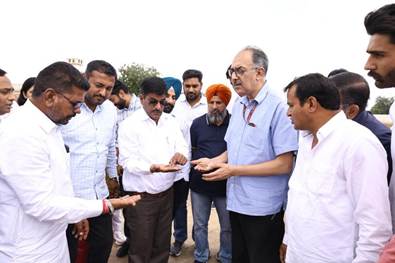
Dr. Abhilaksh Likhi, Secretary, Department of Fisheries, Ministry of Fisheries, Animal Husbandry and Dairying, Government of India, visited Sirsa District, Haryana on 8th April 2026 to review the progress of saline water Aquaculture Cluster notified under PMMSY and interact with shrimp farmers engaged in saline water aquaculture in the region. During the visit, the Union Secretary also interacted with shrimp and fish farmers. to understand the gaps and challenges faced on ground.
Addressing the Fish farmers, Dr. Likhi highlighted the importance of adopting technology‑driven shrimp farming practices, scientific pond management and robust bio‑security measures, along with sustained capacity building to enhance productivity, product quality and overall profitability. He emphasized that saline‑affected regions such as Sirsa possess significant potential for optimal land‑use through shrimp aquaculture, which can play a vital role in income diversification, employment generation and strengthening the rural economy. MPEDA was advised to provide the necessary technical guidance to help establish export linkages and to support capacity building for farmers. It was also highlighted that easy access to testing kits is essential, and the State was urged to ensure their availability locally so that shrimp farmers do not have to travel long distances for testing.
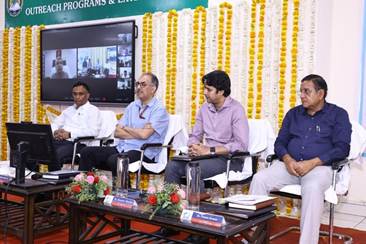
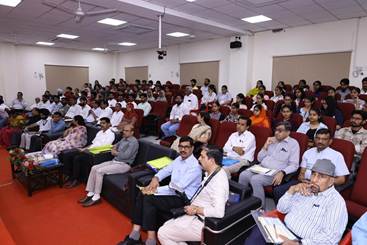
A review meeting was held in hybrid mode at Chaudhary Devi Lal University (CDLU), Sirsa, to review the progress of the overall implementation of cluster‑based fisheries development initiatives under Pradhan Mantri Matsya Sampada Yojana (PMMSY). The discussions focused on progress achieved, inter‑institutional coordination, convergence of schemes, and addressing implementation gaps at the cluster level. The meeting was attended by officials from the Department of Fisheries, Government of India and the Department of Fisheries, Government of Haryana, representatives of fisheries clusters from States and Union Territories, scientists from ICAR fisheries institutes, and representatives of NFDB, ICAR‑CIFE, MPEDA, NABARD, fish farmers, shrimp farmers, fisheries cooperatives, Fisheries universities and Fisheries colleges. The meeting witnessed participation from more than 500 participants.
During the meeting, the shrimp farmers highlighted several challenges, including the high cost and irregular availability of electricity, dependence on other States for quality seed, and inadequate water supply. They also requested that panchayat‑owned land be made available on lease to Self‑Help Groups (SHGs) to support expansion of shrimp farming activities.
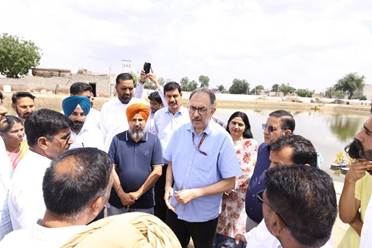
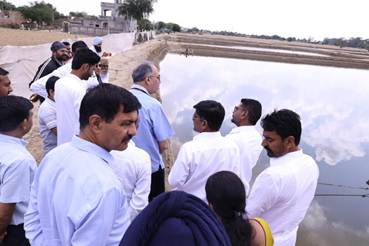
Dr. Abhilaksh Likhi, Secretary, Department of Fisheries, Government of India, visited Shrimp farm of Shri Preetpal Singh and Smt. Manpreet Kaur at village Raghuana, district Sirsa Haryana developed under PMMSY. The farm comprises of 7 ponds spread over around 3 hectares with a total project cost of ₹42 lakh. They are producing around 28 tonnes annually, generating a turnover of nearly ₹90 lakh and creating local employment opportunities. Interactions were held with shrimp farmers to assess the field‑level adoption of saline water aquaculture practices. The need to strengthen backward and forward linkages, including availability of quality seed and feed, improved farm infrastructure and access to organised markets, was underlined to support the sustainable scaling‑up of shrimp farming in inland saline areas.
Haryana has made notable progress under the Pradhan Mantri Matsya Sampada Yojana (PMMSY), attracting investments of ₹760.88 crore, including a central share of ₹262.17 crore. A total of ₹79.47 crore has been invested in technology infusion to harness inland aquaculture potential, leading to the establishment of 456 RAS and Biofloc systems. So far, 3,766 hectares of ponds, 2,204 hectares of saline and alkaline area interventions with a total outlay of ₹176.32 crore has been earmarked. In addition, an Integrated Aquapark with an outlay of ₹98.90 crore has been approved to support the State’s aquaculture growth.
The Deputy Commissioner announced the establishment of ₹110‑crore Integrated Aquapark in Sirsa, along with the development of cold‑chain infrastructure to strengthen post‑harvest handling and value‑addition. The District Magistrate also assured that the State Government would work in close coordination with the Centre to further strengthen and consolidate the fisheries cluster.
Shrimp continues to be India’s flagship seafood export, with frozen shrimp accounting for nearly 69% of the country’s marine products export basket by value during 2024–25. India’s marine products exports shave nearly doubled over the last decade, rising from ₹30,213 crore in 2013–14 to ₹62,408 crore in 2024–25, driven largely by shrimp exports valued at ₹43,334 crore. Notably, India’s seafood sector is supported by approximately 658 processing plants, 532 pre‑processing units, and a wide network of handling centres for fresh, chilled, live, dried, and salted fish, along with over 734 cold storage facilities across the country.
The department of fisheries, Government of India has notified 34 fisheries production and processing clusters across key areas including, Pearl cluster in Hazaribagh, Seaweed in Lakshadweep, Ornamental Fisheries in Madurai, Pearl cluster in Jharkhand, Reservoir Fisheries in Madhya Pradesh, Fishing Harbours ins Gujarat and Puducherry, Saline Water Aquaculture in Sirsa, Punjab and Rajasthan, Cold Water Fisheries in Jammu and Kashmir, Uttarakhand, Himachal Pradesh and Ladakh, Sea Cage Culture in Karnataka, Brackish-Water Fisheries in Andhra Pradesh, Tuna in Andaman & Nicobar Islands, Tilapia in Chhattisgarh, Organic Fisheries in Sikkim and Meghalaya, Wetland Fisheries in Bihar, Murrel in Telangana, Pearl Spot in Kerala, Scampi in Odisha, Pangasius in Uttar Pradesh, Dry Fish Cluster in West Bengal, Integrated fish farming cluster in Nagaland, Pengba Fish Cluster in Manipur, Riverine Fish Cluster in Assam, Paddy cum Fish Cluster in Mizoram, Aqua Tourism Cluster in Arunachal Pradesh, Estuarian Cage Cluster in Goa, Pabda Fisheries Cluster in Tripura and Fisheries Cooperatives Cluster in Maharashtra
The saline water cluster in Sirsa district, with Fatehabad, Hisar and Rohtak as partnering districts, demonstrates how region‑specific aquaculture development can unlock the productive potential of saline and alkaline areas. By promoting diversification into high‑value species such as shrimp, scampi and seabass, the cluster enables efficient resource use while enhancing farmer incomes, generating local employment and strengthening market linkages.
Background –
India’s inland fisheries sector has emerged as a cornerstone of national fish production, contributing 75% to the total production. In the fiscal year 2024–25, inland fish production stood at 153 lakh metric tonnes. Between 2013–14 and 2024–25, inland fisheries production surged by 150%, rising from 61 lakh tonnes to 153 lakh tonnes. This expansion has propelled India’s overall National fish production to 197.75 lakh tonnes, marking a 105% increase over the same period.
The potential of India’s inland water resources remains vast and largely untapped. With 1.95 lakh kilometres of rivers and canals, 6.06 lakh hectares of brackish water, 3.65 lakh hectares of beels and oxbow lakes, 27.56 lakh hectares of tanks and ponds, and 31.53 lakh hectares of reservoirs, the scope for sustainable inland fisheries development is immense. Recognizing this, the Government of India has placed inland fisheries at the heart of its strategic vision for the sector.
****
JP.
(Release ID: 2250030)
Visitor Counter : 1111