|
PIB Backgrounder
India’s Youth Dividend in the AI Era
Building a Future-Ready Talent Ecosystem
Posted On:
19 FEB 2026 9:24AM by PIB Delhi
Key Takeaways
- India’s demographic advantage is powering its AI transformation, with over 65% of the population under the age of 35 positioned at the centre of the country’s digital and innovation strategy.
- AI skilling is accelerating at scale, supported by national initiatives spanning schools, vocational platforms, advanced research fellowships, and industry partnerships.
- Affordable AI infrastructure and policy support under the IndiaAI Mission are democratising access to compute, data, and innovation opportunities beyond metropolitan cities.
- Youth-led innovation is moving from experimentation to global impact, positioning India as an emerging hub for responsible, inclusive, and use-case driven AI leadership.
Introduction
The India-AI Impact Summit 2026 commenced on 16th February 2026 with a powerful vision, placing India's youth at the heart of the nation's Artificial Intelligence (AI) journey. Far from a futuristic dream, the Summit spotlights AI as a transformative force already reshaping jobs and livelihoods. India has the largest youth population in the world, with over 65% of its population under the age of 35, positioning this demographic powerhouse as an engine of economic momentum.
The Summit reflects a shift from passive learning to active participation, redefining employment across sectors, spotlighting new skills, and the urgent need to sync education with industry needs. The focus is on boosting employability, enhancing productivity, and forging seamless bridges from classrooms to AI-driven careers.
At the India-AI Impact Summit 2026, young innovators are driving the agenda through hands-on platforms such as innovation challenges, startup pitches, and live solution demonstrations. These structured engagements connect skills with market needs and channel India’s youth potential into productive capacity. The Summit serves as a catalyst to accelerate job creation in emerging sectors, including Animation, Visual Effects, Gaming and Comics, which are projected to generate nearly 2 million jobs by 2030. By blending global insights with youth skilling and job creation, India is cementing the demographic dividend as the cornerstone of its AI strategy and a future-ready workforce.
AI as an Opportunity for India’s Talent Pool
AI is rapidly emerging as a transformative opportunity for India’s vast talent pool. By reshaping the employment landscape, AI is generating new roles, enhancing productivity, and expanding pathways for inclusive growth. India sees AI as a key lever to expand youth jobs and skills, blending emerging technology with inclusive growth and talent development.
Rising Demand for AI Skilling
Rising demand for AI skills and jobs is reshaping opportunities for young Indians. Between January 2023 and March 2025, AI-related job postings in South Asia increased from 2.9% to 6.5% of all vacancies, with demand for AI skills growing 75% faster than for non-AI roles. This shift signals a structural transformation in India’s labour market—one that increasingly rewards digital fluency, advanced technical capability, and interdisciplinary expertise. For India’s youth, AI is not merely a technological trend but a clear pathway toward skill-intensive, future-ready employment across technology and adjacent sectors.
Policy Push for AI-Ready Youth Skills
Recognising AI as a strategic employment driver, the Union Budget 2026–27 reinforced the government’s focus on AI skilling and talent development. The budget prioritised the Orange Economy, which overlaps with AI-driven fields like Animation, Gaming, Digital content, and Immersive media. It allocated support for the Indian Institute of Creative Technologies (IICT), Mumbai to establish AI-aligned Content Creator Labs in 15,000 schools and 500 colleges, opening pathways for youth to gain future-ready skills and enter AI-centric job roles. This initiative is projected to generate around 20 lakh new jobs, directly boosting employment prospects for students, creators, and young professionals across India.
The Budget also highlighted AI and emerging technologies as central to shaping jobs and skills across sectors. It proposed an Education to Employment and Enterprise Standing Committee to assess how AI and related tech affect jobs and skill requirements, aiming to bridge education, work and enterprise demand.
Democratising Access to AI Infrastructure
Expanding opportunity within India’s talent pool also requires equitable access to digital infrastructure. Under the IndiaAI Mission, the Government has allocated over ₹10,300 crore to strengthen AI capabilities and expand compute capacity beyond the existing 38,000 GPUs, with an additional 20,000 high-end GPUs to be added. Offered at a subsidised rate of ₹65 per hour, this compute access reduces entry barriers for startups, young innovators, and public institutions. By democratising access to compute, datasets, and model ecosystems, India is ensuring that AI opportunity is not confined to metropolitan hubs but is accessible to aspiring talent nationwide. The planned expansion to over 58,000 GPUs reinforces a national commitment to inclusion, responsible innovation, and broad-based participation in the AI economy.
By aligning skilling, innovation, and access, AI is becoming a powerful engine for youth-driven economic growth and global competitiveness.
National Efforts to Build a Skilled AI-Ready Talent Pool
The Government of India is building a comprehensive AI talent pipeline through coordinated interventions across school education, vocational training, higher education, and professional upskilling. These initiatives aim to equip youth with foundational, intermediate, and advanced AI capabilities aligned with industry demand.
Foundational AI Literacy in Schools
- National Education Policy (NEP) 2020: The NEP 2020 prioritizes digital and AI literacy as essential competencies, embedding computational thinking and AI concepts across all educational levels to prepare the next generation for rapid technological evolution. This holistic approach ensures early exposure to data-driven decision-making and ethical AI principles, fostering a culture of innovation from primary schooling onward and positioning Indian students as future-ready contributors to the global AI ecosystem.
- Artificial Intelligence and Computational Thinking (AI & CT): The AI & CT initiative redefines educational paradigms by reinforcing learning, thinking, and teaching methodologies, starting from Grade 3 and progressively advancing toward "AI for Public Good." This foundational initiative organically integrates ethical AI practices into curricula, enabling young learners to grasp algorithms, problem-solving, and societal applications early, thereby building cognitive resilience for an AI-dominated future.
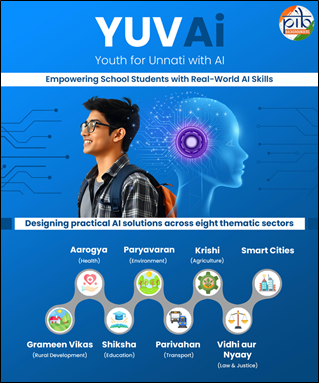
- YUVAi (Youth for Unnati with AI): MeitY's YUVAi, launched with the National e-Governance Division (NeGD), empowers Classes 8-12 students to design practical AI solutions across eight thematic sectors .
- YUVA AI for All: YUVA AI for All offers a free national AI literacy course in 11 languages (Assamese, Bengali, Gujarati, Hindi, Kannada, Malayalam, Marathi, Odia, Punjabi, Tamil, Telugu) accessible via DIKSHA, iGOT Karmayogi, and FutureSkills Prime, targeting 1 crore citizens for foundational AI proficiency. This mass-scale initiative democratizes knowledge, bridges urban-rural divides, and instills AI as a core life skill, amplifying public engagement and readiness for widespread technology adoption.
Vocational and Industry-Aligned Training
- Skill India Mission and SOAR Initiative: The Skill India Mission, led by the Ministry of Skill Development and Entrepreneurship (MSDE), integrates AI into vocational training, with the SOAR (Skilling for AI Readiness) initiative enrolling 1.34 lakh students and teachers by December 2025 through partnerships with Microsoft, HCL Technologies, and NASSCOM. Complemented by the President's #SkilltheNation challenge, it delivers foundational and applied AI courses, accelerating workforce transitions and boosting employability in high-demand tech sectors.
- FutureSkills Prime Initiative: The initiative, a collaboration between MeitY and NASSCOM, focuses on upskilling professionals in AI, big data, cloud computing and other emerging technologies. The initiative is aligned with National Occupational Standards (NOS) and National Skills Qualification Framework (NSQF), enabling learners to acquire in-demand skills that are highly valued by employers. With over 25.3 lakh registered learners and 3,000+ courses and pathways, the platform directly contributes to workforce transformation, enhancing employability and productivity across sectors.
- Skill India Digital Hub (SIDH): MSDE's Skill India Digital Hub (SIDH) unifies skill development on a single digital platform, providing AI and machine learning courses from introductory to advanced levels tailored to diverse learner proficiencies. By streamlining access to quality training, it supports lifelong learning, regional inclusion, and scalable upskilling, ensuring every aspiring professional can pivot toward AI-centric careers regardless of background or location.
Advanced AI Talent and Research Ecosystem
- IndiaAI FutureSkills: Under the IndiaAI Mission, IndiaAI FutureSkills builds an elite AI ecosystem through fellowships for undergraduates, postgraduates, and PhDs, alongside specialized skill-enhancement courses, supporting 500 PhD scholars, 5,000 postgraduates, and 8,000 undergraduates as of December 2025. This targeted intervention nurtures research talent, spurs innovation, and creates a sustainable supply of advanced AI experts to anchor India's leadership in cutting-edge technologies.
- IndiaAI Data and AI Labs: IndiaAI Data and AI Labs, with 27 facilities established via NIELIT in Tier-2/3 cities and approvals for 174 additional labs in ITIs and Polytechnics across 27 States/UTs, emphasize AI coursework, data curation, annotation, cleaning, and applied data science. These hubs decentralize high-end resources, foster grassroots research, and enable hands-on training, ensuring equitable distribution of AI capabilities beyond metros.
From classrooms to advanced labs, this multi-tiered architecture guarantees broad access, regional equity, and industry alignment, empowering India's youth for ethical AI innovation and active participation in the AI-driven economy.
|
Empowering Youth at the India-AI Impact Summit 2026
The India AI Impact Summit 2026 has positioned youth and inclusive talent development at the centre of India’s AI transformation journey. Through global challenges, innovation showcases, and policy dialogues, the Summit is highlighting how young innovators and women entrepreneurs are shaping responsible, scalable AI solutions for public good.
Youth at the Core of India’s Sovereign AI Vision:
At the India AI Impact Summit 2026, youth empowerment is embedded within the broader vision of advancing India’s Sovereign AI capabilities. The session on “Scaling Impact from India’s Sovereign AI and Data” highlighted the need to cultivate deep research talent, sustained innovation ecosystems, and indigenous AI models tailored to India’s linguistic and developmental contexts. Leaders stressed that young innovators must be equipped to build transparent, explainable, and nationally aligned AI systems that address real challenges. By connecting advanced AI research with priority sectors such as agriculture, healthcare, education, and financial inclusion, the Summit is positioning India’s youth as key drivers of globally competitive and socially impactful AI solutions.
From Algorithms to Outcomes:
At the Summit, youth engagement is being reinforced through a strong emphasis on building AI that delivers measurable public impact. In the session “From Algorithms to Outcomes,” Shri S. Krishnan, Secretary, MeitY, highlighted that the India AI Mission is designed to address real-world challenges by translating compute, models, and data into deployable applications. With over 600 startups and companies showcasing AI solutions across healthcare, agriculture, education, and manufacturing, the Summit offers young innovators direct exposure to scalable use cases and public sector problem-solving. Discussions with global experts underscored the importance of rigorous evaluation, responsible scaling, and evidence-based implementation, positioning youth not just as technologists, but as contributors to outcome-driven and citizen-centric AI systems.
YUVAi Global Youth Challenge:
YUVAi Global Youth Challenge, a flagship initiative under the IndiaAI Mission is empowering young innovators aged between 13–21 to build AI solutions aligned with the objectives- People, Planet and Progress. With over 2,500 applications from 38 countries, the Challenge showcased 70 high-potential teams addressing critical sectors such as healthcare, agriculture, climate resilience, accessibility, digital trust and smart mobility. Winning teams received national recognition along with financial awards and structured ecosystem support, including mentorship, incubation and industry linkages. Through rigorous evaluation focused on technical robustness, deployment readiness and social impact, the Summit is demonstrating how youth-led AI innovation can transition from prototype to scalable public-good solutions, strengthening India’s leadership in responsible and inclusive AI.
AI by HER Global Impact Challenge:
The AI By HER Global Impact Challenge positioned women and young innovators at the forefront of India’s responsible AI movement. Through panel discussions, startup showcases, and rapid spotlight pitches, the programme demonstrated how empathy-driven innovation can translate into scalable solutions across healthcare, climate resilience, education, fintech, security, and digital public infrastructure. From school-level problem solvers to deep-tech founders, participants highlighted how AI anchored in trust, sector-specific design, and strong digital public infrastructure can deliver measurable societal outcomes. The announcement of a dedicated capacity-building programme for 150 women-led AI startups further reinforced the Summit’s commitment to moving from access to acceleration, ensuring that youth and women innovators are supported from ideation to scale.
Global Dialogue on AI Usage – Data for Labour Market Resilience:
The session on “Global Dialogue on AI Usage – Data for Labour Market Resilience” on the second day of the India AI Impact Summit 2026 focused on the changing nature of work and job scenarios in the context of accelerating artificial intelligence adoption and the policy choices required to manage this transition. Drawing on emerging international evidence, the discussion noted differentiated impacts across age groups, sectors, and geographies, with early trends indicating employment pressures for younger workers in roles with higher AI exposure.
AI Impact Startup Book:
The launch of the AI Impact Startup Book marked a significant step in empowering young entrepreneurs by providing a consolidated repository of over 100 AI solutions developed across India. The compendium highlights innovation across healthcare, agriculture, education, foundation models, and edge AI, showcasing the growing maturity and global footprint of Indian startups. By creating a structured mechanism to evaluate and scale impactful use cases across ministries and states, the initiative enables young innovators to transition from pilot projects to population-scale deployment. Emphasising the goal of making India the “use-case capital” over the next 12–18 months, the Summit reinforced its commitment to converting youth-led AI innovation into measurable, real-world outcomes.
Collectively, these initiatives reaffirm India’s commitment to building a future-ready, inclusive AI ecosystem powered by youth leadership and gender diversity. By combining innovation platforms with policy engagement and ecosystem support, the Summit strengthened pathways for young talent to drive sustainable growth and global AI impact.
|
Global Indicators of India’s Talent-Pool Leadership in AI
India, on the path of the vision- Viksit Bharat by 2047, has over 50% of the startups now emerging from beyond metropolitan cities, dispelling the myth that innovation is confined to metropolitan cities in India.
Global Indicators Reflecting Youth-Led AI Leadership:
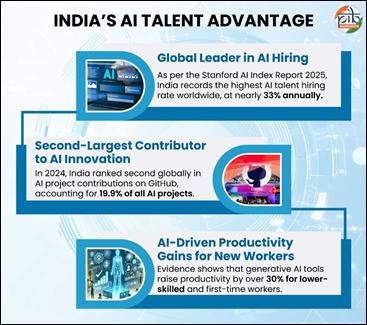
- High penetration of AI skills: According to the Stanford Global AI Index Report 2025, India’s relative penetration of AI skills is 2.5 times higher than the global average across comparable occupations, reflecting the impact of early and broad-based skilling initiatives.
- Widespread enterprise adoption: As per the NASSCOM AI Adoption Index, 87% of enterprises in India are actively using AI solutions, creating sustained demand for AI-ready youth and strengthening school-to-work linkages.
- Demographic advantage: India possesses one of the world’s largest pools of digitally adaptable youth, enabling large-scale participation in AI learning and innovation programmes such as YUVAi.
|
Guinness World Record at the India-AI Impact Summit
Youth engagement extended beyond innovation to responsible AI adoption, as India set a Guinness World Record with over 2.5 lakh AI Responsibility Pledges in 24 hours. Led under the IndiaAI Mission in collaboration with Intel India, the nationwide campaign mobilised students and citizens to commit to ethical, transparent, and accountable AI use. By encouraging reflection on data privacy, misinformation, and accountability through interactive scenarios, the initiative positioned young people as stewards of trustworthy AI. The overwhelming participation underscores a growing culture of responsible digital citizenship, reinforcing India’s vision of a human-centric and ethically grounded AI ecosystem.
|
Together, these indicators underline how YUVAi operates within a broader national ecosystem that is globally competitive and future-oriented. By linking early AI exposure with strong global rankings, enterprise adoption, and demographic scale, India is positioning its youth as active participants and future leaders in the global AI landscape, reinforcing the country’s role as a trusted hub for responsible and inclusive artificial intelligence.
Conclusion
India’s youth dividend is emerging as a defining strength in the age of Artificial Intelligence. Through sustained policy support, large-scale skilling initiatives, and democratised digital infrastructure, the country is transforming its demographic advantage into a globally competitive talent ecosystem. The India AI Impact Summit 2026 underscores how youth-led innovation, responsible AI adoption, and industry alignment are converging to drive inclusive and outcome-oriented growth. As India advances towards a Viksit Bharat, empowering its young population with AI capabilities will remain central to long-term productivity, resilience, and global leadership.
References
Ministry of Electronics and IT
Ministry of Information and Broadcasting
Ministry of Science and Technology
https://www.pib.gov.in/PressReleasePage.aspx?PRID=2217689®=3&lang=1
PIB Headquarters
Click here to see PDF
PIB Research
(Release ID: 2230044)
|