PIB Backgrounder
Strengthening Groundwater Management for India’s Water Future
Posted On:
22 JAN 2026 12:32PM by PIB Delhi
- India has a network of 43,228 groundwater level monitoring stations, 712 Jal Shakti Kendras, and 53,264 Atal Jal Water Quality Monitoring Stations
- Initiatives such as the Jal Shakti Abhiyan: Catch the Rain (JSA: CTR), Jal Sanchay Jan Bhagidari (JSJB), Atal Bhujal Yojana (Atal Jal), and Mission Amrit Sarovar are showing significant progress in groundwater management.
- Effective groundwater management is essential for advancing the Sustainable Development Goals, particularly SDG 6, SDG 11, and SDG 12.
|
Groundwater comprises nearly 99% of Earth’s liquid freshwater and offers substantial social, economic, and environmental benefits, including climate resilience. In India, the groundwater serves as the primary foundation of agricultural activity and drinking water supply, meeting nearly 62% of irrigation needs, 85% of rural consumption, and 50% of urban demand. Rapid population growth, agrarian intensification, industrial expansion, and urbanisation have collectively intensified pressure on groundwater systems in the country. In this context, the adoption of scientifically informed and sustainable groundwater management practices has become imperative. While water governance lies within the purview of State Governments, the Central Government, notably through the Ministry of Jal Shakti and associated ministries, plays a facilitative role by extending coordinated technical and financial support through various schemes and programmes, designed to reinforce conservation, regulation, and enduring groundwater management across the nation.
Groundwater Management for Sustainability and Long-term Security
|
Understanding Groundwater
Groundwater is a freshwater that seeps into soil and rocks, where it is stored underground before naturally emerging or being drawn for human use. It maintains water levels in many rivers and streams, and it strongly influences the habitats of wetlands for plants and animals. The underground layer that can store and transmit ground water in sufficient quantities is called as Aquifer. The water from aquifers can flow out naturally, contributing to springs, streams and rivers or it may be pumped through dug wells, tube well and borewells.
Groundwater Management - Elements and Priorities
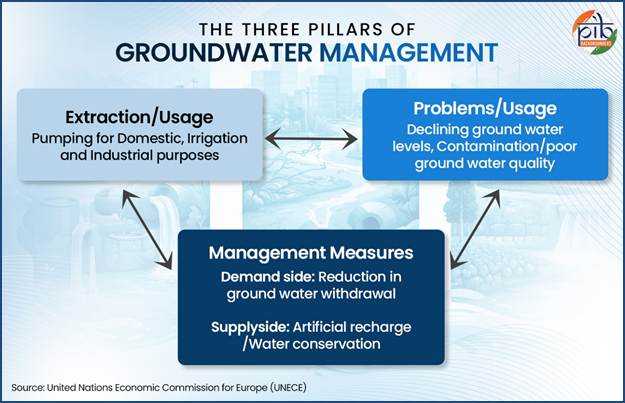
Groundwater management is a part of integrated water resources management and protection. The core foundations in groundwater management are the functions and uses of groundwater (aquifers), the problems and pressures (threats) acting upon them, and the impact of management measures on the overall functioning of the sustainability of the groundwater system.
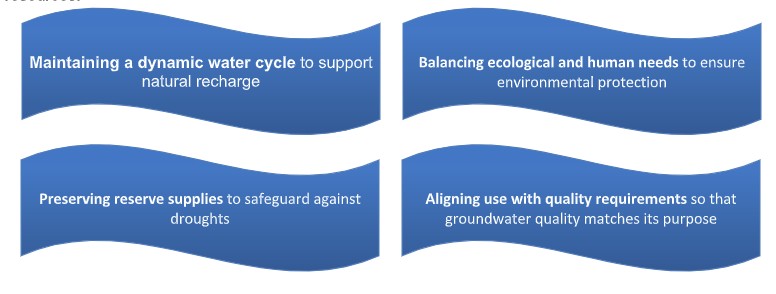
As per the United Nations Educational, Scientific and Cultural Organization (UNESCO), effective groundwater management needs 4 key priorities to ensure sustainable and balanced use of groundwater resources:
Necessity for Groundwater Management
India possesses extensive groundwater reserves whose physical characteristics and availability vary widely across regions, yet in recent decades these resources have faced growing stress from excessive extraction, declining quality, and limited regulation, raising serious concerns about long-term sustainability.
- Rising pressure on groundwater systems: Intensive and largely unregulated pumping has led to rapid and widespread declines in water tables across many parts of the country, signifying growing dependence on subsurface sources.
- Degradation of water quality: Contamination arising from mining activities, industrial effluents, and agricultural practices, combined with naturally occurring elements such as arsenic and fluoride, has progressively impaired groundwater quality, posing long-term environmental and public health risks.
- Drivers of uncontrolled abstraction: The sharp increase in groundwater extraction has been driven by the availability of affordable drilling techniques and pumping technologies, enabling even small farmers and low-income households to construct and operate private tube wells.
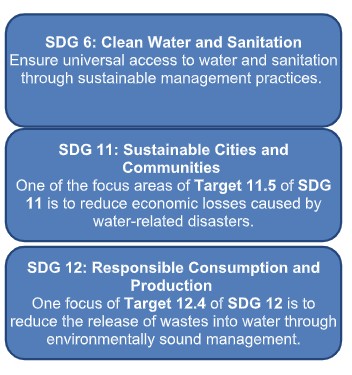
The growing groundwater crisis has strengthened the Government’s commitment to effective management, reaffirmed by India’s COP 21 commitment to climate resilience and long-term growth. Effective groundwater management is vital for achieving the Sustainable Development Goals, especially SDG 6, SDG 11, and SDG 12.
Government Initiatives Strengthening Groundwater Management
|
In response to escalating groundwater stress and the need for sustainable water security, the Government of India has launched a comprehensive set of policies, programmes, and community-driven initiatives aimed at strengthening groundwater management, enhancing recharge and conservation, improving scientific assessment, and promoting participatory and outcome-oriented groundwater management across India.
Model Groundwater (Regulation and Control of Development and Management) Bill
Groundwater resources require effective regulation and management to prevent indiscriminate extraction and to promote sustainable practices such as rainwater harvesting and artificial recharge. In light of these considerations, the Central Government prepared a Model Groundwater Bill to provide a regulatory framework for the control and management of groundwater resources by States.
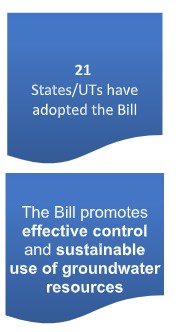
- The Model Bill has been shared with all States and Union Territories, and so far, 21 of them have adopted it, including Bihar, Punjab, Haryana, and Himachal Pradesh.
- The Centre actively engages with State governments to promote prudent regulation and sustainable management of groundwater resources.
- This engagement is undertaken through regular correspondence, seminars, conferences of State Water Ministers and Chief Secretaries, and deliberations under the National Interdepartmental Steering Committee (NISC) on Groundwater, chaired by the Secretary, Department of Water Resources.
Jal Shakti Abhiyan: Catch the Rain (JSA: CTR)
The JSA: CTR campaign was launched on 22 March 2021, coinciding with World Water Day. The campaign works towards building nationwide awareness and nurturing collective action on water conservation, strengthening the message that every drop counts. It encourages citizens across the country to contribute to the preservation of India’s water future through practical measures and community-level engagement.
- Five focused interventions, of JSA: CTR, include (i) water conservation and rainwater harvesting; (ii) identification, geo-tagging, and preparation of an inventory of all water bodies, along with scientific planning for water conservation; (iii) setting up Jal Shakti Kendras in all districts; (iv) concentrated afforestation; and (v) awareness generation.
- One of the key interventions under the JSA: CTR is the revitalisation of abandoned and defunct borewells for enhancing groundwater recharge, supported by other focused interventions implemented across the country.
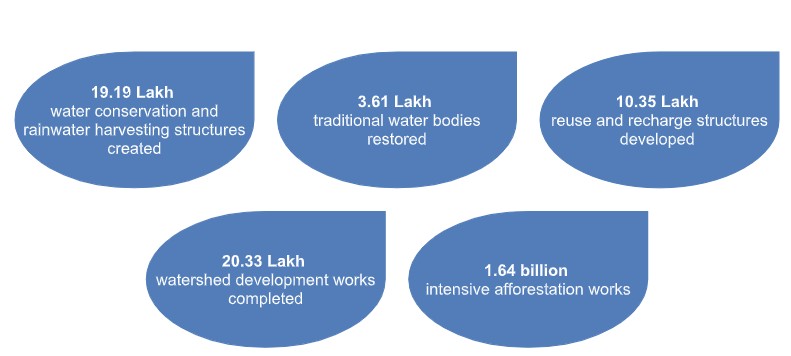
- Progress under JSA: CTR, since March 2021 to January 2026:
Jal Sanchay Jan Bhagidari (JSJB)
The Jal Sanchay Jan Bhagidari (JSJB) initiative was launched under the JSA: CTR campaign on 6 September 2024.
- The initiative seeks to improve groundwater recharge through measures such as rainwater harvesting, aquifer recharge, borewell recharge, and recharge shafts.
- It is designed as a scalable and sustainable model to address declining groundwater levels at the local level and integrates advanced monitoring systems to support groundwater recharge and promote responsible groundwater management and sustainable water use.
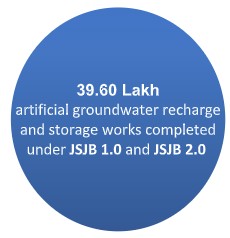
- As of 22 January 2026, the total number of artificial groundwater recharge and storage works completed cumulatively under JSJB 1.0 and JSJB 2.0 stands at 39,60,333.
National Aquifer Mapping and Management Programme (NAQUIM)
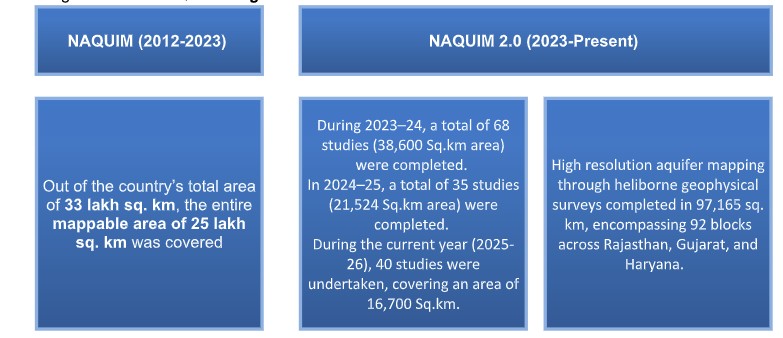
- To support effective groundwater management in the country, the NAQUIM (2012-2023) programme was undertaken with the objectives of:
§ Characterising aquifers based on hydrogeological properties
§ Assessing groundwater availability and quality
§ Preparing detailed aquifer maps
- NAQUIM 2.0: Building on the experience of NAQUIM, the Central Ground Water Board (CGWB) implements NAQUIM 2.0 (2023-Present) to strengthen groundwater management by:
- Providing high-granularity data density on groundwater levels and quality
- Delivering issue-based scientific inputs up to the Panchayat level
- The programme targets water-stressed, coastal, urban, spring-shed, industrial and mining, command, deep aquifer, auto flow, and poor-quality groundwater areas, with area-specific and user-focused outputs.
- Progress under NAQUIM Programme:
Master Plan for Artificial Recharge to Groundwater-2020
- The Master Plan for Artificial Recharge to Groundwater 2020 promotes terrain-specific recharge techniques based on water availability and aquifer storage capacity.
- It addresses regional groundwater challenges, including overextraction, arid zone scarcity, low retention in hills, and urban recharge constraints.
- In rural areas, emphasis is placed on surface spreading and subsurface recharge methods to utilise surplus monsoon runoff effectively.
- In urban, hilly, and coastal regions, priority is given to rainwater conservation through rooftop harvesting and allied measures.
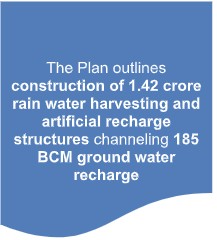
- The Plan also provides a broad outline for the construction of around 1.42 crore rainwater harvesting and artificial recharge structures in the country to channel 185 BCM (Billion cubic meter) groundwater recharge.
Atal Bhujal Yojana (Atal Jal)
Atal Bhujal Yojana (Atal Jal) focuses on promoting community-led sustainable groundwater management in water-stressed areas of 7 States, namely Gujarat, Haryana, Karnataka, Madhya Pradesh, Maharashtra, Rajasthan, and Uttar Pradesh. Launched on 25 December 2019, the scheme supports water source sustainability for the Jal Jeevan Mission. It also supports the Government’s goal of doubling farmers’ income and encourages responsible water use within communities. It further facilitates creating awareness, building local capacity, coordinating with other government schemes, and promoting improved agricultural practices.
- Under the scheme, incentives to State Governments are supported by a strong database, scientific planning, and community involvement for appropriate investments.
- Under the Project Implementation Plan of five years, the total financial outlay of ₹6,000 crore is distributed between Component A (₹1,400 crore) for institutional strengthening and Component B (₹4,600 crore) for incentive-based outcomes, reflecting a strong results-oriented design.
- Progress under Atal Bhujal Yojana, as on 20 January 2026:
|
State
|
Improvement in Rate of Groundwater Decline (m/year)
|
Area under Efficient Water Use (Ha)
|
Digital Water Level Recorder (DWLR) Installed
|
Digital / Analog Water Level Indicators Installed
|
|
Gujarat
|
20
|
58,470.19
|
828
|
2001
|
|
Haryana
|
18
|
1,77,454.25
|
1,165
|
1669
|
|
Karnataka
|
23
|
1,86,595.22
|
970
|
410
|
|
Madhya Pradesh
|
5
|
13,493.24
|
669
|
670
|
|
Maharashtra
|
16
|
1,31,372.06
|
1,129
|
1133
|
|
Rajasthan
|
20
|
74,352.07
|
960
|
1144
|
|
Uttar Pradesh
|
6
|
26,945.97
|
550
|
392
|
|
Total
|
108
|
6,68,683.00
|
6271
|
7419
|
Source: Ministry of Jal Shakti
Mission Amrit Sarovar
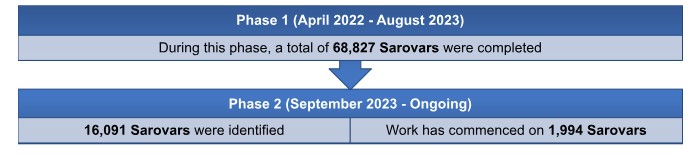
Launched on 24 April 2022, Mission Amrit Sarovar supports the creation of Amrit Sarovars (ponds) across all districts in the country. Each pond is planned to have a minimum area of one acre (0.4 hectare) and a water storage capacity of about 10,000 cubic metres.
- The mission aspires to enhance water conservation, expand irrigated area, and improve groundwater levels, with the rejuvenation and construction of Amrit Sarovars supporting natural groundwater recharge.
- Progress under Mission Amrit Sarovar, as on 22 January 2026:
India’s Groundwater Infrastructure for Monitoring, Restoring, and Knowledge Support
|
- India has a network of 43,228 groundwater level monitoring stations, comprising stations operated by the Central Ground Water Board (CGWB). The CGWB regularly monitors groundwater levels nationwide through its regional network of observation wells.
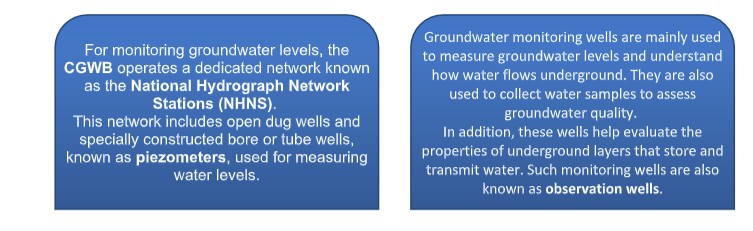
- Under the Atal Bhujal Yojana (Atal Jal), an extensive monitoring, recharge, and data infrastructure has been established to support sustainable groundwater management (as on 30 December 2025):
|
Infrastructure
|
Availability Status
|
|
Water Quality Monitoring Stations
|
53,264
|
|
Artificial Recharge and Water Conservation Structures
|
97,742
|
|
Piezometer (Atal Jal)
|
6,519
|
|
Rain Gauge Stations
|
8,201
|
|
Water Flow Meters
|
32,286
|
|
Well Registered
|
15,03,711
|
|
Water Quality Monitoring (Through Field Testing Kit)
|
1,15,358
|
Ministry of Jal Shakti
- Jal Shakti Kendra (JSK) functions as a district-level technical guidance centre, advising stakeholders on rainwater harvesting and serving as a knowledge hub for disseminating information and providing technical support on water conservation practices. As of 30 December 2025, a total of 712 Jal Shakti Kendras (JSKs) are operational across India.
Conclusion2016 Model Bill for the Conservation, Protection, Regulation and Management of Groundwater 2016
|
Groundwater is central to India’s water security, sustaining agriculture, drinking water supply, ecosystems, and agricultural activity, yet increasing pressures from overextraction, quality degradation, and climate variability have made sustainable groundwater management imperative. In response, India has embraced a comprehensive and multi-layered approach combining policy reform, scientific assessment, infrastructure creation, and community participation, led by the Ministry of Jal Shakti.
Key initiatives such as the Model Bill on Groundwater, Jal Shakti Abhiyan: Catch the Rain, Jal Sanchay Jan Bhagidari, NAQUIM 2.0, the Master Plan for Artificial Recharge to Groundwater 2020, Atal Bhujal Yojana, and Mission Amrit Sarovar jointly reinforce recharge, monitoring, regulation, and demand side management.
Supported by an extensive network of groundwater monitoring stations, advanced data systems, and local knowledge centres, these efforts mark a transition towards scientifically informed, participatory, and outcome-oriented groundwater governance, establishing a durable framework for long term sustainability, climate resilience, and the achievement of national development goals.
References
Parliament of India
Comptroller and Auditor General of India
Economic Advisory Council to the Prime Minister (EAC-PM), Government of India
Ministry of Jal Shakti
Ministry of Electronics and Information Technology
Central Ground Water Board (CGWB), Ministry of Jal Shakti
Central Water Commission (CWC), Ministry of Jal Shakti
Press Information Bureau
United Nations
United Nations Educational Scientific and Cultural Organization (UNESCO)
United Nations Economic Commission for Europe (UNECE)
World Bank
United States Department of the Interior, U.S. Geological Survey (USGS)
U.S. Environmental Protection Agency (US EPA)
California Department of Water Resources
Click here to see in PDF
PIB Research
(Release ID: 2217195)
Visitor Counter : 7198