PIB Backgrounder
Labour Reforms: Formalising and Safeguarding India’s Gig & Platform Workforce
Posted On:
09 DEC 2025 1:14PM by PIB Delhi
Key Takeaways
- Gig & platform workers are formally recognised under labour law
- Social security benefits include life & disability cover, health & maternity benefits, pension, accident insurance, and crèche.
- Aggregators contribute to a Social Security Fund, and facilitation centre to address worker grievances to be setup by Government.
- Each worker gets a unique Aadhaar-linked ID on e-Shram, making benefits portable across platforms.
|
A Landmark Reform for India’s Gig Economy
India’s rapidly expanding Gig and Platform workforce has emerged as a crucial driver of the new economic ecosystem, powered by young demographics, digital adoption, and rapid urbanization. Recognizing their role, the Code on Social Security, 2020 (SS) (one of the four labour codes implemented in a recent labour reform) formally brings Gig and Platform workers under a broader protection umbrella. The reform institutionalises long-overdue security for a workforce that has long powered India’s digital economy without commensurate protections.
Empowering Gig and Platform Workers
By providing legal recognition, portable social security benefits, a dedicated welfare fund, and a national registration framework, the enhanced provisions equip gig and platform workers with essential safeguards, empower them with portable rights, and transform informal work into a secure, recognised, and sustainable livelihood.
Legal Recognition
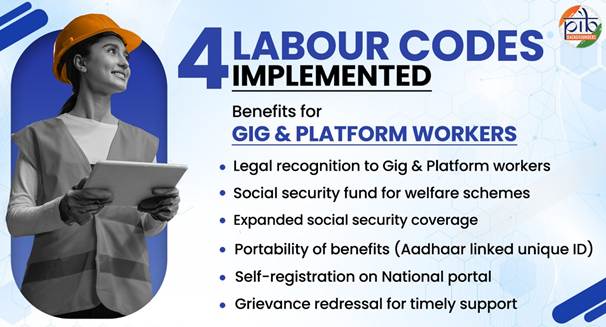
With no recognition under the Payment of Wages Act (1936), Minimum Wages Act (1948), EPF Act, or ESI Act, Gig and Platform workers were considered a part of the informal or unorganised sector. The SS Code for the first time, provides a formal recognition to Gig workers and Platform workers, bringing them under the ambit of social security and legal protection. Moreover, certain definitions have also been included to augment the recognition:
- “Aggregator” - a digital intermediary or a market place for a buyer or user of a service to connect with the seller or the service provider;
- ‘Gig worker’- a person who performs work or participates in a work arrangement and earns from such activities outside of traditional employer-employee relationship;
- ‘Platform worker’ – a person engaged in or undertaking platform work and;
- ‘Platform work’ - work arrangement outside of a traditional employer-employee relationship in which organisations or individuals use an online platform to access other organisations or individuals to solve specific problems or to provide specific services or any such other activities which may be notified by the Central Government, in exchange for payment.
Welfare / Social Security Fund
Under the SS Code, aggregators are now required to contribute 1-2% of their annual turnover (capped at 5% of payments made or payable to gig/platform workers) to a Social Security Fund. The fund finances a range of welfare schemes for these workers, where earlier, these workers bore all risks themselves, with no obligation on aggregators to contribute to their welfare. The Code has provisions for multiple financing mechanism, from the Government, CSR initiatives, etc.
Social Security Schemes
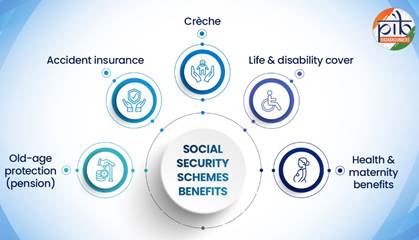
Once dependent solely on voluntary schemes or CSR initiatives, with no statutory entitlement to PF, ESI, pension or insurance, Gig & Platform workers now become eligible for government-notified social security benefits such as accident insurance, health and maternity benefits, any other benefits. This landmark reform shifts these workers from being invisible in the legal framework to becoming part of a formal social security framework.
Portability of Benefits
Gig and platform workers can continue to enjoy their social security benefits even when switching jobs or platforms, ensuring continuity and security. These benefits were lost previously, while switching jobs. However, now each worker will receive a unique Aadhaar-linked ID generated through registration on e-Shram, allowing their social security benefits to be portable across platforms. Whether juggling multiple platforms or moving from one Platform to another, workers retain a unified set of benefits that continues seamlessly.
Registration & Database
Gig and platform workers can self-register on the Government e-Shram portal, creating a comprehensive national database that supports social security, skill development, targeted delivery of welfare delivery and policy making.
Grievance Redressal
Earlier, Gig and Platform workers had no access to formal labour laws and therefore, no structured grievance redressal mechanism. Under the SS Code, the appropriate Government may set-up a toll-free helpline, call centre, or facilitation centre to address worker grievances and ensure timely support.
Transforming the Gig Economy: From Informal to Protected
Gig and platform workers, once largely invisible, highly vulnerable and without uniform benefits, now gain a baseline of protections and social security coverage. This reform marks a major step towards formalising the Gig economy, granting these workers legal recognition, tangible support, and access to welfare schemes that were long missing. By establishing a dedicated Social Security Fund, portable benefits, and a national registration framework through e-Shram, the Code on Social Security, 2020, not only safeguards today’s workforce but also lays the foundation for a more inclusive, resilient, and future-ready gig economy.
Click here to see PDF
M
(Release ID: 2200767)
Visitor Counter : 15246