Ministry of Communications
Union Minister Shri Jyotiraditya M. Scindia Inaugurates AI for Good Lab Workshop at India Mobile Congress 2026
"The True Measure of AI Will Not Be Model Size, But the Number of Lives It Improves": Union Minister Shri Scindia
India Partners as Pilot Country with ITU to Bridge the Gap between AI Strategy and Impact Across the Global South
प्रविष्टि तिथि:
09 OCT 2026 6:17PM by PIB Delhi
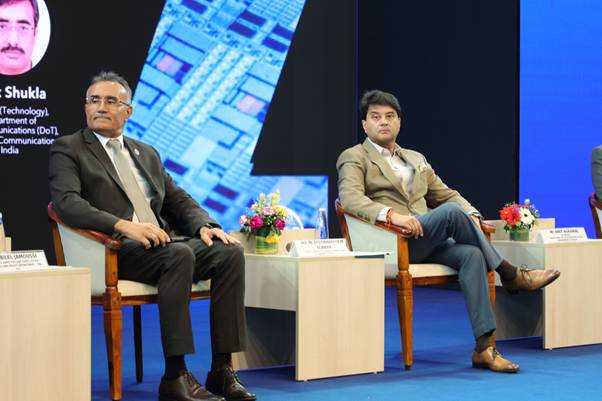
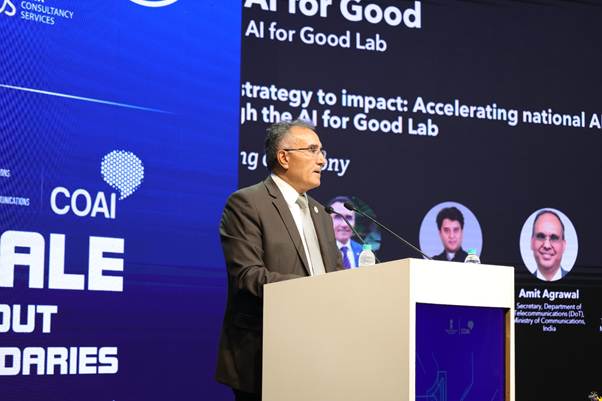
Union Minister for Communications and Development of North Eastern Region Shri Jyotiraditya M. Scindia inaugurated "AI for Good Lab Workshop: From Strategy to Impact," organized jointly by the Department of Telecommunications (DoT), Ministry of Communications, and the International Telecommunication Union (ITU) at the India Mobile Congress (IMC) 2026 in New Delhi. The landmark event marked a major milestone in transitioning artificial intelligence from global strategy discussions to practical deployment, local solutions, and human-centric scale. The workshop gathered key international dignitaries, including Dr. Bilel Jamoussi, Deputy Director of the ITU Telecommunication Standardization Bureau, Shri Amit Agrawal, Secretary, Department of Telecommunications along with distinguished researchers, innovators, industry leaders, and policy experts.
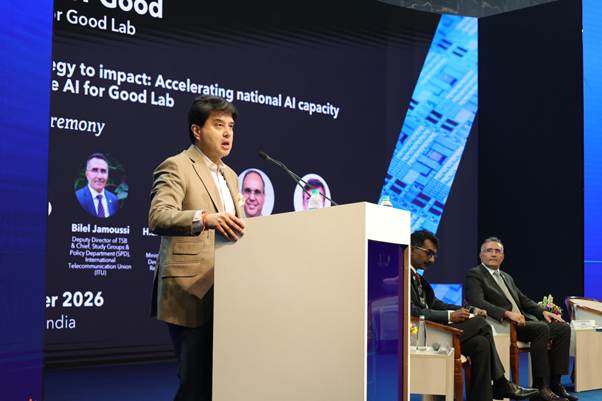
Addressing the gathering, the Union Minister Shri Scindia stated, “The journey of the AI for Good Lab from Geneva to New Delhi mirrors the journey that artificial intelligence itself must make—from global conversations to local solutions, from technological possibility to human impact, and from strategy to scale. The distance between AI ambition and AI impact is bridged by skills, compute, data, institutions, and connectivity. Ultimately, the true measure of artificial intelligence will not be the size of its models or the sophistication of its algorithms, but the number of human lives it improves.”
The Union Minister reiterated India's guiding philosophy of "Sarvajan Hitaya, Sarvajan Sukhaya" (for the welfare of all, for the happiness of all), noting that while nearly 2.2 billion people worldwide remain offline, technology must expand human opportunity rather than concentrate it, ensuring the digital divide does not morph into an AI divide.
During the address, the Minister detailed key milestones driving India's domestic AI capabilities and digital infrastructure under the ₹10,000-crore-plus IndiaAI Mission. On the compute infrastructure front, more than 38,000 high-end GPUs have been onboarded at approximately one-third of the global average cost, with an additional 20,000 GPUs being added. In terms of open data and talent, the AI Kosh platform is unlocking datasets and sovereign models across agriculture, healthcare, and education. India currently ranks first globally in relative AI skill penetration, with Indian developers contributing approximately 5.2% of open-source AI projects on GitHub with ten or more stars. Furthermore, telecom innovation is being paired with trust through AI and data analytics tools like Sanchar Saathi, which has facilitated the disconnection of over 7.14 crore fraudulent mobile connections, traced over 35 lakh lost handsets, and prevented potential financial fraud worth over ₹5,000 crore. To support standardization, India's Telecommunication Engineering Centre (TEC) has developed national standards covering AI fairness, robustness, and incident reporting, while establishing a National Working Group on AI Standardization to align with ITU-T global benchmarks.
The workshop introduced the AI for Good Lab framework, designed to help countries overcome challenges related to limited skills, fragmented innovation, and missing infrastructure through three interconnected pillars. First, the AI Readiness and Policy pillar assesses policy gaps and establishes practical governance frameworks. Second, the AI Skills Development pillar focuses on scaling national AI talent, capacity-building, and training initiatives. Third, the Public AI Infrastructure pillar establishes standards-based, interoperable AI Sandbox environments for testing, validating, scaling, and re-using locally relevant AI solutions. As one of the ten pilot countries alongside partners from Africa, Asia, Latin America, and the Gulf, India brings its model of shared compute, open datasets, and Digital Public Infrastructure (DPI) to lead cross-regional learning and technical collaboration across the Global South.
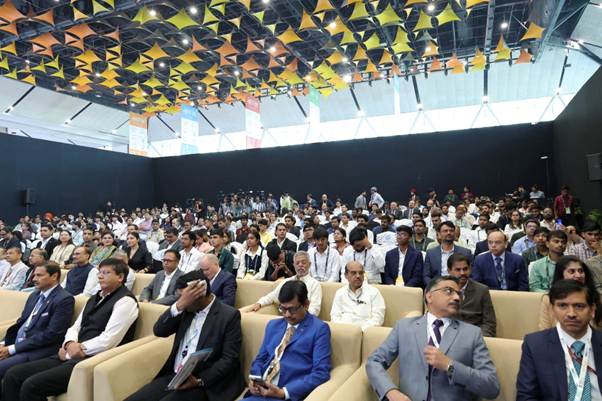
The sessions delivered structured deliberation on defining a concrete roadmap for institutional engagement, priority sector adoption, and Global South knowledge-sharing. Stakeholders achieved a shared understanding of the AI Sandbox requirements to support experimentation while validating fairness, robustness, and safety before scaling solutions to the last citizen.
The workshop concluded with a summary by Dr. Bilel Jamoussi, followed by a Call for Follow-up Actions by Shri Sanjeev Kumar Sharma, Deputy Director General, AI & Digital Intelligence Unit, DoT, and special address by Shri S. T. Abbas, Sr. Deputy Director General, TEC.
The workshop reinforced the importance of sustained collaboration among Government, industry, academia, startups, civil society and international organisations to build an AI ecosystem that is innovative, inclusive, secure, trusted and beneficial for all. The discussions provided a strong foundation for moving from dialogue to implementation, from vision to action and from isolated initiatives to a collaborative movement for AI for Good and AI for All.
*****
NJ/AR
(रिलीज़ आईडी: 2321480)
आगंतुक पटल : 186