PIB Backgrounder
When Swachhata Became a People’s Movement
Collective Action and Behaviour Change Transforming Rural Sanitation
प्रविष्टि तिथि:
20 SEP 2026 12:04PM by PIB Delhi
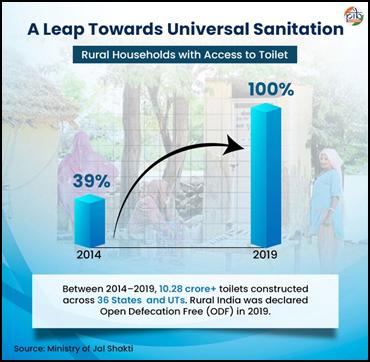
For decades, rural sanitation remained a persistent development concern nationwide. Sanitation coverage stood at 39 percent when the Swachh Bharat Mission (SBM) began in 2014. By 2019, rural India had achieved 100 percent sanitation coverage. More than 10.28 crore toilets were constructed across 36 states and union territories between 2014 and 2019. Rural India was subsequently declared Open Defecation Free (ODF) in 2019. This achievement transformed the nature of India’s sanitation landscape. The focus shifted from an emphasis on household toilet access to a broader concern with the sustainability of sanitation practices and the management of waste at the village level. This became the focus of Swachh Bharat Mission-Gramin Phase II. It focuses on sustaining ODF status and strengthening Solid and Liquid Waste Management systems.
The impact of this focus is now visible in India’s villages. An ODF Plus village not only sustains ODF status but also effectively manages solid and liquid waste, while maintaining visual cleanliness. Along with sustaining ODF Plus village status, these villages are classified into three progressive stages: Aspiring, Rising, and Model. Aspiring villages manage either solid or liquid waste. Rising villages manage both solid and liquid waste. Model villages, in addition to managing both waste streams, also demonstrate visual cleanliness and display ODF Plus messaging.
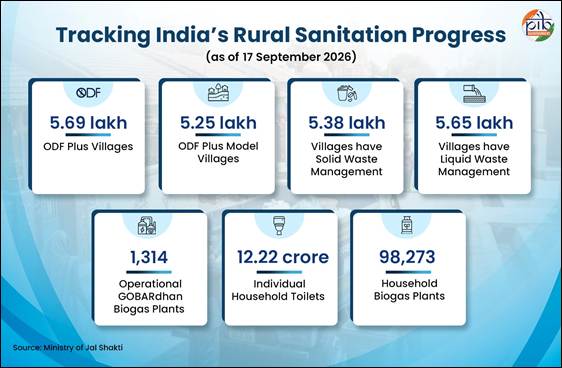
As of 17 September 2026, India has attained 5.69 lakh ODF Plus villages, of which 5.25 lakh have achieved ODF Plus Model status. Furthermore, 5.38 lakh villages have established solid waste management arrangements, and 5.65 lakh villages have established liquid waste management systems. 1,314 GOBARdhan biogas plants are currently operational in 582 districts. At the household level, 12.22 crore individual toilets and 98,273 biogas plants have been constructed.
GOBARdhan (Galvanizing Organic Bio-Agro Resources Dhan)
A flagship umbrella initiative under SBM-G Phase II that converts cattle dung, agricultural crop residue, and organic waste into biogas, compressed bio-gas (CBG), and organic manure/bio-slurry.
From Building Toilets to Building Habits
These national-level numbers reflect bigger changes at the individual and community levels, because lasting transformation begins with everyday behaviour. A toilet becomes meaningful when households choose to use, maintain and sustain it. Similarly, effective waste management begins with decisions and practices within individual households. Recognising this, SBM-G places Behaviour Change Communication (BCC) at the centre of sustaining ODF outcomes. Households are encouraged to adopt safe toilet use and disposal practices, understand appropriate sanitation technologies, and manage wet waste through compost pits or biogas plants. The focus also extends to everyday hygiene practices, including handwashing, safe water storage, maintaining sanitation facilities, and avoiding littering and spitting in public spaces. Thus, sanitation extends beyond the provision of infrastructure. It becomes a set of everyday practices adopted within households, reinforced through communities, and sustained through collective behaviour.
When Women Became Agents of Change
Women have been central to this transformation. Sanitation directly affects women’s privacy, safety, dignity, and health. They are not merely beneficiaries of interventions but active participants in development and agents of social change. The SBM-G guidelines give special preference to women as Swachhagrahis. They also recognize DAY-NRLM Self-Help Groups (SHGs) as important platforms for Behaviour Change Communication. Working closely with households and communities, Swachhagrahis support families in adopting and sustaining toilet use, while undertaking door-to-door outreach, awareness activities, and cleanliness verification. Through this community-based engagement, they help translate sanitation interventions into sustained everyday practices.
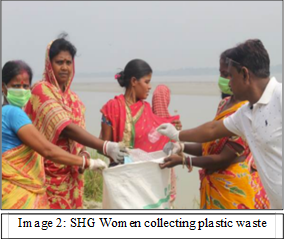
Image 2: SHG Women collecting plastic waste
|
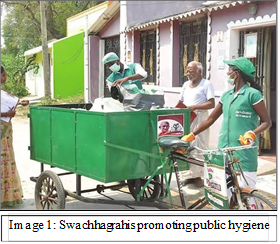
Image 1: Swachhagrahis promoting public hygiene
|
Women’s collectives have helped translate sanitation awareness into sustained community action. In Howrah, West Bengal, SHGs supported a plastic removal programme across 18 Ganga-adjacent gram panchayats, collecting 9.32 tonnes of plastic waste within 18 days. The initiative further established a regular plastic collection network through the SHG federation. It brought together elected representatives, panchayat functionaries, community members, and market vendors to strengthen collective action on waste management.
Women have also emerged as sanitation workers, entrepreneurs, and local service providers. In Gorakhpur, Uttar Pradesh, around a dozen SHG women manage a Resource Recovery Centre, collecting household waste and segregating it into wet and dry waste. Wet waste is converted into vermicompost, while dry waste is channeled for sale, generating wages and additional income for the women. In Bhopal, Madhya Pradesh, a Cluster Level Federation operates a Material Recovery Facility, supported by an MoU with the Swachh Bharat Mission-Gramin for the sale and purchase of plastic waste collected at the facility. Women’s participation in sanitation has expanded from awareness and mobilisation to implementation, waste management, livelihood generation, and local decision-making.
The Change Comes Home from School
Beyond women’s collectives, schools serve as another important institution for translating sanitation awareness into everyday practices. They provide a structured environment where children can develop habits related to hygiene, sanitation, and waste management, while also influencing practices within their families and communities. SBM-G Phase II explicitly recognises schools as important institutions for sustaining sanitation outcomes. It has provisions for functional sanitation facilities and arrangements for managing biodegradable and liquid waste. In Chandil, Jharkhand, a school banned single-use plastic and constructed a soak pit for greywater (domestic wastewater from kitchens and baths) management. Teachers also regularly engage students on personal hygiene and puberty-related concerns. Such efforts create a two-way flow of behavioural change. Children learn and practice sanitation at school and carry these behaviours into their homes, while families, in turn, become part of a broader culture of cleanliness and responsible waste management.
The role of children is also expanding into a wider youth-led movement for cleanliness.
Swachhata Hi Seva 2026 places students and youth at the centre of sustainable behavioural change. Schools and educational institutions are being positioned as spaces for building cleanliness as a sanskaar. Activities include Swachhata Gyan Yatras, school Samvads, and demonstrations on source segregation. Students will also engage with the Swachhata Evam Jal Samvads and learn about the Solid Waste Management (SWM) Rules, 2026. This approach extends the school-to-home cycle into a broader school-to-community movement.
Going Beyond the Realm of Traditional Swachhata
Interestingly, children are taking SBM-G beyond conventional sanitation. In Jharkhand, members of child cabinets have taken responsibility for menstrual hygiene management (MHM) activities. In one school, girls maintain the stock register for sanitary pads, while child cabinet members help ensure regular availability. At Kasturba Gandhi Balika Vidyalaya, Jhikpani, child cabinet ministers proposed the establishment of an MHM laboratory to the school authorities. The laboratory was subsequently established with support from school funds and external resources.
When a Village Takes Ownership
As sanitation practices take root within households and schools, they increasingly require collective systems and institutions to sustain them at the community level. Household waste needs to be collected, segregated, and treated; greywater requires appropriate drainage and disposal; and public spaces require regular upkeep. This is where the Gram Panchayat assumes a central role. Under SBM-G, Gram Panchayats are responsible for planning and implementing village-level sanitation activities. Their role extends beyond infrastructure to community mobilisation, demand generation, hygiene promotion, Information, Education and Communication (IEC), and capacity building. In this way, the Gram Panchayat provides the institutional framework that connects individual practices with collective sanitation outcomes.
Village Water and Sanitation Committees (VWSCs) further strengthen this community-level institutional structure by supporting village planning, mobilisation, implementation, supervision, and behaviour change. The impact of such collective ownership is evident in Gadli Gram Panchayat, Haryana, which achieved ODF Plus Model status through a process-driven community approach. The Sarpanch, Kanta Kanwar, worked with the cleanliness committee to establish community and separate toilets, a village-wide drainage system, and greywater treatment through five ponds. The village also adopted GOBARdhan biogas plants, converting cow dung into manure and biogas, with the resulting slurry used in agriculture. Public rallies, meetings, and announcements reinforced these practices. Gadli illustrates how individual sanitation practices, when supported by local institutions and collective action, can evolve into a village-wide sanitation system.
People Lead. Institutions Make It Last.
The people-led sanitation movement is supported by government institutions through financing, convergence, and capacity building. SBM-G draws resources from government allocations, Finance Commission grants, Viksit Bharat-Guarantee for Rozgar & Ajeevika Mission (Gramin) funds, and other revenue-generation mechanisms. Convergence with Deendayal Antyodaya Yojana – National Rural Livelihoods Mission (DAY-NRLM) engages SHGs and CLFs, while skill development initiatives strengthen field capacities and the Jal Jeevan Mission supports greywater management. This multi-level institutional structure links community action with government support: Gram Panchayats lead implementation, blocks provide handholding, districts offer technical support, and States and the Centre enable financing, convergence, and scale.
Cleanliness Becomes a Collective Ritual
Jan Bhagidari further strengthens sanitation as a shared community responsibility. Cleanliness drives bring together panchayat representatives, SHGs, youth, schools and local communities to translate collective ownership into regular action. Karnataka’s Swachh Sanivara offers one such example. Before each drive, panchayat representatives engage with village communities, youth groups, cooperatives and SHGs. On the first Saturday of every month, communities undertake cleanliness activities across schools, Anganwadis, hospitals, offices, water sources, temples and other public spaces. The activities include shramdaan, waste segregation, drain cleaning, identification of sites for compost pits, and reinforcing sanitation messages through wall writings.
Swachhata Hi Seva: Turning Participation into a People’s Movement
Launched in 2017, Swachhata Hi Seva (SHS) is an annual campaign promoting citizen participation in cleanliness. It brings together government institutions, local bodies, organisations, and citizens around shared responsibility for cleanliness. The campaign strengthens the Jan Bhagidari approach by encouraging cleanliness as an everyday practice. Swachhata Hi Seva 2025 witnessed participation from more than 18.06 crore citizens. Swachhata Hi Seva 2026 will begin on 17 September. Its theme is “Swachhata Mein Sahbhag; Swachh Bharat, Viksit Bharat.” On 1 October, citizens will undertake collective shramdaan under “Ek Din, Ek Ghanta, Ek Saath.” On 2 October, special Gram Sabhas and cleanliness awareness programmes will be organised in villages. The campaign will also promote community action for cleaner public spaces and sustained cleanliness.
A New Economy Around Sanitation
As collective sanitation systems take shape, they can also generate new livelihood opportunities. In Betul, Madhya Pradesh, Babita Dhurve found a livelihood opportunity through household waste collection. After losing both parents in 2021, she approached her Gram Panchayat to operate an e-rickshaw for waste collection. Despite initial community resistance, she learned to operate the vehicle and became the district’s first woman e-rickshaw waste collector, enabling her to earn a livelihood while remaining in her village. With around 100 Gram Panchayats in Betul now using waste-collection vehicles, the initiative demonstrates how sanitation systems can simultaneously strengthen village cleanliness and create local employment.
The livelihood potential of sanitation extends beyond waste management to the skills and services required to sustain sanitation infrastructure. In Nadia, West Bengal, the expansion of toilet construction created demand for trained masons, leading to the establishment of two masonry training institutes. Around 2,400 men and women were trained in toilet construction. This reflects that sanitation can generate a wider local ecosystem of livelihoods spanning construction, collection, transportation, processing, and maintenance.
SBM-G Transforming Waste into a Resource
As sanitation systems expand, community-led efforts increasingly require appropriate infrastructure and technical support. Vedancha, Gujarat, demonstrates how community demand can evolve into a locally designed wastewater management system. Its greywater treatment system was planned around local land and water-flow patterns, with local contractors supporting
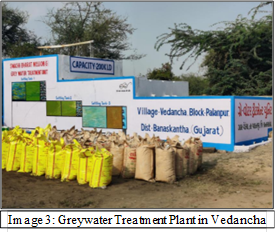
Image 3: Greywater Treatment Plant in Vedancha
|
its operation and maintenance. Panchayat members, operators, and participating citizens were also trained to manage the system. The system treats 200 kilo-litres of greywater daily, with treated water used for irrigation and groundwater recharge. The panchayat earns around ₹2.5 lakh annually through compost and treated-water reuse. At the same time, the initiative has also contributed to improved public health, including reductions in reported waterborne diseases and mosquito-borne outbreaks. This model shows how sanitation can evolve from waste disposal and resource recovery to environmental sustainability and local value creation.
Therefore, the ultimate objective of rural sanitation is sustained behaviour and collective ownership. An ODF Plus village must not only sustain ODF status but also manage solid and liquid waste and maintain a clean environment. India’s sanitation journey has therefore moved from access to usage, and from usage to sustainability.
The enduring measure of Swachh Bharat lies not only in the infrastructure created, but in whether cleanliness becomes an everyday practice sustained by people and communities. “Clean villages are not built for communities; they are built by communities.”
References
Ministry of Jal Shakti
https://gobardhan.sbm.gov.in/
https://sbm.gov.in/SBMGDashboard/StatesDashboard.aspx
https://www.pib.gov.in/PressReleasePage.aspx?PRID=1820414®=48&lang=2
https://www.pib.gov.in/newsite/PrintRelease.aspx?relid=151337®=48&lang=2
https://swachhbharatmission.ddws.gov.in/sites/default/files/Technical-Notes/Voices-from-the-States-29-April-2023.pdf
https://swachhbharatmission.ddws.gov.in/sites/default/files/Guidelines/SBMG%20Phase-II%20Operational%20Guidelines.pdf
PIB Backgrounders
https://www.pib.gov.in/PressReleasePage.aspx?PRID=2191618®=3&lang=2
https://www.pib.gov.in/PressNoteDetails.aspx?NoteId=160036&ModuleId=3®=3&lang=1
Click here to see PDF
********
PIB Research
(रिलीज़ आईडी: 2312635)
आगंतुक पटल : 117
इस विज्ञप्ति को इन भाषाओं में पढ़ें:
हिन्दी