Ministry of Health and Family Welfare
Union Health Minister Shri Jagat Prakash Nadda Unveils Operational Guidelines on National Ambulance Services (NAS), 2026
National framework to standardise emergency medical transport across the country
Guidelines promote technology-driven emergency response, AIS-125 compliant ambulances and integrated command centres
प्रविष्टि तिथि:
29 JUN 2026 6:41PM by PIB Delhi
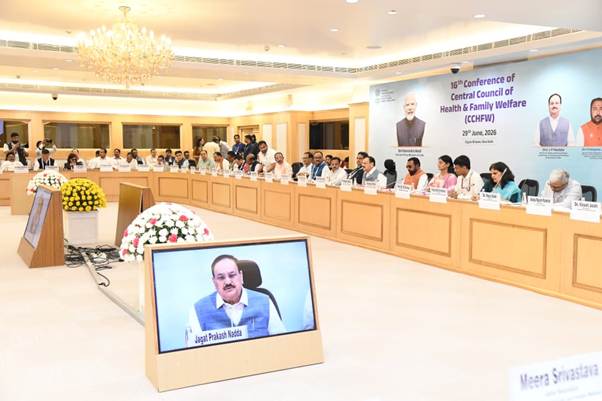
In a major step towards strengthening India's emergency healthcare delivery system, Union Minister for Health and Family Welfare, Shri Jagat Prakash Nadda, today unveiled the Operational Guidelines on National Ambulance Services (NAS), 2026. Developed by the Ministry of Health and Family Welfare, the Guidelines provide, for the first time, a comprehensive national framework for planning, operating and monitoring ambulance services across all States and Union Territories, with the objective of ensuring timely, safe and quality emergency medical transport for every citizen.
Ambulance services are the foundation of effective emergency medical care, serving as the first point of contact between patients and the healthcare system during medical emergencies. Recognising their critical role in providing pre-hospital care, stabilising patients and ensuring prompt referral to appropriate health facilities, the Guidelines seek to establish uniform operational standards that will strengthen emergency response capacity across the country.
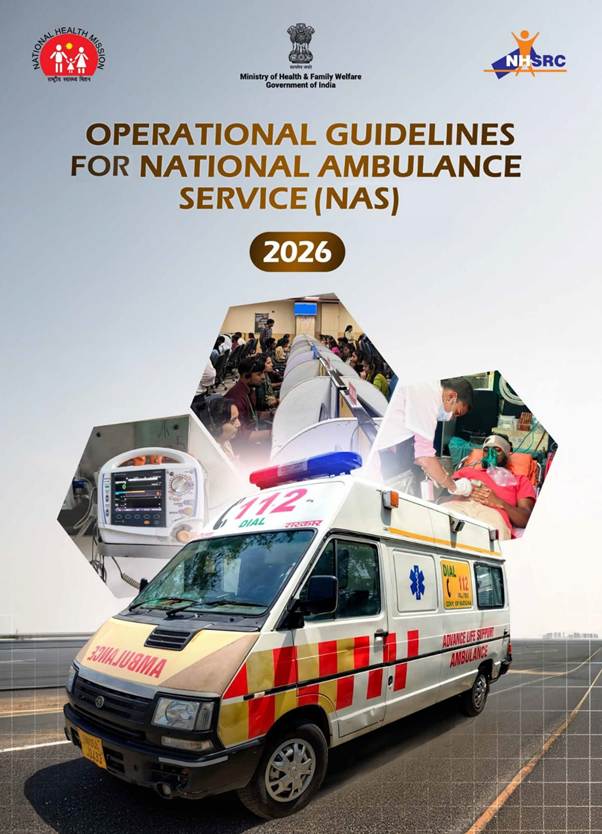
The framework comprehensively addresses every aspect of ambulance service delivery, including ambulance categorisation, population-based fleet deployment, human resource norms, equipment specifications, medicines and consumables, competency-based training for Emergency Medical Technicians (EMTs), infection prevention and control practices, vehicle maintenance protocols, quality assurance, performance monitoring and grievance redressal mechanisms. The Guidelines further stipulate that all ambulances shall conform to AIS-125 standards, ensuring uniformity, safety and quality in emergency medical transport.
To enhance coordination and response efficiency, the Guidelines advocate the establishment of Integrated Command and Dispatch Centres (ICDCs) supported by GPS-enabled ambulance tracking, digital call management systems, structured triage protocols, intelligent dispatch mechanisms and real-time monitoring dashboards. They also envisage the progressive integration of ambulance services with the unified emergency response number '112', enabling seamless access to emergency care across States and Union Territories.
The Guidelines encourage the adoption of advanced digital technologies for emergency response planning. Through Geographic Information System (GIS)-based mapping of healthcare facilities, referral centres, ambulance stations, accident-prone areas, high-risk locations, bed availability and critical care preparedness, dispatch teams will be able to identify the nearest and most appropriate healthcare facility, thereby reducing response time and improving patient outcomes.
Emphasising data-driven planning, the framework recommends evidence-based deployment of ambulances by analysing emergency call trends, referral patterns, traffic density, accident hotspots, geographical constraints and population distribution. Such scientific deployment is expected to optimise resource utilisation, improve service accessibility and ensure equitable emergency medical coverage, particularly in rural, remote and difficult-to-reach areas.
The Operational Guidelines on National Ambulance Services (NAS), 2026, represent a significant milestone in the Government's ongoing efforts to modernise emergency healthcare infrastructure and strengthen pre-hospital care services.
*****
SR
HFW/ HFM launches NAS 2026 Guidelines /29 June 2026/13
(रिलीज़ आईडी: 2279073)
आगंतुक पटल : 2678