Security
Border Roads Organisation: Connecting Places, Connecting People
Posted On:
19 JAN 2026 10:40AM
Key Takeaways
- The Border Roads Organisation constructs and maintains strategic roads, bridges, tunnels and airfields in border and inaccessible regions to meet both military and civilian needs.
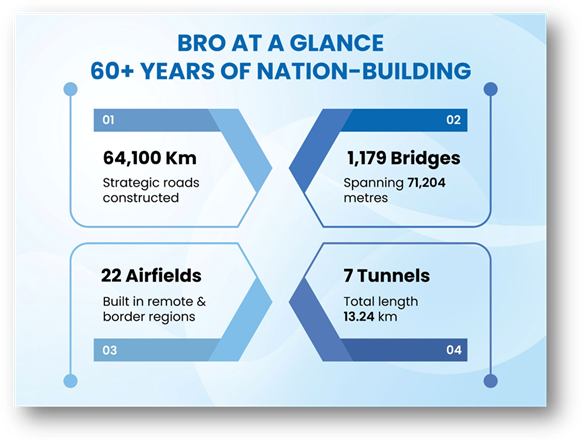
- Since its inception in 1960, the Border Roads Organisation (BRO) has built over 64,100 kms of roads, 1,179 bridges, 07 tunnels and 22 airfields across India’s border areas and in friendly neighbouring countries.
- Through overseas infrastructure in Bhutan, Myanmar, Afghanistan and Tajikistan, BRO supports regional connectivity and strategic partnerships.
- In Financial Year 2024–25, the Border Roads Organisation (BRO) recorded its highest-ever expenditure of ₹16,690 crore. Building on this momentum, an ambitious expenditure target of ₹17,900 crore has been set for FY 2025–26.
- In the two-year period from 2024 to 2025, BRO dedicated 250 infrastructure projects, marking a major milestone in strategic border development.
From Himalayan glaciers where oxygen thins, to river valleys where torrents roar, and deserts where silence burns-Border Roads Organisation leaves behind a signature of courage etched in asphalt, steel, and stone. To the soldier on the frontline, these are lifelines of defence; to the villager in a remote valley, theyare bridges of hope.
Born on 7 May 1960, the Border Roads Organisation carries a simple yet stirring creed: “Shramena Sarvam Sadhyam” means “through hard work, all things are possible.”. Over sixdecades, this mantra has guided the BRO beyond the role of a construction agency, shaping it into a silent sentinel of India’s frontiers.
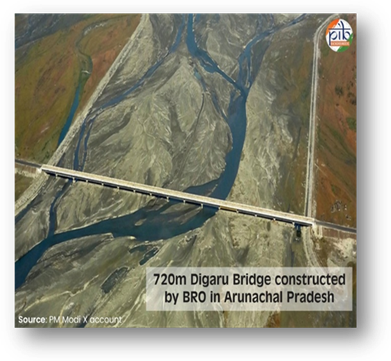 Beyond India’s borders, the BRO’s footprint extends to Bhutan, Myanmar, Afghanistan and Tajikistan, where roads and airfields serve as instruments of regional connectivity and strategic cooperation. Landmarks such as the Delaram–Zaranj Highway in Afghanistan stand not merely as feats of engineering, but as enduring symbols of partnership and trust.
When disaster strikes, be it the 2004 tsunami, the Kashmir earthquake, or flash floods in Ladakh, the BRO is among the first to arrive, restoring broken lifelines and hope itself.
In the years 2024 and 2025, 356 infrastructures projects executed by the Border Roads Organisation (BRO) have been dedicated to the nation, setting a significant benchmark in the development of strategic border infrastructure. In recognition of BRO’s vital contribution to national security and regional development, the government has increased its allocation from ₹6,500 crore in the Union Budget 2024–25 to ₹7,146 crore in the Union Budget 2025–26. In FY 2024–25, the Border Roads Organisation (BRO) achieved its highest-ever expenditure of ₹16,690 crore. Continuing this upward trajectory, an expenditure target of ₹17,900 crore has been set for FY 2025–26.
Today, the BRO stands as a living monument to the belief that the toughest terrains yield to the toughest spirit. It is more than an organisation, it is the quiet, steadfast architect of India’s security and development at the nation’s edges, where every milestone doubles as a marker of sovereignty.
BRO Panorama: Legacy and Scale
Established in 1960, the BRO is the Government of India’s premier border infrastructure agency. It builds and maintains vital connectivity in remote and strategic regions. Since 2015–16, BRO is functioning fully under the Ministry of Defence. Earlier, it was partially under the Ministry of Road Transport and Highways.
At the core of BRO’s achievements lies its people- a distinctive fusion of military precision and civilian craftsmanship. The organization is built upon the twin pillars of the General Reserve Engineer Force (GREF) and Indian Army engineer officers, supported by essential civilian personnel and Casual Paid Labourers (CPLs).
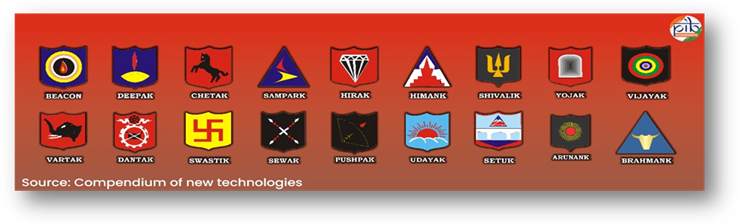
From its humble start with just two projects- Vartak in the East and Beacon in the North, BRO now commands 18 dynamic projects:
•9 in North West India (J&K, Ladakh, Himachal Pradesh, Uttarakhand, Rajasthan)
•8 in North East and Eastern India (Sikkim, Arunachal Pradesh, Nagaland, Mizoram, Meghalaya)
•One in Bhutan
Strategic Projects in Border States
BRO currently maintains 18 field Projects, each dedicated to engineering and executing strategic infrastructure across 11 States and 3 UTs. Large-scale roads, bridges, tunnels, and airfields, complemented by tele-medicine nodes, reinforcing both national security and socio-economic development under initiatives like Act East and Vibrant Villages Programme.
In Arunachal Pradesh, BRO projects such as Vartak, Arunank, Udayak, and Brahmank tackle some of India’s most challenging frontiers, connecting remote villages to the Line of Actual Control (LAC) through critical infrastructure including Sisseri Bridge, Siyom Bridge, Sela Tunnel, and Nechiphu Tunnel.
In Ladakh, projects like Himank, Beacon, Deepak, Vijayak, and Yojak maintain vital lifelines to Kargil, Leh, and the Karakoram region, covering strategic routes such as the Srinagar–Leh highway, Darbuk–Shyok–DBO (DS‑DBO) Road, Atal Tunnel, and the ongoing Shinku La Tunnel, ensuring all‑weather connectivity.
The Northeast sees projects like Swastik in Sikkim, Pushpak in Mizoram, Setuk in Assam and Meghalaya, and Sewak in Nagaland and Manipur strengthening regional access. On the western borders, Sampark in Jammu and Chetak in Rajasthan enhance strategic mobility.
Beyond the Himalayas, Shivalik ensures reliable access to the Char Dham Yatra in Uttarakhand, while Hirak extends connectivity into Left-Wing Extremism-affected areas of Chhattisgarh.
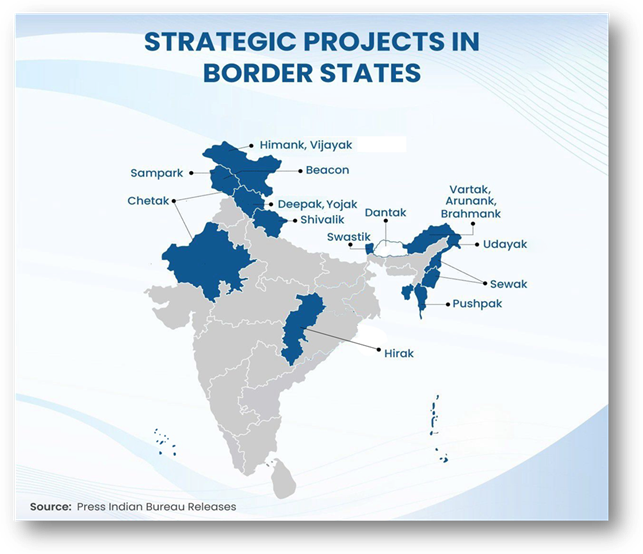
Finally, Dantak, BRO’s overseas arm in Bhutan, reinforces bilateral ties through extensive road, bridge, and infrastructure development. Together, these initiatives exemplify BRO’s unwavering commitment to national security, strategic preparedness, and regional development.
Critical BRO Infrastructure: Roads, Tunnels, Bridges & Airfields
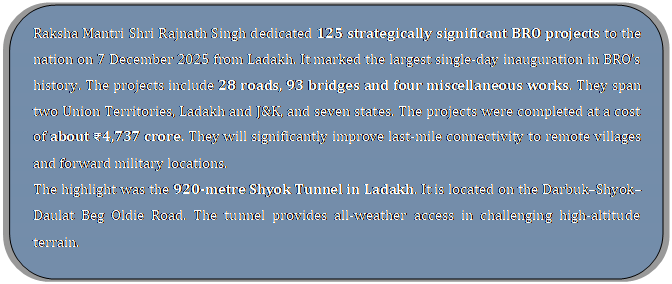
The BRO has significantly accelerated the pace of infrastructure development across border States and Union Territories, delivering strategic assets that serve defence preparedness, socio-economic growth, disaster resilience, and neighborhood integration.
Roads
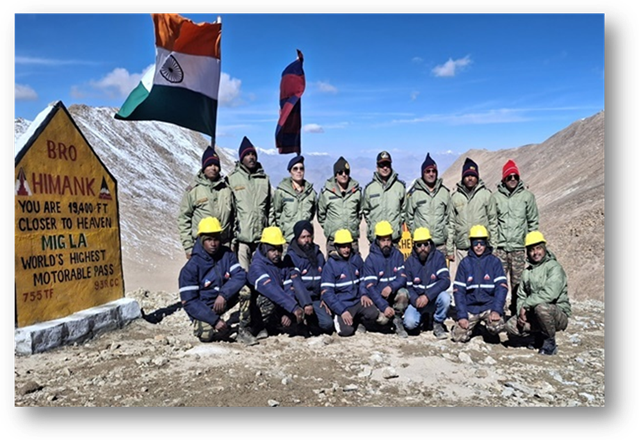
Over the five-year period from Financial Year 2020–21 to 2024–25, the Ministry of Defence has allocated approximately ₹23,625 crore to BRO for General Staff (GS) roads. This funding has enabled the construction of around 4,595 km of roads in forward areas. Significant progress has been made in improving connectivity, particularly along the Northern borders. In the FY 2024‑25 alone, about 769 km of road construction has been completed.
Blacktopping the remote Hapoli-Sarli-Huri Road and advancing links toward the Line of Actual Control.
Ladakh: Project Vijayak has developed more than 1,000 km of roads and it ensures rapid restoration of critical routes such as ZojiLa Pass, providing year-round connectivity and enhancing both civilian access and troop mobility in challenging terrain.
Sikkim: Project Swastik has developed more than 1,000 km of roads and is planning new highways, including NH‑310A/310AG, to ensure year-round connectivity, enhancing both civilian access and troop mobility in challenging terrain.
Bridges
Arunachal Pradesh: Project Arunank, raised in 2008, has constructed and maintained 1.18 km of major bridges in remote valleys and forward areas. The Siyom Bridge and Sisseri River Bridge further strengthens logistics and troop movement along the Line of Actual Control (LAC).
Ladakh: Project Vijayak has delivered and maintained over 80 major bridges across Ladakh, significantly improving year-round movement in high-altitude terrain. Notably, the Zojila Pass was rapidly reopened by BRO on 1 April 2025 after a record winter closure of just 32 days.
Sikkim: Project Swastik has built 80 major bridges, with 26 bridges completed in the last decade, ensuring year-round access despite natural challenges like floods and Glacial Lake Outburst Floods (GLOFs).
Jammu & Kashmir: The 422.9 m Devak Bridge, constructed under BRO’s Project Sampark, strengthens a vital road linkage, enhancing troop movement, heavy vehicle transit, and regional connectivity. It was inaugurated as part of 90 BRO projects in September 2023.
North Sikkim: By April 2024, as part of Project Swastik, BRO restored six key bridges damaged by heavy rains and flash floods, re-establishing vital lifelines and ensuring continued civilian and strategic movement in the high-altitude region.
Tunnels
Himachal Pradesh: The Atal Tunnel, a 9.02-km highway tunnel under Rohtang Pass and the world’s longest highway tunnel above 10,000 ft, was inaugurated by Prime Minister Narendra Modi, enabling all-weather Leh–Manali connectivity.
Arunachal Pradesh: The 500-metre Nechiphu Tunnel bypasses the Nechiphu Pass, a fog-prone section on the Balipara–Charduar–Tawang route, ensuring safer, faster, all-weather transit and enhancing both local connectivity and strategic military logistics.
Arunachal Pradesh / Tawang region: The Sela Tunnel, located at 13,000 ft, bypasses the high-altitude Sela Pass, ensuring uninterrupted, all-weather access to Tawang for both civilian and military movement.
Ladakh: The Shyok Tunnel on the Darbuk–Shyok–Daulat Beg Oldie Road, a 920‑metre tunnel, delivers reliable year-round access in extremely challenging terrain.
In 2025, the Border Roads Organisation (BRO) continued to expand strategic road, bridges and tunnel connectivity across India’s frontier regions, enhancing all-weather access crucial for both defence and civilian movement.
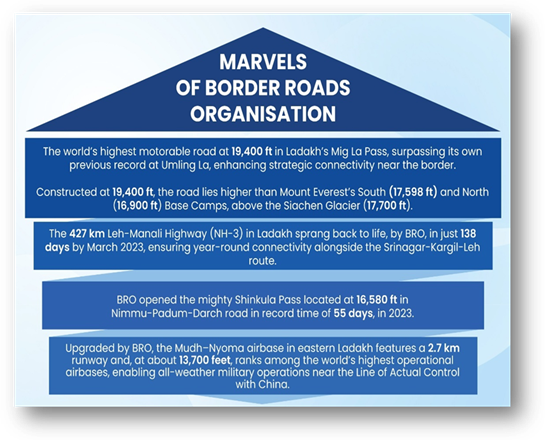
Airfields West Bengal: On 12 September 2023, as part of 90 BRO infrastructure projects dedicated to the nation by Raksha Mantri Shri Rajnath Singh, the Bagdogra and Barrackpore airfields were reconstructed. The works, costing over ₹500 crore, were undertaken to enhance Indian Air Force operational readiness, dual-use civilian connectivity, and strategic capability in the eastern sector.
BRO in Disaster Response
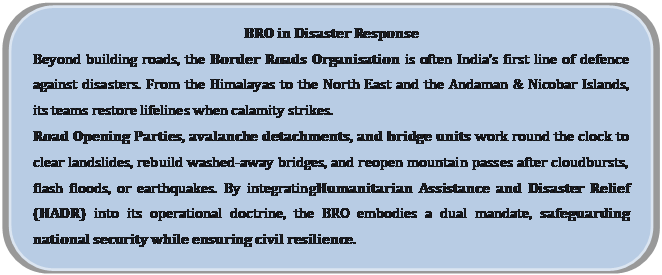
Beyond building roads, the Border Roads Organisation is often India’s first line of defence against disasters. From the Himalayas to the North East and the Andaman & Nicobar Islands, its teams restore lifelines when calamity strikes.
Road Opening Parties, avalanche detachments, and bridge units work round the clock to clear landslides, rebuild washed-away bridges, and reopen mountain passes after cloudbursts, flash floods, or earthquakes. By integratingHumanitarian Assistance and Disaster Relief (HADR) into its operational doctrine, the BRO embodies a dual mandate, safeguarding national security while ensuring civil resilience.
|
BRO: Enabling Fast and Effective Relief
- Road Clearance & Snow Management
Every winter, mountains shut their doors. And every spring, the Border Roads Organisation forces them open. From Zoji La to Rohtang and Sela, its teams cut through towering walls of snow, bringing back lifelines for soldiers, rescue teams, and civilians. In 2023, BRO made history when Zoji La was cleared on 16 March - just 68 days after closure, the fastest ever. Each pass reopened is more than a road. It is access to safety, supplies, and survival.
 Bailey/Modular Bridges & Causeways
When floods wash away connectivity, the Border Roads Organisation builds new ones. Class-70 Bailey bridges and modular spans built within days, reconnecting villages to hope and help. In 2021, when the Rishiganga floods swept away Reini’s bridge, BRO restored access in just 26 days with a 200-foot Bailey bridge, aptly named the Bridge of Compassion. From Uttarakhand to Assam, these instant bridges carry more than supplies. They carry survival itself.
- Emergency Air Logistics
BRO by restoring access to Advanced Landing Grounds and helipads, enables the Indian Air Force to fly in relief and fly out the injured. From Pasighat, Along, and Mechuka in the Northeast to Harsil and Gauchar in flood-hit Uttarakhand, BRO has kept the skies open when the ground was broken.
- Inter-Agency Coordination
The Border Roads Organisationworks with the Army, Air Force, NDRF, and state agencies. Its Road Opening Parties act as the spearhead, clearing paths for troops, relief teams, and supplies.
Regional and Neighborhood Connectivity
The BRO has played a pivotal role in strengthening India’s regional outreach through the execution of critical overseas infrastructure projects.
Bhutan: BRO’s oldest and most enduring mission, Project DANTAK, launched in 1961, has shaped Bhutan’s modern connectivity. Project DANTAK has built bridges, developed key airports such as Paro and Yonphula, and supported telecom networks and hydropower infrastructure, contributing directly to Bhutan’s socio-economic development and symbolizing the deep Indo-Bhutan partnership.
Myanmar / Southeast Asia: BRO has advanced regional integration through projects such as the 160 km India-Myanmar Friendship Road, inaugurated in 2001, connecting Moreh in India to Tamu and Kalewa in Myanmar.
Afghanistan: BRO constructed the 218 km Delaram-Zaranj Highway (Route 606), providing Afghanistan with direct access to Iran and the Port of Chabahar. This project enhanced regional trade options and demonstrated India’s commitment to development-led diplomacy.
Tajikistan: BRO undertook strategic reconstruction at the Farkhor and Ayni air bases, including runway expansion, air traffic control systems, hangars, and navigational upgrades, strengthening India’s strategic reach and reinforcing its role as a trusted regional partner.
These projects strengthened India’s strategic reach and reinforced its role as a trusted partner in regional connectivity and cooperation.
Under BRO’s perspective plan, 470 roads covering about 27,300 km are planned in border areas. The Trans-Kashmir Connectivity project, spanning about 717 km, has been approved for development to NHDL (paved shoulders) standards. The alignment will run from Poonch to Sonamarg, strengthening strategic road infrastructure across key mountain passes. Tunnels are planned at Sadhna Pass, P Gali, Z Gali, and Razdhan Pass to ensure all-weather connectivity. The project will be executed phase-wise by the BRO, with funding from MoD (GS). Once completed, it will significantly enhance forward connectivity, improve inter-sector movement, and strengthen inter-valley linkages. Overall, the project will play a critical role in boosting operational preparedness and long-term regional integration.
Conclusion
For over six decades, the Border Roads Organisation has exemplified resilience, innovation, and nation-building. Operating in some of the world’s toughest terrains, from the icy passes of Ladakh to the dense forests of the Northeast, BRO delivers infrastructure that strengthens India’s defence preparedness while transforming lives in remote border regions.
As it moves ahead, BRO will continue to build not just roads, but confidence and connectivity, binding the nation’s frontiers with its heartland and ensuring security, mobility, and prosperity reach the last mile. True to its ethos, BRO will always find a way or make one.
References
Ministry of External Affairs
PIB Press Releases
DD News
Border Road Organisation
State Governments
Other Publications
- OONCHI SADAKEN, Vol XXXIII, May 2024, Published at: H Q DGBR
Click here to see PDF
*****
PIB Research
(Explainer ID: 156986)
आगंतुक पटल : 3890
Provide suggestions / comments