Economy
The Repealing and Amending Act, 2025
प्रविष्टि तिथि:
01 JAN 2026 13:32 PM
Streamlining India’s Legal Framework Through Periodic Statutory Clean-Up
Key Takeaways
- The Repealing and Amending Act, 2025 steps in as a thoughtful editor of the accumulation.
- The Act removes 71 outdated Acts from 1886 to 2023, clearing obsolete, redundant and no longer relevant laws from the statute book.
- Simpler, clearer legislation with targeted corrections to core laws like Code of Civil Procedure, General Clauses Act, Succession Act, and Disaster Management Act.
- Savings Section ensures no accrued rights, liabilities, proceedings, or obligations are affected by repeals.
- The Act improves ease of governance and ensures that India’s legal environment evolves with the needs of a modern economy.
|
Introduction
Every legal system carries its history, and India’s statute book is no different. Over decades, it has held onto laws that once had a role but slowly faded out of relevance. Some written as far back as 1886. Amendment Acts that quietly completed their job and stayed behind with nothing more to contribute. As governance modernises and administrative practices evolve, whether through better technology, updated postal services, or streamlined procedures, the statute book feels the weight of these outdated pieces.
Did You Know?
- Repeal means an abrogation or removal of any law by a competent authority.
- Amendment is an action or result of amending an existing statute by alteration or by adding, deleting or substituting something.
|
The Repealing and Amending Act, 2025 steps in as a thoughtful editor of the accumulation. It carefully identifies the pages that have served their time and removes 71 obsolete enactments, while polishing important sections of the core laws to correct inconsistencies and bring them in line with current realities. Through a quiet but essential clean-up, the Act helps the Government’s broader objective of improving ease of governance, fostering ease of doing business, and ensuring that India’s legal environment evolves with the needs of a modern economy.
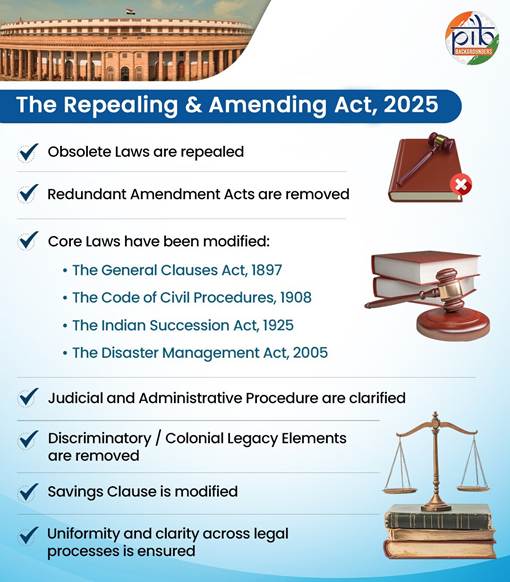
A Balanced Approach: Repeal & Amend
The Repealing and Amending Act undertakes a calibrated exercise to remove outdated laws and correct technical issues, thereby strengthening legal consistency across sectors. It employs a two- pronged approach: Repeals and Amends.
Did You Know?
Since 2014, India has cleared more than 1,500 outdated Central laws, making the statute book significantly lighter and easier to navigate.
|
The First Schedule of the Act specifies all enactments to be repealed and the Act permanently removes laws that are no longer needed. This includes acts whose purpose is fulfilled, are redundant, or are otherwise obsolete.
The Second Schedule of the Act details the precise amendments and makes targeted corrections and updates to current laws. This modernizes language, corrects errors and removes inconsistencies.
Clearing the Statute Book
In order to reduce interpretational burdens and improve judicial and administrative efficiency, the Act aims at delivering a cleaner and more navigable statute book by repealing numerous Acts. These measures include replacement or removal of 71 Acts from the statute book for the period 1886-2023, that have become unnecessary or obsolete or have simply served their temporary purposes. By adopting a balanced legislative housekeeping effort, redundancies are eliminated and core provisions are reinforced:
- The Acts which are relics of a different era and have been superseded by modern legislation or are no longer applicable to the courts are repealed.
- Laws including acquisition/nationalisation Acts, amendment Acts whose changes are already incorporated into principal legislation are repealed as their independent existence is unnecessary.
Refining the Legal Framework Through Targeted Amendments
Beyond the repeals, the Act makes four strategic Amendments that have been incorporated to rectify drafting-inconsistencies and update statutory references in foundational enactments, including the General Clauses Act, 1897, the Code of Civil Procedure (CPC), 1908, the Indian Succession Act, 1925, and the Disaster Management Act, 2005.
Replacement of outdated postal references (e.g., “registered post” replaced now with “speed post with registration and proof of delivery”) in the CPC and General Clauses Act, ensuring alignment with current India Post Services and preventing procedural confusion.
Removal of Section 213 of the Indian Succession Act, enhancing fairness and uniformity in succession matters by eliminating community-based disparities in probate requirements.
Corrections made to the Disaster Management Act- The word “prevention” has been substituted with the word “preparation”, strengthening the statutory framework by ensuring that the law accurately reflects the operational mandate of the National Disaster Management Authority.
|
Legislative Objectives of the Amendments
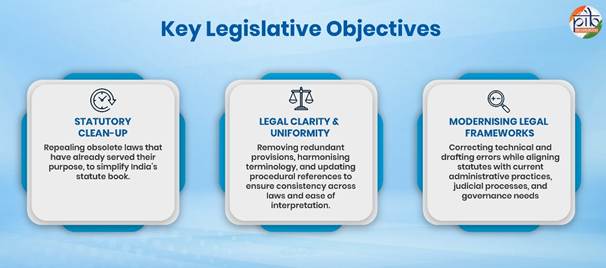
The amendments made in the Act updates the provisions in the Acts mentioned above and addresses everything from modernizing official communication methods to removing discriminatory colonial-era provisions to match current administrative practices. Broadly, the amendments reflect three key legislative objectives of the said enactment:
Savings Clause: Ensuring Continuity Amid Legal Repeals
The Savings section of the Act, ensures that removing outdated laws doesn’t create confusions or disruptions in implementation.
- Past actions, existing rights, and current legal processes remain unaffected in spite of repeals and amendments.
- Other laws continue to work as they did before and repealed laws are not brought back.
- The repeal does not change any existing rule of law, court jurisdiction, legal procedure, customary practice, privilege, exemption, office, or appointment that is currently in force, even if it originated from a repealed law.
Overall, it helps maintain stability and continuity while cleaning up the law.
Conclusion
The Repealing and Amending Act, 2025 steps in to quietly set things right. It gently cleared away laws that no longer belonged, trimmed redundant provisions, and refined those that still mattered. In doing so, it brings clarity where confusion once lingered and replaced interpretational complexity with coherence. Old references have been updated, loose ends are tied, and the statute book begins to read as a living document rather than a historical archive.
References
LOK SABHA:
https://sansad.in/getFile/BillsTexts/LSBillTexts/Asintroduced/AS%20intro%20(4)1215202530613PM.pdf?source=legislation
MINISTRY OF LAW & JUSTICE:
https://cdnbbsr.s3waas.gov.in/s380537a945c7aaa788ccfcdf1b99b5d8f/uploads/2025/08/202508251865097049.pdf
https://cdnbbsr.s3waas.gov.in/s380537a945c7aaa788ccfcdf1b99b5d8f/uploads/2025/08/20250825492472647.pdf
OTHERS:
https://www.indiacode.nic.in/bitstream/123456789/13813/1/the_code_of_civil_procedure%2C_1908.pdf
https://www.indiacode.nic.in/bitstream/123456789/15374/1/the_general_clauses_act%2C_1897.pdf
https://www.indiacode.nic.in/bitstream/123456789/2385/1/a1925-39.pdf
https://ndmindia.mha.gov.in/ndmi/images/The%20Disaster%20Management%20Act,%202005.pdf
PRESS INFORMATION BUREAU:
https://www.pib.gov.in/PressNoteDetails.aspx?ModuleId=3&NoteId=154686®=3&lang=1
The Repealing and Amending Act, 2025
-------------------
PIB RESEARCH
(तथ्य सामग्री आईडी: 150601)
आगंतुक पटल : 16498
Provide suggestions / comments