Economy
Petroleum Industry Benefits with Improved Safeguards under New Labour Codes
प्रविष्टि तिथि:
01 DEC 2025 09:40 AM
Key Takeaways
- The OSHWC Code, 2020 establishes a unified national safety framework broadly including all petroleum units, refineries to fuel depots.
- Worker protections are enhanced through compulsory medical surveillance, competency-based training & certification, modern safety standards, and enforceable emergency preparedness.
- The Social Security Code, 2020 expands ESIC coverage and introduces digital, streamlined compliance processes that improve welfare delivery and governance across petroleum sector.
|
Introduction
The Government has undertaken a historic consolidation of labour laws through the implementation of four Labour Codes; Occupational Safety, Health and Working Conditions Code, 2020 (OSHWC Code), Code on Social Security, 2020, Industrial Relations Code, 2020 and Code on Wages, 2019. These reforms establish a comprehensive and harmonized structure for safety, working conditions, and social security across industrial establishments. In this context, the Petroleum Industry is a key sector where unified regulatory provisions play an essential role.
With the coming into effect of labour codes, the petroleum industry will undergo transition from a fragmented and inspector-driven regulatory regime of labour laws framework to a unified, compliance oriented, and technology-enabled regulatory system, also designed for high-risk industries handling flammable, explosive, and toxic substances. The Labour codes give integrated regulatory framework for the entire value chain of the petroleum sector from upstream to downstream.
Transforming Framework of the Petroleum Industry
The petroleum industry represents one of the most safety-critical and hazard-intensive sectors in the country. These operations involve continuous handling of highly flammable hydrocarbons, toxic gases such as Hydrogen sulphide, carcinogenic benzene vapors, cryogenic LNG, pressurized LPG, and high-temperature process streams, exposing workers to thermal radiation hazards and exposure-related illnesses.
Earlier, safety regulations in this sector relied mainly on the Factories Act, 1948, which, while historically progressive, provided a limited, factory-centric approach to hazardous industries. These provisions offered limited medical surveillance, scattered emergency requirements, and variable enforcement mechanisms, which need to evolve to address complex risks in exploration and production, refineries, petrochemical plants, LNG terminals, pipelines, tank farms, and retail fuel facilities. Enforcement under present regime was primarily inspector-driven; documentation was physical, emergency management operated in silos and record-keeping lacked long-term health protection for workers exposed to chronic petroleum hazards. Moreover, cross-country pipelines, fuel retail outlets, and multi-location storage hubs often require approvals from multiple departments, creating fragmented oversight.
Provisions under Occupational Safety, Health and Working Conditions (OSHWC) Code, 2020
The introduction of the Occupational Safety, Health and Working Conditions (OSHWC) Code, 2020 marks a decisive move from fragmented, factory-centric regulation to a unified, national, risk-focused safety system applicable across petroleum facilities. The OSHWC Code broadly includes all petroleum units, refineries to fuel depots, fall under a single, comprehensive safety umbrella.
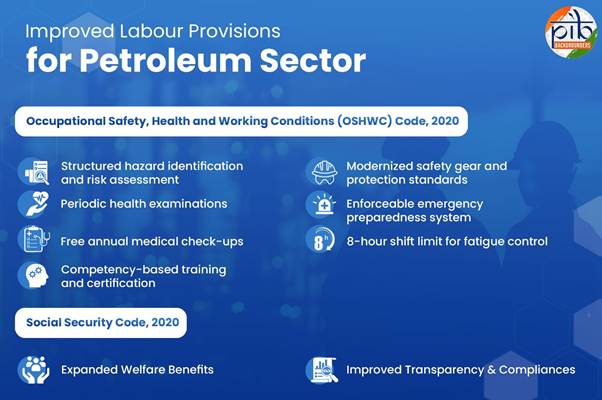
- Mandatory Risk Assessment and Operational Approvals: The Code now mandates structured hazard identification and risk assessment, prior to government approval before commencing hazardous operations, and national standards for handling, storage, transport, and disposal of petroleum substances. These reforms align with contemporary process-safety frameworks used globally by oil and gas majors, incorporating risk-based inspections, safety audits, emergency command-structure involvement, and digital compliance platforms.
- Improved Worker Protection: Worker protection is substantially enhanced. Unlike the earlier periodic medical check-ups, the Code requires pre-employment, periodic, and post-exposure health examinations, supported by free annual medical check-ups for all workers engaged in hazardous petroleum operations.
- Competency-based Training, Certification and Modernized Protective Standards: The Code enforces competency-based training and certification before a worker can handle petroleum or hazardous chemicals. Safety gear and protection standards are modernized and made enforceable: employers must provide, maintain, and train workforce and ensure fatigue-control through 8-hour shift limits; a major safeguard for continuous-process plants.
- Emergency Preparedness and Worker Safety Rights: On-site emergency planning, earlier a compliance document, is now an enforceable emergency preparedness system, requiring detailed on-site emergency plans and periodic mock drills. This ensures integrated response to major incidents. Worker empowerment is strengthened by the right to refuse dangerous work. Protective rules for pregnant women and adolescents in petroleum industries are reinforced to prevent chemical and thermal exposure.
- Improved Facilitation over Inspection: The inspector-cum-facilitator model under the OSHWC Code, combined with risk-based inspections, digital submissions, single-window approvals reduce procedural complexity for employers and strengthens compliance governance consistent with global petroleum regulatory trends.
Provisions under Social Security Code, 2020
- Expanded Welfare Benefits: The code on Social Security Code, 2020 further institutionalizes welfare measures by extending ESIC coverage to petroleum workplaces, enabling medical care, injury compensation, disability benefits, dependents' benefits, maternity protection, compensation for occupational diseases and accidents.
- Improved Transparency & Compliances: Digital social-security and health records ensure portability, beneficiary transparency, and accountability.
Conclusion
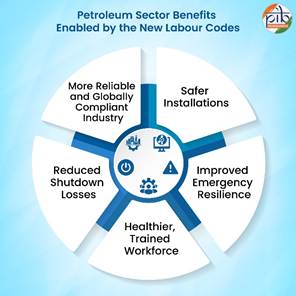
On one hand, the OSHWC Code establishes a modern, integrated, and proactive safety architecture that delivers safer petroleum installations, stronger emergency resilience, healthier workers, and more reliable, globally compliant operations. On the other hand, the Code on Social Security broadens welfare benefits and strengthens compliance across the sector. Together, the Codes shift petroleum-sector safety from a reactive, compliance-heavy system to a modern, prevention-focused, technology-enabled, and welfare-centric framework. The provisions enhance operational discipline, workforce capability, emergency readiness, medical monitoring, regulatory clarity, and coordination, delivering safer operations, a healthier skilled workforce, higher productivity, fewer disruptions, and stronger global compliance.
Collectively, these outcomes reinforce a robust safety culture and bolster industrial resilience across India’s petroleum sector.
Click here for pdf file.
****
M
(तथ्य सामग्री आईडी: 150516)
आगंतुक पटल : 399
Provide suggestions / comments