Posted On:
29 OCT 2026 2:04PM by PIB Delhi
India’s rapid digitalisation is driving demand for secure, scalable and reliable cloud infrastructure. Cloud computing is becoming an important foundation for digital governance and public service delivery. India is building domestic cloud capabilities through initiatives such as MeghRaj and the expansion of indigenous data centre capacity. Policy measures, institutional mechanisms, and public-private collaborations further drive cloud adoption across sectors in India.
Seeding Cloud for Data Sovereignty
India’s digital transformation is generating unprecedented volumes of data across governance, commerce, communication and public services. The country’s internet subscriber base reached 1,092.79 million in March 2026. Rising digital adoption is also driving higher data consumption, with average wireless data usage reaching 25.51 GB per subscriber per month. Total wireless data usage rose to 285,376 petabytes in FY 2025–26. Digital payments generate transaction records, online public services create digital records, and artificial intelligence applications generate and process vast amounts of information. Managing this growing data requires secure, scalable and reliable infrastructure to store, process and manage information efficiently.
Meeting these requirements demands more than storage space. Organisations also need computing power to process information, run applications and deliver digital services reliably. Maintaining physical servers and other equipment independently can be expensive and difficult to expand. Cloud computing addresses this challenge by providing computing resources over the internet, whenever required. However, as dependence on cloud services grows, protecting sensitive information and maintaining control over its storage and processing become increasingly important. Developing a domestic cloud can support data sovereignty by strengthening national control over critical digital resources.
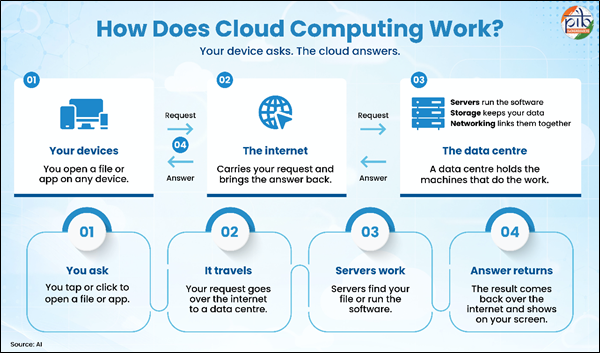
Cloud computing enables users to access computing resources, including data storage, servers, software and processing capabilities, over the internet. Instead of purchasing and maintaining their own servers, organisations can use these resources as needed. For example, Google Drive allows users to store documents online and access them across multiple devices. Similarly, a government department can host its applications and databases on a cloud platform instead of maintaining all the necessary equipment itself. When backed by appropriate security safeguards and governance frameworks, domestic cloud infrastructure can strengthen control over sensitive information. It can also support reliable public services, artificial intelligence development and India’s technological self-reliance.
|
India’s Cloud Service Provider Ecosystem
As of September 2026, India has empanelled 30 Cloud Service Providers (CSPs), with infrastructure across locations including but not limited to Mumbai, Navi Mumbai, Chennai, Hyderabad, Bengaluru, Delhi-NCR and Jamnagar. The empanelled providers include Indian companies such as Jio Platforms Limited, Tata Consultancy Services Limited, Bharat Sanchar Nigam Limited (BSNL), ITI Limited, RailTel Corporation of India Limited, AdaniConneX Private Limited and Yotta Data Services Private Limited. International providers include Google Cloud India Private Limited, Oracle India Private Limited, Microsoft Corporation India Private Limited and Amazon Web Services India Private Limited, among others.
|
Key Benefits of Cloud Computing
Cloud computing offers several benefits by making digital infrastructure more accessible, flexible and efficient. It reduces costs by limiting the need to purchase and maintain physical servers.
A server room is a dedicated space housing computers that store data and run digital services. For example, a school can store student records on a cloud platform instead of investing in its own computing infrastructure.
It enables faster deployment of digital services and applications by letting organisations launch services without lengthy infrastructure setup. For instance, a hospital can introduce an online appointment system without setting up its own servers.
Cloud platforms also provide easy scalability, allowing organisations to adjust computing resources according to demand. For example, an online examination portal can increase its resources during registration periods and reduce them afterwards.
Cloud computing promotes better collaboration by allowing users in different locations to access and share information. For instance, university students can collaborate on research projects, share study materials and edit documents online.
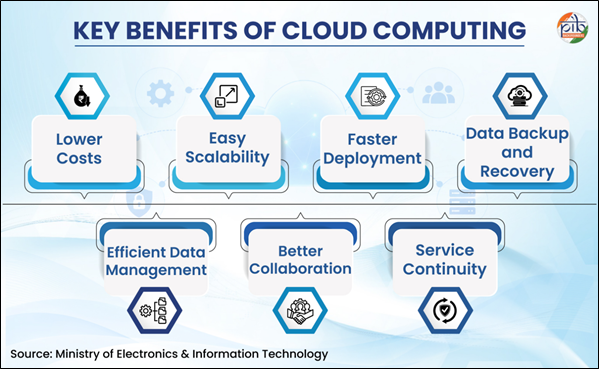
Cloud platforms reinforce data backup and recovery, helping users retrieve information after accidental deletion, equipment failure or other disruptions. For example, a hospital can restore backed-up patient records following a system failure.
These capabilities also strengthen service continuity by helping organisations resume operations quickly after unexpected interruptions. For example, an online banking service can switch to backup systems when its primary infrastructure encounters technical problems.
Cloud computing further supports efficient data management by simplifying the storage, organisation and retrieval of digital records. For instance, an e-commerce business can manage product information, customer orders and inventory records through a single cloud-based system.
|
Migration of Digital India BHASHINI Platform to the Cloud
The Digital India BHASHINI platform demonstrates how indigenous cloud infrastructure can support data sovereignty while improving digital services. In February 2026, the Ministry of Electronics and Information Technology reported BHASHINI’s migration to an Indian cloud operated by Yotta Data Services. This transition keeps its language datasets, AI models and citizen interactions within India’s jurisdiction. The deployment reportedly achieved up to 40% improved performance, 20–30% cost savings and 99.99% uptime.
During Maha Kumbh 2025, BHASHINI supported real-time translation and voice-based assistance in more than 11 Indian languages. Its multilingual services helped pilgrims access information despite language barriers.
|
|
Creative Minds, Catalyzing Science, Empowering Technologies

ESTIC-2026, the second edition of India’s Emerging Science, Technology and Innovation Conclave, is being held from 27–29 October 2026 at Bharat Mandapam, New Delhi. The conclave follows the theme “Creative Minds, Catalyzing Science, Empowering Technologies.” Organised by the Council of Scientific and Industrial Research (CSIR), ESTIC-2026 advances emerging scientific and technological frontiers, including cloud computing and other emerging technologies. It catalyses strategic collaborations and supports India’s vision of Viksit Bharat 2047. Spanning 12 thematic areas, the conclave features plenary sessions, technical discussions and exhibitions.Click to Read More on Agenda: ESTIC 2026
|
Understanding the Fundamentals of Cloud Computing
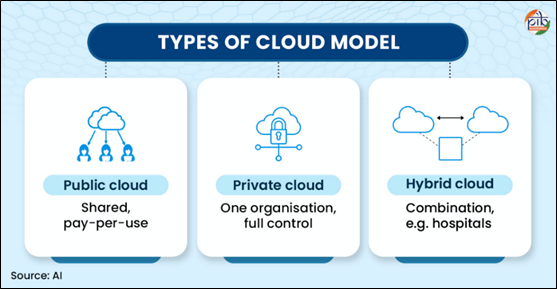
Cloud models determine where cloud infrastructure operates, who can use it, and how much control an organisation retains. The three commonly discussed models are public, private and hybrid cloud.
A public cloud uses infrastructure provided by a third-party provider and shared among multiple customers. For example, a business/video-streaming company serves millions of viewers from shared servers.
A private cloud dedicates infrastructure to a single organisation. For example, a state treasury office keeps payment and accounts data on a private cloud to manage sensitive administrative records with greater control over security.
A hybrid cloud combines public and private cloud environments. For example, a municipal corporation keeps its property-tax payment portal on a public cloud and citizens’ records on a private one. The choice depends on an organisation’s security, cost and operational requirements.
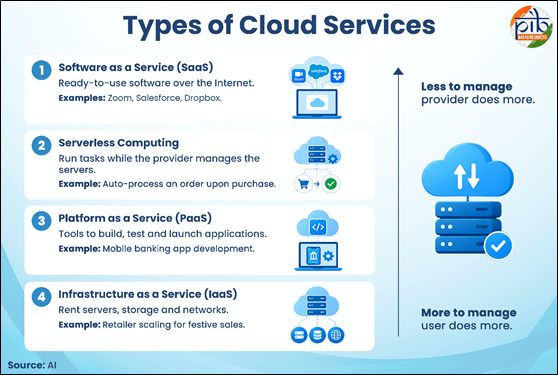
Cloud services offer different levels of computing support, from renting digital infrastructure to using ready-made applications. Four common categories are Infrastructure as a Service (IaaS), Platform as a Service (PaaS), Software as a Service (SaaS) and serverless computing. These are also sometimes called the cloud computing "stack" because they build on top of one another.
Infrastructure as a Service (IaaS) allows users to rent computing resources such as virtual servers, storage and networks instead of buying physical equipment. For instance, an online retailer can lease cloud servers to host its website and scale computing capacity to accommodate surges in traffic during festive sales.
Platform as a Service (PaaS) enables developers with tools to build, test and launch applications without managing the underlying infrastructure. For example, a team developing a mobile banking application can use a cloud platform to build and test its software.
Software as a Service (SaaS) delivers ready-to-use software over the internet, with the provider managing updates and maintenance. Examples include Zoom for video conferencing, Salesforce for customer relationship management and Dropbox for online file storage and sharing.
Serverless computing allows developers to run specific tasks without managing servers directly. The cloud provider manages the infrastructure and allocates resources when required. For example, an online shopping platform can automatically process an order when a customer completes a purchase. Despite its name, serverless computing still uses servers; the provider manages them on the developer’s behalf.
India’s Progress in the Deployment of Indigenous Cloud Ecosystem
India is reinforcing its domestic cloud ecosystem to aid digital governance, data management and emerging technologies. The Government is branching out shared infrastructure, implementing trusted cloud services and driving indigenous computing capabilities.
MeghRaj and MeghRaj 2.0: Government of India’s Cloud Ecosystem
MeghRaj, the Government of India’s Cloud Ecosystem, was launched in 2014 by the MeitY to accelerate e-governance and optimize public ICT spending. MeghRaj 2.0 represents the second-generation iteration of this National Cloud Computing Initiative, serving as the secure digital backbone for the country’s Digital India mission. By providing flexible IaaS, PaaS, and SaaS models through a distributed cloud architecture, it allows government departments to rapidly deploy digital applications on demand.
The ecosystem has scaled tremendously in the last decade. By September 2026, adoption grew to encompass 2,330 government departments. Today, MeghRaj 2.0 provides the highly secure, AI-ready hosting required to power India's digital platforms, including DigiLocker, MyGov, and the National Scholarship Portal, alongside the Department of Posts' Advanced Postal Technology (APT). Click to Read More About: India Digital Public Infrastructure
Data Centres as a Pillar of India’s Cloud System
Data centres house the servers and storage systems that power cloud computing. India’s data centre sector is gaining momentum, driven by growing demand for digital services and AI computing. As of August 2026, India’s data centre capacity reached 1.57 GW and is projected to grow to nearly 8 GW by 2030. The sector is concentrated in Mumbai, Navi Mumbai, Chennai, Hyderabad, Bengaluru, Delhi-NCR and Jamnagar. Emerging data centre hubs are also gaining traction in Andhra Pradesh, Madhya Pradesh, Chhattisgarh and West Bengal. Meeting this growing demand requires substantial capital, and the sector is attracting around USD 70 billion in investments underway, alongside a further USD 90 billion in announced projects. These investments are expected to augment computing capacity and broaden India’s domestic cloud capabilities. Click to Read More About: Data Centres In India
Strengthening the Data Centre Network
The National Informatics Centre (NIC) forms an integral part of India’s data centre infra, operating 4 National Data Centres and 24 Mini Data Centres across the country. These facilities provide shared hosting, co-location and cloud services to government departments. Mini data centres at NIC State Centres further cater to state-level e-governance requirements through decentralised yet standardised infrastructure.
IndiaAI Mission — Democratizing Access to AI Computing
Cloud infrastructure equips researchers and start-ups with the computing resources needed to deploy AI applications. The IndiaAI Mission, approved with an outlay of ₹10,371.92 crore, is broadening access to computing resources. More than 45,000 Graphics Processing Units (GPUs) have been onboarded for a common AI computing facility. These resources provide Indian start-ups and academic institutions with affordable computing power for AI development, reducing the need for investment in dedicated equipment. Click To Read More About: Transforming India with AI
Upskilling and Capacity Building Initiatives in Cloud Computing
Building a skilled workforce is essential to operating India’s expanding digital infrastructure. The FutureSkills PRIME Programme, launched in 2021 by MeitY–NASSCOM, promotes emerging-technology skills. By August 2026, it had 34 lakh registered candidates, with over 23 lakh enrolled or trained. It ranked 3rd globally in the European Commission’s Pact for Skills Report 2024 for industry-focused training in AI, cloud computing and data analytics. Complementing this initiative, the National Institute of Electronics and Information Technology (NIELIT) operates 56 centres, 750 affiliated institutes and over 9,000 facilitation centres, training professionals in cloud computing, AI, cybersecurity, blockchain and IoT.
Further reflecting this talent base, a 2026 report by the Cloud Native Computing Foundation (CNCF) estimates that India has 2.25 million cloud-native developers. The report also finds that 44% of Indian developers use hybrid cloud, combining public and private cloud environments. This skilled workforce can facilitate the management of India’s evolving cloud ecosystem.
Policy Push Driving Cloud Adoption in India
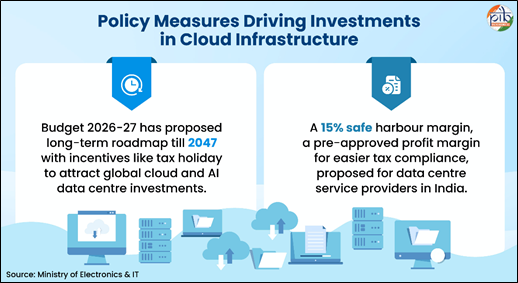
India’s cloud strategy centres on building a globally competitive digital infrastructure through coordinated policy initiatives and targeted investments. Recognising cloud and data centres as critical to emerging technologies and data-driven services, the Union Budget 2026–27 highlighted their role in advancing India’s digital capabilities. The measures aim to attract investment in cloud computing, AI, and hyperscale data centres while enhancing India’s long-term digital capacity.
|
Did You Know?
In March 2026, MeitY issued a Cloud Selection Framework which provides structured guidance to Ministries and Departments for selecting cloud infrastructure based on data sensitivity and criticality. It introduces a data classification approach aligned with national security considerations, prioritises the use of government-backed cloud such as NIC and State Data Centres, and enables adoption of hybrid deployment models with empanelled cloud service providers.
|
Additionally, the Digital Personal Data Protection (DPDP) Act, 2023 establishes safeguards for personal data processing and sets conditions for cross-border data transfers. It encourages the use of local data centres and cloud services, as reflected in provisions related to data residency and restrictions on cross-border data transfer. It also ensures better control over data and compliance with regulations through provisions on explicit user consent, accountability of data fiduciaries, and strict data processing obligations.
Guiding Secure and Standardised Digital Governance
The National e-Governance Division (NeGD) offers technical and advisory aid for e-governance projects at central and state levels. Its responsibilities include technical appraisal of projects, including their technology architecture, security, standards and use of common infrastructure. This collaborative framework is taking forward cloud services throughout India's government ecosystem, fuelling Digital India and e-Governance priorities.
The Path Forward for India’s Cloud Ecosystem
India’s cloud ecosystem is witnessing rapid expansion, with the country’s cloud data capacity projected to grow nearly 4–5 times by 2030. Rising reliance on cloud infrastructure across digital governance, public service delivery, and technology-driven platforms is driving demand for computing resources. Investments in data centres are augmenting domestic capacity, while targeted skill-development initiatives are cultivating a workforce equipped for cloud-based technologies. Together, these measures are fostering innovation and positioning cloud computing as a cornerstone of India’s long-term digital transformation.
References
Rajya Sabha
Ministry of Electronics and IT
Ministry of Communications
Ministry of Skill Development & Entrepreneurship
NITI Aayog
PIB Headquarters
Network Readiness Index Report 2025
NASSCOM
Click to see pdf
***
PIB Research