Posted On:
22 OCT 2026 2:17PM by PIB Delhi
On 14 October 2026, the Union Cabinet approved the continuation of the National Social Assistance Programme for five years, 2026-27 to 2030-31, with an outlay of Rs 53,428 crore. The programme becomes the Pradhan Mantri Samajik Sahayata Yojana, and its four sub-schemes are renamed with it. While the pension schemes for the old aged, widows and family benefit will continue in their existing forms, the Disability Pension has been revised. It will now use the 40 per cent benchmark disability of the Rights of Persons with Disabilities Act 2016, in place of 80 per cent. Its minimum eligibility age of 18 years is removed, so eligibility now runs from birth. Central assistance rises to Rs 375 a month for age 0-79 years, and Rs 625 at 80 years and above. Further, number of beneficiaries under the disability scheme has increased from 8.33 Lakhs to 27.48 Lakhs.
A Renewed Programme for Social Assistance
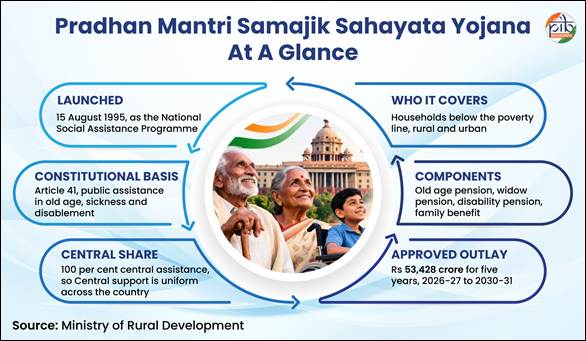
The Union Cabinet, chaired by the Prime Minister, approved on 14 October 2026 the proposal of the Department of Rural Development to continue the National Social Assistance Programme for five years. The approval runs from 2026-27 to 2030-31 and carries an outlay of Rs 53,428 crore.
The approval covers three matters. It renames the programme and each of its sub-schemes. It revises the disability pension. It continues the other sub-schemes in their existing form.
The programme is now the Pradhan Mantri Samajik Sahayata Yojana. Its four pension sub-schemes carry new names with it. The old age pension becomes the Pradhan Mantri Vridhavastha Pension Yojana. The widow pension becomes the Pradhan Mantri Vidhawa Pension Yojana. The disability pension becomes the Pradhan Mantri Divyangjan Pension Yojana. The family benefit scheme becomes the Pradhan Mantri Parivar Labh Yojana.
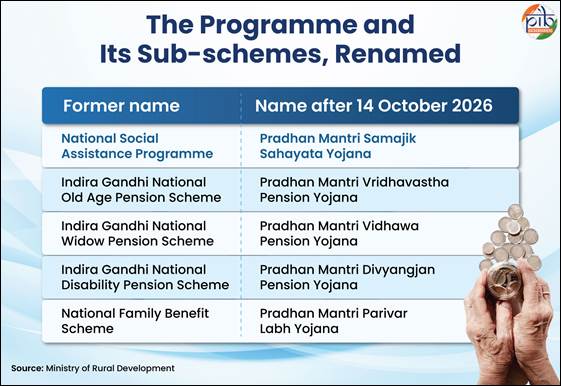
The old age pension, the widow pension and the family benefit scheme continue in their existing form. What changes is the disability pension, in its eligibility, its coverage and its rate of assistance.
What the National Social Assistance Programme Is
The programme was launched on 15 August 1995. It gives effect to Article 41 of the Constitution, which directs the State to provide public assistance in cases of unemployment, old age, sickness and disablement. It is a fully funded centrally sponsored scheme and carries 100 per cent central assistance. This ensures that a person below the poverty line receives at least the minimum support anywhere in the country. It covers both rural and urban areas, and the basic condition across its components is that the household is below the poverty line.
The programme has following components. Three are monthly pensions, for the old aged, for widows and for persons with disabilities. The fourth is a one-time family benefit on the death of a household's primary breadwinner.
States and Union Territories implement the schemes mainly through their social welfare departments, and in several States through the rural development, women and child development, revenue or labour departments. Gram Panchayats and municipalities take an active part in identifying beneficiaries, and payment is largely by direct benefit transfer.
The States and Union Territories also add their own top-up above the central rate. As on September 2026, those top-ups ranged from Rs 50 to Rs 5700 per month per beneficiary, giving an average monthly pension of around Rs 1100 in most States and Union Territories. The central rate is therefore the floor on which each State builds.
The programme covered about 3.09 crore beneficiaries, against scheme-wise ceilings for each State and Union Territory. It was allocated Rs 9,652 crore for 2025-26, of which the disability pension accounted for Rs 290 crore. The approval of 14 October 2026 puts the programme's coverage at 3.20 crore beneficiaries across all 36 States and Union Territories.
The Divyangjan Pension in Detail
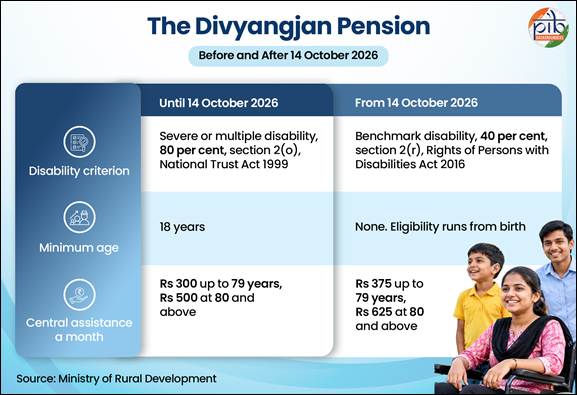
The disability pension was introduced in February 2009, as the Indira Gandhi National Disability Pension Scheme. Section 2(o) of the National Trust Act 1999 defines severe disability as disability with 80 per cent or more of one or more multiple disabilities. A person therefore had to be assessed at 80 per cent or above, and to be at least 18 years old, to receive the pension. Central assistance was Rs 300 a month for beneficiaries upto the age of 79, and Rs 500 a month for beneficiaries at age 80 and above.
Parliament then enacted the Rights of Persons with Disabilities Act 2016, to give effect to the United Nations Convention on the Rights of Persons with Disabilities. That Act sets a single working measure across its own entitlements. Section 2(r) defines a person with benchmark disability as a person with not less than 40 per cent of a specified disability, as certified by the certifying authority.
The 2016 Act has necessitated changes in the eligibility criteria for the disability pension, linking it to benchmark disability of 40 per cent.
By its decision of 14 October 2026, the Government has brought the pension, now the Pradhan Mantri Divyangjan Pension Yojana, onto that benchmark. It has removed the minimum age requirement, so that eligibility runs from birth. It has also raised central assistance to Rs 375 a month up to 79 years and Rs 625 a month at 80 years and above. The number of beneficiaries under this sub-scheme scheme has increased from 8.33 Lakhs to 27.48 Lakhs.
Revised guidelines carrying the eligibility criteria, the number of beneficiaries and the rates of assistance will be issued and implemented within three months.
Who the Decision Will Benefit
Three groups gain from the decision, and they are worth keeping distinct.
· Persons certified between 40 and 79 per cent, in households below the poverty line. The benchmark disability criterion approved on 14 October 2026 brings them within the pension.
· Children, from birth. A child with a certificate of benchmark disability in a household below the poverty line will benefit under the approved criteria, where the family earlier waited until the child turned 18.
· Persons already receiving the pension. They will receive the enhanced rates of Rs 375 and Rs 625 approved by the Government.
Three conditions are unchanged for all of them. A certificate of disability is still required, since benchmark disability under the 2016 Act is a percentage certified by the certifying authority. The household must still be below the poverty line, and the application route remains the State welfare department.
A Common Measure Across the Welfare System
Census 2011 recorded 2.68 crore persons with disabilities in India, 2.21 per cent of the population. The Schedule to the 2016 Act specifies 21 types of disabilites.
Since the 2016 Act came into force on 19 April 2017, its 40 per cent benchmark has governed disability entitlements in higher education, government employment, and land and housing. By the decision of 14 October 2026, the Government has brought its oldest social assistance programme, i.e., disability pension, in alignment with the Rights of Persons with Disabilities Act 2016.
The revised guidelines will complete the picture, carrying the eligibility criteria, the number of beneficiaries and the rates of assistance under the Pradhan Mantri Divyangjan Pension Yojana in one official document.
References
Cabinet
https://www.pib.gov.in/PressReleasePage.aspx?PRID=2323264
Ministry of Rural Development
https://www.pib.gov.in/PressReleasePage.aspx?PRID=2323266
https://www.dord.gov.in/static/uploads/2024/07/1ff5b85d83a44d7b22cda3b40547ed4c.pdf
Ministry of Social Justice and Empowerment
https://cdnbbsr.s3waas.gov.in/s3e58aea67b01fa747687f038dfde066f6/uploads/2023/10/202310161053958942.pdf
https://cdnbbsr.s3waas.gov.in/s3e58aea67b01fa747687f038dfde066f6/uploads/2023/11/202311171038909259.pdf
https://cdnbbsr.s3waas.gov.in/s3e58aea67b01fa747687f038dfde066f6/uploads/2023/10/20231107101118372.pdf
https://depwd.gov.in/en/about-department/introduction/
PIB Backgrounders
https://www.pib.gov.in/PressReleasePage.aspx?PRID=2187327
https://www.pib.gov.in/PressNoteDetails.aspx?NoteId=158466&ModuleId=3
Click here to see pdf
****
PIB Research