PIB Backgrounder
PMAY-U: The Story of Housing, Inclusion and Empowerment
Posted On:
16 SEP 2026 1:02PM by PIB Delhi
|
PMAY-U is a flagship urban housing mission aimed at ensuring Housing for All in urban areas. It provides pucca houses with basic civic amenities to eligible urban households across the country. The Mission primarily targets EWS, LIG, MIG families and slum dwellers in cities and towns. Implementation experience under PMAY-U led to the launch of a restructured PMAY-U 2.0 in 2024. Strong emphasis is placed on inclusivity, with benefits extended to women and other vulnerable urban groups. Technology-enabled systems such as geo-tagging and real-time dashboards have strengthened transparency and monitoring.
|
The Foundation of Urban Aspiration
A safe and secure home is the foundation of a dignified life. It provides families with stability, protection, and the confidence to pursue better opportunities. Access to quality housing not only improves living conditions but also contributes to better health, education, financial security, and overall well-being. For millions of urban families, a permanent home represents more than shelter; it is a pathway to a brighter and more secure future.
Recognising the transformative role of housing in fostering inclusive growth, Pradhan Mantri Awas Yojana–Urban (PMAY-U) was launched in June 2015. The Mission places affordable housing at the centre of urban development. Over the years, it has evolved the housing landscape through scale, innovation, and a focus on those who need support the most.
PMAY-U: A National Response to Urban Housing Needs
Pradhan Mantri Awas Yojana–Urban (PMAY-U) provides all-weather pucca houses with basic civic amenities to eligible urban households across the country. It focuses on the housing needs of slum dwellers and families belonging to the Economically Weaker Sections (EWS), Low Income Groups (LIG), and Middle-Income Groups (MIG). Under the scheme, central assistance is provided to States and Union Territories for the construction and delivery of affordable housing. The original mission period was up to March 2022. However, on the request of States/UTs and to ensure the completion of sanctioned projects, the scheme period has been extended until 30th September 2026. Further, based on the learnings and experiences from implementation of PMAY-U and owing to the increase in housing demand, the scheme was revamped and launched as PMAY-U 2.0 in September 2024. The scheme continues the vision of “Housing for All” in urban areas with a more responsive and inclusive approach.
Who is a beneficiary family?
A beneficiary family under PMAY-U includes a husband, wife, and unmarried sons and/or unmarried daughters. The family should not own a pucca house (an all-weather dwelling unit) anywhere in India in any member’s name. An adult earning member, regardless of marital status, is considered a separate household. This applies only if:
- He or she does not own a pucca house in his/her name anywhere in India.
- In a married couple, either spouse or both jointly can avail a single house. This is subject to household income eligibility under the scheme. An eligible beneficiary can avail benefits under only one of the Mission’s four verticals.
- Individuals with a pucca house below 21 sq. m. can be considered for upgradation with expansion of up to 30 sq. m. under the scheme. If this is not feasible due to land or other constraints, she/he can get a house under PMAY(U) elsewhere.
PMAY – Urban 2.0: Building the Next Chapter
PMAY-U 2.0 marks the next phase of India's affordable housing mission, building on the strong foundation laid by PMAY-U. The scheme aims to provide financial assistance to 1 crore additional urban poor and middle-class families and is being implemented from 2024 to 2029. Under the scheme, eligible families receive financial assistance of up to ₹2.50 lakh per unit to support the construction or purchase of affordable houses in urban areas. PMAY-U 2.0 also supports the provision of affordable rental housing for eligible beneficiaries, helping address diverse housing needs across urban India.
The PMAY-U 2.0 scheme is open to families belonging to EWS, LIG, and MIG segments. The income criteria for beneficiaries is as follows:
- EWS households: Annual income up to ₹3 lakh.
- LIG households: Annual income from ₹3 lakh to ₹6 lakh.
- MIG households: Annual income from ₹6 lakh to ₹9 lakh.
Four Verticals of PMAY-U 2.0
Building on the experience of PMAY-U, PMAY-U 2.0 adopts a similar four-pronged approach to address diverse housing needs in urban India.
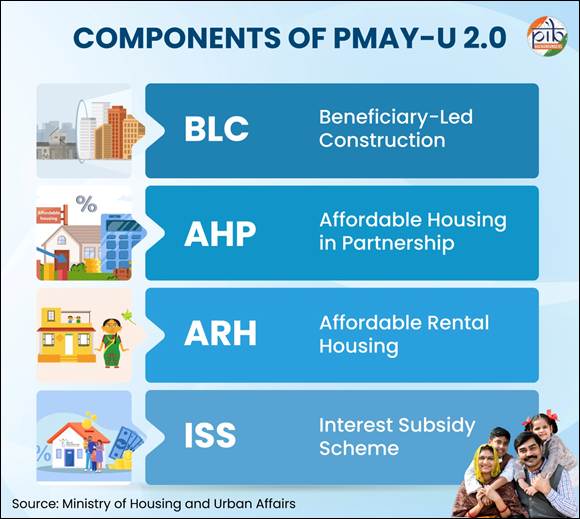
Beneficiary-Led Construction (BLC)
The BLC vertical provides financial assistance of up to ₹2.5 lakh to eligible EWS families. They can construct new pucca houses on their own available land, with a maximum carpet area of 45 sqm.
Affordable Housing in Partnership (AHP)
The AHP vertical provides financial assistance to EWS beneficiaries for owning a pucca house. Public or private agencies construct affordable houses with 30–45 sqm carpet area for eligible beneficiaries. Financial assistance of up to ₹2.5 lakh per unit is provided together by Central and State Governments towards the property's purchase price.
Affordable Rental Housing (ARH)
The ARH vertical provides affordable, dignified and hygienic rental housing for urban dwellers needing short-term accommodation or for those who are unable to buy or construct houses. It covers EWS and LIG beneficiaries, including migrants, homeless, industrial workers, working women, construction workers, urban poor and destitute persons. It also covers street vendors, rickshaw pullers, contractual employees among others. Essential infrastructure, including water, sewerage or septage, sanitation, internal roads, health centres, etc., is also addressed to make the houses livable.
Interest Subsidy Scheme (ISS)
The ISS vertical provides interest subsidy on eligible home loans under PMAY-U 2.0. It covers loans sanctioned and disbursed on or after 1st September 2024. Eligible EWS, LIG and MIG beneficiaries can avail the subsidy for purchase, repurchase or construction of houses. A maximum interest subsidy of ₹1.80 is provided to eligible beneficiaries having a loan tenure of more than five years.
Key Achievements of PMAY-U and PMAY-U 2.0
The journey of PMAY-U reflects a sustained commitment to making affordable housing accessible at scale. Between 2005 and 2014, only about 8 lakh urban houses were completed under earlier schemes. As on 9th August 2026, 1.25 crore houses have been sanctioned across PMAY-U and PMAY-U 2.0. Of these, more than 1 crore houses have been completed and delivered to beneficiaries across the country.
Ensuring Equitable Access to Urban Housing
The true success of urban development lies in how widely its benefits are shared. The Mission places inclusivity at the centre of its approach, supporting vulnerable households across cities and towns.
Women have remained at the heart of this transformation. PMAY-U mandates ownership or co-ownership of houses in the name of women beneficiaries. This provision has strengthened financial security and enhanced their role in household decision-making.
The Mission also prioritises housing access for SCs, STs, OBCs, minorities, senior citizens, persons with disabilities and transgender persons. By addressing the needs of diverse beneficiary groups, PMAY-U has helped make urban growth more equitable and accessible.
PMAY-U 2.0 continues this commitment through targeted support for diverse beneficiary groups. As on 9th August 2026, about 18.38 lakh houses have been sanctioned under the scheme. It combines home ownership opportunities with focused interventions for vulnerable communities.
- Of the 18.38 lakh houses sanctioned, 14.40 lakh houses fall under the Beneficiary-Led Construction vertical.
- 2.48 lakh houses have been sanctioned under the Affordable Housing in Partnership vertical.
- 1.36 lakh houses have been covered under the Interest Subsidy Scheme vertical.
- 13,046 dwelling units have been sanctioned under the Affordable Rental Housing component.
- Among the 1.25 crore houses sanctioned under PMAY-U and PMAY-U 2.0, 1 crore houses have been allotted to women (in the name of female head of the household or in joint ownership).
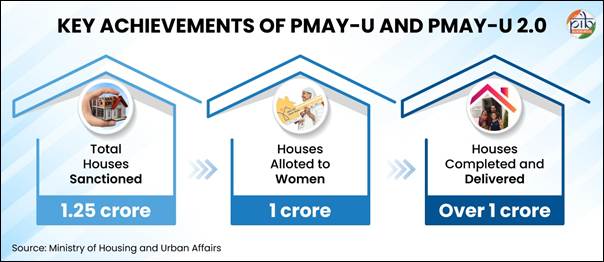
These achievements reflect the Mission's continued focus on ensuring that housing benefits reach those most in need. By combining affordability with inclusion, PMAY-U is helping create more equitable and resilient urban communities.
Technology-Enabled Implementation and Monitoring
Modern technology has added a new dimension to urban housing delivery. Digital dashboards, geo-tagging and integrated monitoring systems have strengthened implementation under PMAY-U. These tools have improved transparency and enhanced project monitoring.
- Unified Web Portal: The Unified Web Portal of PMAY-U 2.0 serves as a single digital platform for the implementation and monitoring of the scheme across urban areas. It enables eligible beneficiaries to apply for housing assistance and facilitates the processing and tracking of applications. The portal brings together key stakeholders, including beneficiaries, Urban Local Bodies (ULBs), States/UTs and other implementing agencies, on one platform. It also facilitates geo-tagging of houses at different stages of construction and streamlines fund disbursement, ensuring transparency, accountability and efficient monitoring of the scheme.
- PMAY-U Dashboard: The dashboard provides real-time progress on key performance indicators, accessible to States, UTs, ULBs/implementing agencies, Hon’ble MPs and MLAs, beneficiaries and all concerned stakeholders. This enables informed and data-driven decision-making and facilitates effective monitoring of implementation.
- Geo-tagging: Projects are tracked across five stages starting from grounding, foundation, superstructure, finishing & external development, and completion. This staged monitoring ensures large-scale projects remain on schedule and meet quality benchmarks.
- Technology Sub-Mission (TSM): This supports the adoption of modern, green and innovative construction technologies for faster and better-quality housing. Under TSM, Global Housing Technology Challenge – India (GHTC-India) was organized. A total of 54 proven technologies from across the world were shortlisted as mainstream, globally proven disaster-resilient technologies. Six Light House Projects (LHPs) using six distinct technologies shortlisted under GHTC-India are constructed at six places in the country.
- Technology and Innovation Sub-Mission (TISM): Building on TSM’s progress, the Technology & Innovation Sub-Mission (TISM) under PMAY-U 2.0 promotes innovation in housing construction. It encourages innovative design, quality assurance, and adoption of green building standards for sustainable housing. TISM supports climate-responsive layouts and building plans across diverse geo-climatic zones.
- Technology Innovation Grant (TIG): PMAY-U 2.0 provides an additional Technology Innovation Grant (TIG) for AHP projects. The grant supports the use of innovative and alternative technologies notified under the GHTC-India.
Impact on Beneficiary Lives
The real impact of PMAY-U is best understood through the lives it has transformed across urban India. These success stories reflect how secure housing has strengthened dignity, stability and self-reliance for beneficiaries.
A Roof of Their Own, A Future of Possibilities
Mandhalapu Ananthalakshmi lived with her husband and three children in a small house with a temporary roof in Addanki, Andhra Pradesh. The family depended on buffalo rearing for a modest income, and owning a permanent home seemed beyond their reach. After receiving support under PMAY-U, they overcame financial constraints by constructing the house themselves. The new pucca house brought safe sanitation, ended open defecation, and improved their quality of life. More importantly, it instilled confidence, inspiring the family to invest in their children’s future.
From Constant Repairs to Lasting Stability
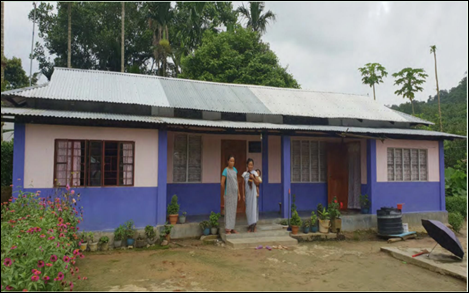
In Nongpoh town, Meghalaya, Lucybon Syngkli supports her father and sisters as the family’s sole breadwinner. An ASHA worker and pineapple cultivator, she lived in a kutcha house that required frequent repairs, especially during the rainy season. The costs often strained the family’s finances and affected her father’s medical care. After becoming a PMAY-U beneficiary, Lucybon secured a permanent all-weather home, reducing maintenance expenses and improving the family’s financial stability. The savings help meet her father’s healthcare needs. The family has also adopted rainwater harvesting, planted fruit-bearing trees, received an LPG connection and switched to LED lighting. Their new home has brought peace of mind for the entire family.
Advancing the Vision of Housing for All
The story of a city is ultimately the story of the people who call it home. As urban centres grow and evolve, housing becomes one of the most visible indicators of inclusion, opportunity and quality of life. The journey of PMAY-U reflects this understanding. It has brought housing closer to millions who had long remained on the margins of urban development. In doing so, it has helped transform home ownership from an aspiration into a reality for countless households across the country. The Mission has also been strengthened by the use of technology-driven systems for planning, monitoring and transparent implementation. Through PMAY-U 2.0, the mission continues to ensure that every family has a safe place to call home.
Ministry of Housing and Urban Affairs
https://pmay-urban.gov.in/about
https://pmaymis.gov.in/pmaymis2_2024/PMAY_SURVEY/EligiblityCheck.aspx
https://www.pib.gov.in/PressReleasePage.aspx?PRID=2274164®=48&lang=2
https://www.pib.gov.in/PressReleasePage.aspx?PRID=2239027®=48&lang=2
https://dashboard.pmay-urban.gov.in/
https://www.pib.gov.in/PressReleasePage.aspx?PRID=2231861®=3&lang=2
https://pmay-urban.gov.in/uploads/progress-pdfs/68ac528160e77-Achievement_under_PMAY-U_&_PMAY-U2.0_cropped.pdf
https://pmay-urban.gov.in/uploads/guidelines/AHP-SOP.pdf
https://pmaymis.gov.in/PMAYMIS2_2024/PmayUrban.aspx
https://pmay-urban.gov.in/uploads/pmayu-9-years/Booklet.pdf
https://www.pib.gov.in/PressReleasePage.aspx?PRID=1953776®=48&lang=2
https://www.pib.gov.in/PressReleaseDetail.aspx?PRID=2296797®=48&lang=1
https://pmay-urban.gov.in/uploads/success-stories/605c36ab8e06f-Meghalaya_Lucybon%20Syngkli.pdf
https://pmay-urban.gov.in/uploads/success-stories/605c2ccda9adb-Andhra%20Pradesh_Mandhalpu%20Ananthalakshmi.pdf
https://pmay-urban.gov.in/uploads/success-stories/605c347e9d8cd-Kerala%20A%20R%20Ragasree.pdf
https://pmay-urban.gov.in/uploads/guidelines/Operational-Guidelines-of-PMAY-U-2.pdf
Click here to see pdf
***
PIB Research
(Release ID: 2310759)
Visitor Counter : 405