PIB Backgrounder
Data Centres in India Infrastructure for the Digital Age
Posted On:
14 SEP 2026 11:05AM by PIB Delhi
|
Data centres are the invisible engines powering India’s digital life. They support banking, e-Governance and online services every second. As emerging technologies drive rapid data growth, the Government is building a supportive policy ecosystem. Infrastructure status, fiscal incentives and clean energy adoption are strengthening India’s data centre ecosystem.
|
Strengthening India's Digital Infrastructure through Data Centres
India’s digital economy is entering a new phase of rapid growth and technological transformation. Digitalisation is reshaping productivity, competitiveness and service delivery across sectors. As digital services expand, they are generating unprecedented demand for computing capacity, data storage and high-speed connectivity. Meeting this demand requires infrastructure that can operate continuously, securely and at scale. Data centres provide this critical foundation, powering the digital services that increasingly drive India’s economy and governance.
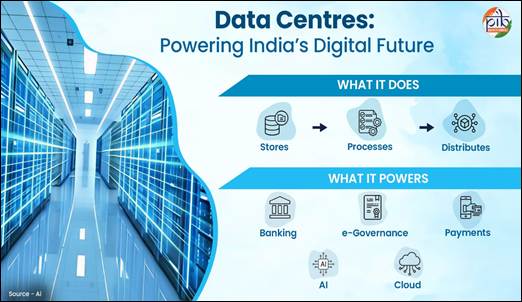
A data centre is a secure facility that houses computing, storage and networking equipment. It stores, processes, manages and distributes large volumes of digital information. These capabilities support online banking, e-Governance, digital payments, cloud computing and other emerging technologies.
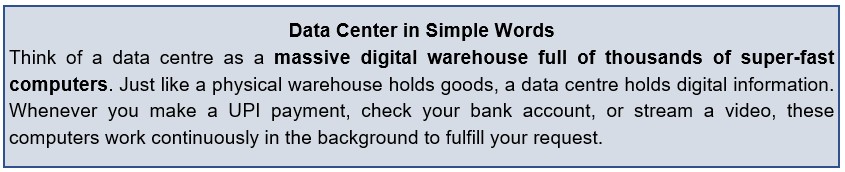
Modern data centres integrate computing, networking, power, cooling, security and management systems. These systems work continuously to maintain reliable operations, data security and uninterrupted digital services. As India’s digital economy expands, resilient data centres are becoming a strategic infrastructure for innovation, competitiveness and sustained digital growth.
Inside a Data Centre: The Technologies Powering Digital Services
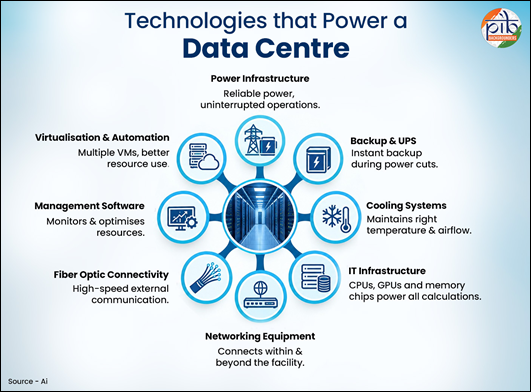
A data centre relies on a reliable power infrastructure to ensure uninterrupted operation of critical equipment. Data centre computers can never turn off—not even for a millisecond. Uninterruptible Power Supplies (UPS) provide immediate backup during electrical interruptions. Backup generators and electrical distribution systems provide additional resilience during prolonged power disruptions. Continuous operations of this scale requires cooling systems to maintain suitable operating conditions for the computing equipment. Heating, Ventilation and Air Conditioning (HVAC) systems regulate temperature and airflow within the facility. Advanced airflow management and liquid cooling further improve thermal efficiency and reliability.
The Information Technology (IT) infrastructure then performs the core computing functions. Servers process information and run digital applications. Storage systems securely hold large volumes of data using Hard Disk Drives (HDDs) and Solid-State Drives (SSDs). Security systems protect equipment, networks and data from physical and digital threats.
Networking equipment, including routers and high-speed switches, enables data exchange within and beyond the facility. Fiber-optic connections provide high-speed communication between the data centre and external networks.
Finally, management software monitors the systems and helps optimize the use of computing resources efficiently. Virtualisation allows multiple virtual machines to run on one physical server, improving resource use. Imagine taking one large house and dividing it into several separate apartments. Virtualization allows one physical computer to run multiple virtual "mini-computers" inside it, maximizing resource efficiency. Automation tools manage workloads, support maintenance and help identify operational problems.
From Click to Response: How a Data Centre Handles Your Request
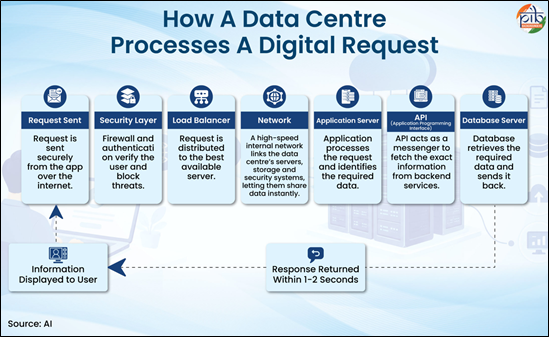
Every digital request begins with a simple action, such as opening an app, checking a bank balance or accessing a document. Behind the instant response, the request travels through a network to a data centre, where multiple systems work together to process it securely and efficiently.
The security layer first checks the request and protects the system from cyber threats. The load balancer then directs the request to an available server, helping distribute the workload efficiently.
The application server processes the request and determines what information or service is required. If necessary, it uses an Application Programming Interface (API) to communicate with other applications or services.
The database server then retrieves the required information and sends it back to the application server. Once processed, the information travels back through the network and reaches the user’s device.
This entire process can take just 1–2 seconds, enabling fast and seamless digital services. This interconnected chain— Connect → Receive → Network → Process → Store → Secure → Respond—allows cloud services, e-governance platforms and Artificial Intelligence (AI) applications to deliver information reliably and at scale. It shows why modern data centres are far more than storage facilities; they are the digital infrastructure that enables everyday online services.
|
In Simple Terms: The Behind-the-Scenes Team
- Network = The Corridors & Intercom, the internal hallways that connect the whole team so they can pass information to each other instantly.
- Security Layer = The Security Guard, inspects your request at the entrance for safety.
- Load Balancer = The Traffic Cop, directs incoming digital traffic so no single server gets overwhelmed
- Application Server = The Chef, takes your order, figures out what information or recipe is needed.
- API = The Waiter, acts as a messenger.
- Database Server = The Digital Vault, where details are locked away and retrieved when needed.
|
Status of Data Centers in India
India’s data-centre journey has evolved alongside the rapid expansion of e-Governance and digital services. Rising citizen expectations for online services are increasing demand for robust data-centre infrastructure. The National Informatics Centre (NIC) has established state-of-the-art National Data Centres across the country. These include facilities at NIC Headquarters in Delhi, Pune, Hyderabad and Bhubaneswar. NIC has also established 37 smaller Data Centres at various State Capitals. These facilities provide reliable digital services to Government institutions at different levels. They support round-the-clock operations, system management and skilled onsite personnel.
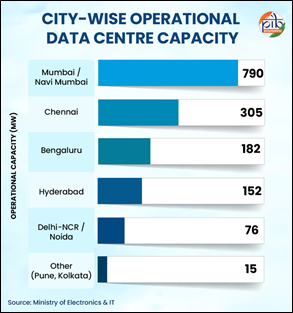
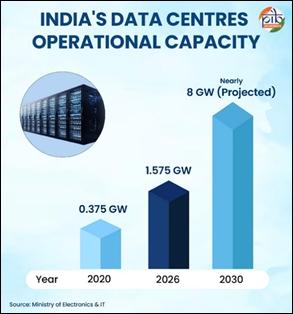
India’s rapidly expanding digital economy is further strengthening demand for secure and reliable data infrastructure. Installed data-centre power capacity stood at around 375 MW in 2020. It has increased to 1.57 GW as of August 2026. The capacity is projected to expand further to nearly 8 GW by 2030. Investments of nearly USD 70 billion are already underway in India’s data centre sector, with an additional USD 90 billion in announced projects, highlighting the scale of expansion and reflecting strong investor confidence.
Enabling Policy Environment for Data Centres
The Government has strengthened the data-centre ecosystem through targeted policy and fiscal measures. In the Union Budget 2022–23, data centres were included in the Harmonized List of Infrastructure. This accorded infrastructure status to data centres and facilitated greater access to credit for digital infrastructure. The measure also supported investment and expansion of India’s data-centre capacity.
|
Infrastructure Status in Simple Terms
Giving data centres "Infrastructure Status" treats them like national highways, airports, and power grids, granting them access to easier and cheaper long-term loans.
|
The Union Budget 2026–27 further introduced a tax holiday for eligible foreign cloud service providers until 2047. The incentive applies to global operations using India-based data-centre infrastructure. It covers Tax Years 2026–27 to 2046–47 for notified foreign companies. These measures strengthen India’s investment environment for data centres and cloud infrastructure.
|
Linked Ecosystem Schemes Supporting Data Centre Growth
- The second phase of the Semicon India Programme (Semicon 2.0) was approved by the Union Cabinet on 15.07.2026, with an outlay of ₹1,27,500 crore under the India Semiconductor Mission (ISM). It aims to holistically build a trusted and resilient semiconductor ecosystem in the country.
- The IndiaAI Mission was approved with a total budget outlay of ₹10,371.92 crore to build a comprehensive AI ecosystem in the country. The AI ecosystem being fostered under the Mission is a key driver of data centre growth in India.
- The Electronics Components Manufacturing Scheme (ECMS) has also received higher financial support. Its allocation increased from ₹22,000 crore to ₹40,000 crore.
- The Government of India has also launched PLI Scheme 2.0 for IT Hardware to create a robust domestic manufacturing ecosystem for IT hardware (such as servers), attract large investments, reduce import reliance, and make India a trusted global supply chain hub.
|
Sustaining the Data Centre Sector: Energy and Water Planning
Data centre capacity is expanding rapidly, making energy and resource efficiency increasingly important. Data centres require reliable electricity and efficient cooling systems for continuous operations. According to the Central Electricity Authority (CEA), Ministry of Power, demand could reach 17 GW by 2031–32. As the sector is expanding, the Government is also promoting cleaner energy and efficient resource use to support sustainable sectoral growth.
Renewable Energy & Clean Power
The Government is promoting renewable energy through several key initiatives. These include the Green Energy Open Access Rules, Green Energy Corridor Scheme and National Green Hydrogen Mission. The National Programme on High Efficiency Solar PV Modules and Solar Park Scheme further support clean-energy deployment. These measures improve access to cleaner and more reliable power for energy-intensive digital infrastructure.
The Sustainable Harnessing and Advancement of Nuclear Energy for Transforming India (SHANTI) Act strengthens the clean-power ecosystem. It supports reliable nuclear power for emerging sectors, including Artificial Intelligence and data centres. The framework also enables future deployment of Small Modular Reactors and Micro Nuclear Reactors.
BIS Standards for Data Centres
The Bureau of Indian Standards (BIS) has developed standards for data-centre efficiency. Its technical committee LITD 31 covers Cloud Computing, Information Technology and Data Centres. BIS has published standards covering Power Usage Effectiveness (PUE) and Carbon Usage Effectiveness (CUE). These standards also address Cooling Efficiency Ratio (CER) and Water Usage Effectiveness (WUE).
|
In Simple Terms
PUE and WUE - serve as green mileage ratings to measure how efficiently a facility uses electricity and water.
CUE measures how much carbon pollution a data centre produces for every bit of electricity its computers use.
CER measures how efficiently the cooling systems (like fans, chilled water pipes, or liquid coolant) remove that heat relative to the electricity they consume.
|
Energy and Water Efficiency Standards
The Bureau of Energy Efficiency (BEE) has notified the Energy Conservation Building Code (ECBC) 2017. It also notified the Energy Conservation and Sustainable Building Code (ECSBC) 2024. These codes prescribe energy-efficiency and water-conservation norms for buildings. They also include provisions relevant to data-centre infrastructure.
Advanced Cooling and Water Management
Data-centre water requirements depend on the cooling technologies deployed. Groundwater extraction, including for industrial purposes, is regulated under guidelines issued by the Ministry of Jal Shakti. AI infrastructure is driving adoption of advanced cooling technologies in data centres. These include direct-to-chip liquid cooling, adiabatic cooling and immersion cooling. Closed-loop liquid cooling systems are also emerging as resource-efficient solutions.
Way Forward
India’s data-centre growth reflects a steady policy journey towards a resilient and sovereign digital infrastructure. It is increasingly important for data sovereignty, digital trust, economic competitiveness and technological self-reliance. The expansion of cloud and Artificial Intelligence infrastructure is creating new opportunities for innovation and economic growth. However, this growth also requires responsible governance of data, technology, energy and digital infrastructure. A technology governance approach can help balance innovation with security, sustainability, accountability and public interest. This requires strong standards, robust cybersecurity, responsible data practices and efficient resource management. It also calls for greater domestic capabilities across computing, semiconductors, energy and critical digital infrastructure. As India advances towards Viksit Bharat by 2047, data centres can serve as a foundational layer of the digital economy.
References:
Niti Aayog
Ministry of Electronics & IT
Ministry of Finance
Ministry of Communications
Press Information Bureau
Others:
Click here to see pdf
PIB Research
(Release ID: 2309950)
Visitor Counter : 328