Ministry of Statistics & Programme Implementation
Quarterly Bulletin of Unincorporated Sector Enterprises (QBUSE)
(Survey period: April 2026 to June 2026)
Unincorporated Sector registered resilient Y-o-Y growth of 9.2% despite global uncertainties
Women's Share in Workforce Expands to 30%
Digital adoption maintains momentum: 8 in 10 Establishments Go Online and Cashless
Posted On:
21 AUG 2026 4:00PM by PIB Delhi
|
Snapshot:
- Both the number of establishments and employment recorded significant growth over the corresponding quarter of the previous year (April–June 2025).
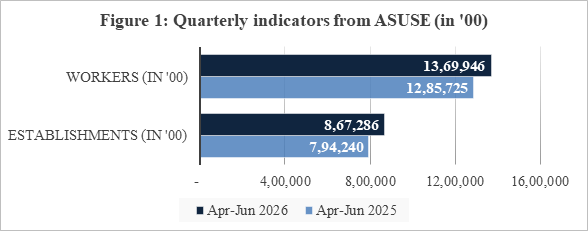
- The estimated number of establishments stood at 8.67 crore, registering a Year-on-Year growth of 9.20%.
- Employment in the unincorporated non-agricultural sector reached 13.70 crore, with the Other Services sector emerging as a key driver, recording employment growth of more than 21%.
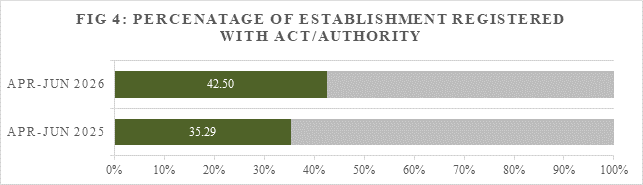
- Enterprise Registration Rises to 42.5% in April–June 2026, up over 7 percentage points from April–June 2025, signalling increasing formalisation.
- Cashless transactions gained widespread acceptance, with about 80% of establishments adopting cashless modes of transaction.
- The participation of women in the workforce continued to strengthen, with women accounting for more than 30% of total employment in the sector.
|
NSO Releases Quarterly Estimates of the Unincorporated Non-Agricultural Sector for the quarter April to June 2026
In line with its commitment to strengthening the availability of high-frequency indicators, the National Statistics Office (NSO), Ministry of Statistics and Programme Implementation (MoSPI), has been publishing quarterly bulletins on key findings from the unincorporated non-agricultural sector since 2025. The present release, the Quarterly Bulletin on Unincorporated Sector Enterprises (QBUSE) for April–June 2026, represents the quarterly edition of the Annual Survey of Unincorporated Sector Enterprises (ASUSE) and provides key estimates at more frequent intervals. The introduction of QBUSE reflects NSO’s continued efforts to deliver timely and actionable data to policymakers, researchers, and other stakeholders on one of the most dynamic segments of the Indian economy.
While ASUSE will continue to publish detailed annual estimates on a wider set of financial and non-financial indicators, QBUSE delivers periodic quarterly estimates on the scale, composition, and employment profile of unincorporated non-agricultural enterprises using the same framework. The quarterly data aims to capture short-term movements in the sector.
The unincorporated non-agricultural sector plays a vital role in the Indian economy being a major contributor to GDP, a significant source of employment, and a crucial driver of local entrepreneurship and supply chains. Recognizing its importance, the NSO launched the ASUSE in 2021–22. This was followed by three successive annual rounds, providing comprehensive and consistent insights into the structure, operations and economic performance of the sector. This press note is for the quarterly bulletin for the quarter April - June, 2026. It is available on the website of the Ministry (https://mospi.gov.in).
A brief overview of the coverage, sampling methodology, and data collection mechanism of ASUSE 2026 are provided in the Endnote.
Key highlights of the results for the quarter April - June, 2026:
Unincorporated Sector Records Strong Year-on-Year Growth
The unincorporated non-agricultural sector maintained its resilient year-on-year (Y-o-Y) growth momentum during the April–June 2026 quarter despite global uncertainties. The sector remained a significant source of employment and livelihood for a diverse workforce.
Similar annual estimates from the latest ASUSE (Jan 25- Dec 25)
- Estimated number of establishments 7.92 crores
- Estimated number of workers 12.81 crores
|
The estimated number of unincorporated establishments increased by 9.20% year-on-year, rising from 7.94 crore in April–June 2025 to 8.67 crore in April–June 2026.
Workforce Trends: Employment in the unincorporated non-agricultural sector was estimated at 13.70 crore during the April–June 2026 quarter, registering a year-on-year growth of 6.55% over the corresponding quarter of the previous year. This growth was primarily driven by the services sector, which recorded an increase of over 21% in its estimated workforce.
The estimated number of establishments and workers from quarterly data are given in Figure 1:
Changing Workforce Composition:
Working owners continued to account for the largest share of the workforce in the unincorporated sector for the April–June 2026 quarter, constituting 62.38% of total workers, compared to 60.18% in the corresponding quarter of the previous year. In contrast, the share of hired workers witnessed a marginal decline, falling to 22.77% from 24.38% over the same period.
The urban sector outperformed the rural sector in employment growth during April–June 2026, registering a robust year-on-year growth of over 12%, compared with 0.70% growth in rural sector.
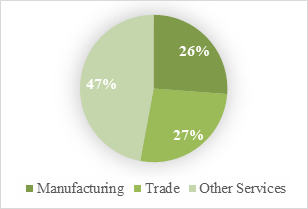
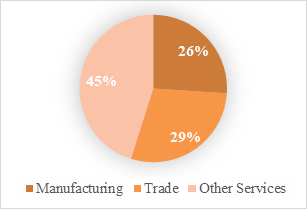
The percentage share of establishments and workers among Broad Activity Categories (Manufacturing, Trade and Other Services) is given in Figure 2 and Figure 3 respectively.
|
Fig 2: Percentage Share of Establishments among Broad Activity Categories (Apr- Jun '26)
|
Fig 3: Percentage Share of Workers among Broad Activity Categories (Apr- Jun '26)
|
|
|
|
Services Sector Emerges as Key Driver of Growth:
The other services sector recorded the highest growth among all sectors, with both establishments and employment increasing by over 21% year-on-year. This was followed by the manufacturing sector, which registered growth of 10.06% in the estimated number of establishments and 6.60% in the estimated workforce.
However, the unincorporated trade sector recorded a year-on-year decline of 7.88% in the estimated number of establishments and 10.29% in the estimated workforce. While the survey does not provide information on the specific factors underlying these changes, it is worth noting that the retail landscape has been undergoing significant transformation, including the expansion of e-commerce and quick-commerce platforms, alongside global economic challenges. These developments provide a broader context to the changing business environment.
Women’s Participation:
The women workforce remained impressive, constituting more than 30% of total employment in the sector. This is slightly higher than the same observed during April-June 2025. The gradual increase in percentage share of female workers highlights the growing importance of the sector in generating employment opportunities for women and promoting inclusive economic participation.
Digital Adoption and Advancing Formalisation:
Internet usage among enterprises in the unincorporated non-agricultural sector reflects an encouraging trend of digital adoption across establishments in the economy. Data on ICT usage indicates that around 82% of establishments in the unincorporated sector have used internet for entrepreneurial purposes. Further, nearly 80% of establishments have adopted cashless modes of transaction, including online banking, UPI, POS devices, and other digital payment mechanisms.
Use of Cashless mode of Transaction:
ICT module of ASUSE has been significantly revamped from 2026 to capture more policy relevant question for the unincorporated sector. A newly added question in the schedule was about usage of online banking and/or online payment gateway by the establishment.
|
The percentage of firms reporting some form of registration was estimated to be 42.50%, more than 7 percentage point higher than that observed during April-June 2025, indicating an increasing trend in integration of enterprises with regulatory mechanisms.
Key indicators of QBUSE for the quarter April-June 2026:
|
Indicator
|
April-June 2026
|
|
Number of Establishments (in ’00)
|
8,67,286
|
|
Percentage of proprietary and partnership establishments
|
98.88
|
|
Percentage of hired worker establishments
|
12.13
|
|
Number of Workers (in ’00)
|
13,69,946
|
|
Percentage share of working owners
|
62.38
|
|
Percentage share of hired workers
|
22.77
|
|
Percentage share of other workers (including unpaid family workers)
|
14.85
|
Endnote: A brief about the coverage, sampling scheme, and data collection mechanism in the Annual Survey of Unincorporated Sector Enterprises (ASUSE):
A. Coverage:
A.1. Geographically, the survey covers the rural and urban areas of whole of India (except some of the villages in Andaman and Nicobar Islands, which are difficult to access).
A.2. Sector-wise, this survey captures unincorporated non-agricultural establishments belonging to three sectors viz., Manufacturing, Trade and Other Services.
A.3. Ownership-wise, unincorporated non-agricultural establishments pertaining to proprietorship, partnership (excluding Limited Liability Partnerships), co-operatives, societies/trusts etc. have been covered in this survey.
B. Sampling Scheme:
The survey has been conducted following a multi-stage stratified sampling scheme, where first stage units (FSUs) are census villages in rural area (except for rural Kerala, where Panchayat wards have been taken as FSUs) and UFS (Urban Frame Survey) blocks in urban areas which are updated periodically. The ultimate stage units (USUs) are establishments for both the sectors. In the case of large FSUs, one intermediate stage of sampling has been done in the form of hamlet groups in rural and sub-blocks in urban.
C. Sample Size:
At all-India level, 5,994 First Stage Units (2,411 villages in rural sector and 3,583 UFS blocks in urban sector) have been surveyed during the quarter April, 2026 – June, 2026. This excludes FSUs of Andaman & Nicobar Islands, Lakshadweep, Ladakh and rural areas of Arunachal Pradesh and Nagaland which are not considered for this quarterly bulletin, as sub-round restrictions were not imposed in these areas while conducting field-work, due to arduous field conditions. Accordingly, the number of establishments surveyed (excluding these states/UTs/areas) and considered for this bulletin are 1,75,618 (74,621 in rural and 1,00,997 in urban).
D. Data Collection Mechanism:
The survey has been conducted based on area frame and establishments have been listed in the selected FSUs of both rural and urban sector and from the listed establishments in the FSUs, requisite number of establishments were surveyed as per the sampling design. Mostly, data were collected from the selected establishments through oral enquiry pertaining to the ‘monthly’ reference period. The data for the survey were collected in Tablet using Computer Assisted Personal Interviewing (CAPI).
E. Comparability of quarterly results with previously released estimates of ASUSE and caveats:
The estimates presented in this quarterly bulletin pertain specifically to the unincorporated non-agricultural sector for the reference quarter under consideration. The comparison presented in this bulletin is between the quarter under consideration in the current year and the corresponding quarter of the previous year. Such year-on-year comparison accounts for inherent seasonal variations, if any, and facilitates a more meaningful assessment of annual growth trends since the comparison is made between the same periods of two years.
Although sampling design of ASUSE has provision for generation of quarterly estimates using an area frame, the quarterly sample size is significantly less than the annual sample size. Also, the area frame used for rural sector is based on Census 2011. This bulletin has been prepared with due consideration to sample adequacy and reliability of the estimates.
As part of the continuous effort to keep the survey relevant and responsive to stakeholder requirements, a few changes have been introduced in ASUSE 2026. The ICT block of the ASUSE questionnaire has been comprehensively redesigned with more policy-oriented questions to better capture the extent and nature of ICT usage in the sector. Further, ASUSE 2026 has adopted NIC 2025 in place of NIC 2008, which was used in the earlier rounds of ASUSE. Due to this, some activities like maintenance and repair of motor vehicles and maintenance and repair of motor cycles, mopeds, scooters and three wheelers that were considered under trade in NIC 2008 are now being considered under service sector (NIC 2025) and accordingly, all such establishments engaged in these activities are now counted in “other services” in ASUSE 2026.
Accordingly, users may interpret quarterly movements with caution, considering potential sampling variability, and short-term fluctuations in activity levels and changes in classification and questionnaire. It is important to note that ASUSE covers only a part of the non-agricultural economy, namely, the unincorporated segment of the establishments in manufacturing, trade and services (excluding construction). Hence, the trends observed in the quarterly results of the unincorporated sector as presented in QBUSE, may not directly align with the corresponding quarterly GDP estimates which covers the entire economy. Where relevant, the estimates presented in the Quarterly Bulletin are accompanied by confidence intervals to enable informed interpretation of the estimates.
The Quarterly Bulletin for the quarter April– June, 2026 is available on the website of the ministry (https://www.mospi.gov.in).Scan the below QR code to access the Publications/Reports

****
Samrat
(Release ID: 2301953)
Visitor Counter : 1359