Posted On:
16 JUL 2026 8:08PM by PIB Delhi
India’s fashion and apparel industry stands at a historic inflection point, moving beyond its traditional manufacturing strengths towards recognition for design innovation, quality and cultural distinctiveness. With India’s textile and apparel exports reaching approximately INR 3.16 lakh crore in 2025 – 26 and a target of INR 9 lakh crore by 2030, alongside an expanding network of FTAs opening access to major global markets, the session examined how Indian brands can translate competitiveness into sustained international growth by building strong brand identities, scaling omnichannel capabilities and navigating evolving consumer and regulatory requirements.
Against this backdrop, a session on “Indian Brands, Global Ambitions: Redefining Retail Growth Beyond Borders” was held on 16th July 2026 at Bharat Tex 2026, Bharat Mandapam, New Delhi, bringing together designers, entrepreneurs, e-commerce platforms and manufacturers to discuss how Indian textile and lifestyle brands can scale for global markets while staying rooted in craft and heritage. The session brought together 20+ distinguished panelists including Indian brands, luxury designers, e-commerce platforms and Industry leaders from brands such as PDS, Welspun World, Neytt Homes, Pashmina.com, ExpoBazaar and Trident. The panelists shared their perspectives on scaling Indian brands globally, strengthening retail competitiveness and leveraging innovation to expand into international markets.
While addressing the gathering of Indian textile and apparel brands, designers, e-commerce platforms, retailers, exporters, and innovation leaders, Shri Giriraj Singh, Union Minister of Textiles, shared a compelling vision for the future of India's textile sector. He highlighted the immense potential for Indian artisans, designers, and MSMEs to build globally trusted brands while preserving the country's exceptional craftsmanship, rich textile heritage, and cultural legacy.
He emphasised on the importance of quality, sustainability and traceability to Indian brands for propelling in global markets, in addition to the quantity, while showcasing the richness of India’s crafts and textile heritage to the world. The Hon'ble Minister emphasized that "Artisans Bharat ki punji hain", reaffirming that India's artisans and weavers are at the heart of India’s textile ecosystem. He noted that initiatives such as Bharat Tex 2026 provide a global platform to showcase their craftsmanship, connect them with international buyers, and create new opportunities for sustainable livelihoods while preserving India's rich textile heritage.
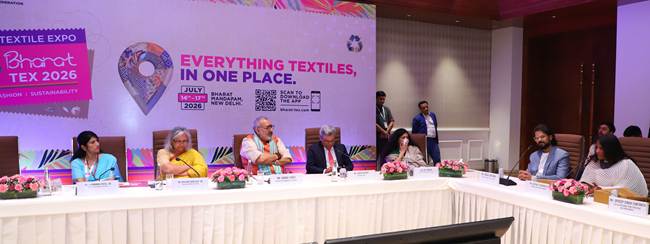
Indian brands are at an opportune moment to advance their global ambitions and redefine growth by leveraging pillars like quality, sustainability, heritage and craftsmanship, he further added. He emphasized the importance of promoting India’s rich handicrafts heritage globally and called for greater support to manufacturers, artisans and weavers, describing them as India’s greatest strength and stressing that empowering them is essential for achieving inclusive and globally competitive growth in the textile sector.
Prominent Indian designers like Vaishali Shadangule and Rahul Mishra also presented their viewpoint regarding the growing prominence of Indian brands and crafts in the global arena. Sharing her journey, Vaishali Shadangule highlighted how her initiative began with just four weaving families and has since grown into a community where over 90 per cent of the weavers are young women, creating sustainable livelihoods while preserving traditional crafts. She also spoke of her vision to revive 100 lost weaves of India, stating, “If you want to capture the global market, you have to showcase the strengths of Indian weaves.” Shri Nand Kishore Chaudhary, Founder, Jaipur Rugs emphasised that authentic storytelling is a brand’s strongest defence, observing that the deeper a brand draws from its roots, the harder it becomes for competitors to replicate.
Rahul Mishra emphasized on supporting indigenous craftsmanship, stating “Focus on remaining true to Indian craftsmanship rather than altering designs to suit every geography, noting that authenticity itself is a source of differentiation”. Handmade crafts and handlooms are, where the soul of India is, especially in the age of AI, he further added.
E-commerce leaders positioned marketplaces and omnichannel strategies as central to international expansion, noting that while scaling takes time, it creates long-term sustainability once achieved. Shri Srinidhi Kalvapudi, Country Head, Amazon Global Selling, observed that the platform supports more than two lakh sellers, including artisans from tier-two and tier-three cities. Stressing the importance of brand creation, she remarked, “India should not only export more but also be remembered more,” adding that “building brands is no longer optional; it is existential.” Speakers also discussed the role of technology, data and artificial intelligence, including AI-enabled solutions across regional languages, and identified practical enablers such as a trust mark, sample logistics support and incentives for business-to-consumer exports.
Large-scale manufacturers highlighted the need to strengthen India’s production ecosystem, supply chains and global competitiveness. Dr. Anil Rajvanshi, Senior Executive Vice President & Head Corporate & Industry Affairs, Reliance Industries appreciated the Government’s efforts towards cluster development, noting that integrated manufacturing ecosystems would enable Indian brands to achieve greater scale and efficiency. Shri Venkatesalu Palaniswamy, Managing Director, Trent emphasised that India must build a strong global identity for its textiles, supported by consistency in quality, delivery and services, while ensuring greater transparency and speed across the value chain. Speakers also questioned why cotton, one of India’s core strengths, is often processed and branded elsewhere, and called for a central institution offering end-to-end support for building global brands, drawing an analogy with NASSCOM. Sustainability was identified as a key enabler for accessing global markets, while collaboration between large exporters and designers was seen as essential to combining scale with creativity.
Senior officials reinforced these themes discussed during the session. Shri Jawed Ashraf (IFS), Chairman, ITPO stressed that India sells not only quantity but also quality, and that the “Made in India” identity must become synonymous with high standards, while noting that exhibitions remain vital platforms for MSMEs. Smt. Neelam Shami Rao, Secretary, Ministry of textiles emphasised the need for stronger designer houses, shared infrastructure and greater e-commerce visibility, observing that brand-building is a long-term endeavour, while addressing the gathering of Indian brands and designers.
The session concluded with a call for greater collaboration between government and industry to position Indian brands as a trusted, high-quality, and internationally recognisable brand, with an emphasis on strengthening craft visibility, cluster development, and storytelling and content as key levers for growth.
*****
MAM/VN