Posted On:
16 JUL 2026 6:14PM by PIB Delhi
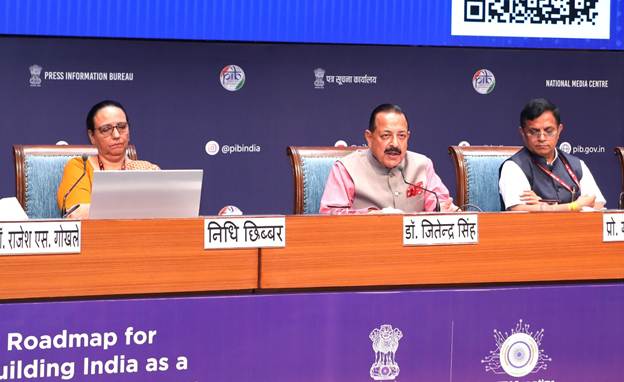
Union Minister of State (Independent Charge) for Science & Technology and Earth Sciences; Minister of State in the Prime Minister's Office, Department of Atomic Energy, Department of Space, Personnel, Public Grievances & Pensions, Dr. Jitendra Singh today announced the introduction of India's first Engineering Biology graduation course, describing it as a significant step towards building an independent and sovereign biotechnology ecosystem capable of supporting the country's long-term scientific, healthcare and economic aspirations.
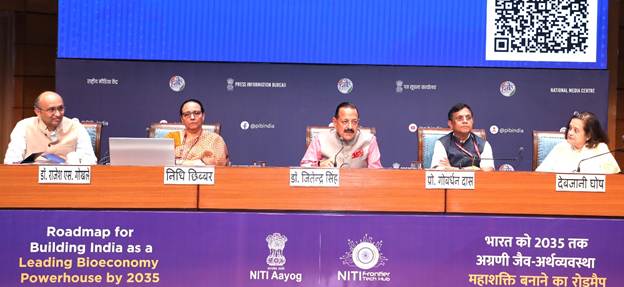
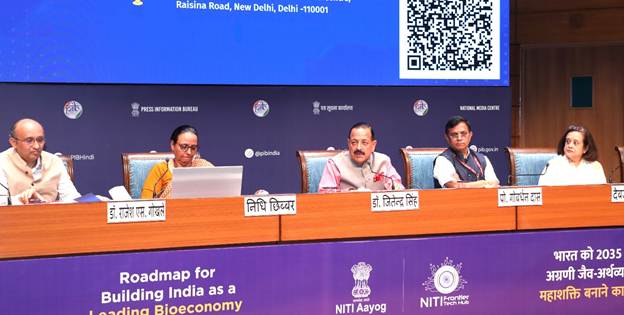
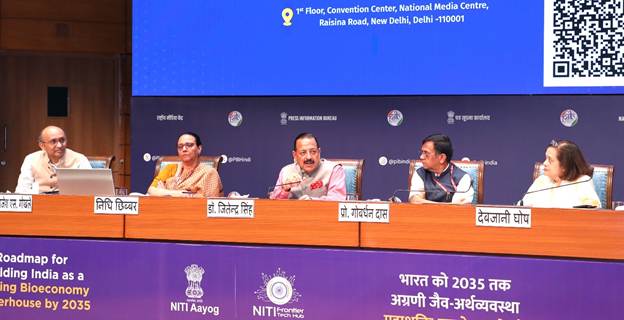
Addressing the launch of the roadmap on "Building India as a Leading Bioeconomy Powerhouse by 2035", the Minister said that Engineering Biology would emerge as a foundational discipline for the next phase of India's bioeconomy, much like Computer Science drove the digital revolution. He informed that IITs have already begun submitting proposals for interdisciplinary programmes with medical institutions, reflecting the growing convergence of engineering, biology and healthcare. The event featured the roadmap presentation, industry perspectives and addresses by senior policymakers before its formal launch.
"We have to have our own independent, sovereign ecosystem," Dr. Jitendra Singh said, announcing the new course. He noted that the initiative would be the first of its kind in the country and would prepare a new generation of professionals equipped to work at the intersection of engineering, biology, medicine and emerging technologies.
Highlighting India's rapid progress in biotechnology over the last decade, Dr. Jitendra Singh said the country's bioeconomy has expanded from nearly USD 10 billion in 2014 to about USD 95 billion today, with projections indicating growth to nearly USD 300 billion by 2030. He noted that India is now home to more than 11,000 biotechnology start-ups, reflecting the transformation of the country's innovation ecosystem.
The Minister said India has emerged as one of the few countries with a dedicated biotechnology policy centred on Biotechnology for Economy, Employment and Environment, enabling faster translation of scientific research into economic and societal outcomes. He observed that the country has moved from following global developments to becoming an active contributor in frontier areas of biotechnology.
Referring to India's achievements in healthcare biotechnology, Dr. Jitendra Singh highlighted that the country developed the world's first DNA vaccine against COVID-19 and supplied vaccines to nearly 30 countries, demonstrating India's growing scientific capabilities and global leadership. He further noted that indigenous advances in CAR-T cell therapy and emerging gene-based therapies are making advanced treatments significantly more affordable while strengthening India's position as a cost-effective global healthcare destination.
The Minister stressed that the future of biotechnology would increasingly be driven by synthetic biology, AI-enabled biological research and bio-manufacturing. He said technologies capable of designing new proteins, developing living-cell-based medicines, clean fuels and sustainable food systems would fundamentally transform healthcare, agriculture and industry over the coming decades.
Calling for stronger partnerships with industry, Dr. Jitendra Singh said India has consciously opened biotechnology to greater private-sector participation. He observed that successful initiatives such as the indigenous DNA vaccine demonstrated the importance of industry collaboration from the earliest stages of technology development. He urged stakeholders to move beyond traditional mindsets and build stronger partnerships between scientists, entrepreneurs and manufacturers to accelerate innovation.
The Minister also highlighted the importance of scaling indigenous bio-manufacturing capacities, strengthening talent development and promoting cross-sectoral collaboration among science, health and industry. He said emerging disciplines such as Engineering Biology would create a future-ready workforce capable of supporting India's ambitions in healthcare, food security, environmental sustainability and advanced manufacturing.
Addressing the gathering, Dr. Rajesh S. Gokhale, Secretary, Department of Biotechnology, said India is today among the world's fastest-growing bioeconomies, registering 15–18 per cent annual growth. He noted that the country has developed nearly 100 bio-incubators and more than 10,000 biotechnology companies, supported by progressive policy initiatives including the BioE3 Policy. He emphasised that the roadmap provides a strategic framework for advancing innovation-driven biomanufacturing, precision healthcare, sustainable agriculture and AI-enabled biology while building a skilled workforce and globally competitive biotechnology ecosystem.
Prof. Gobardhan Das, Member, NITI Aayog, said India is witnessing a defining moment in biotechnology comparable to previous industrial revolutions. He noted that the country's bioeconomy has grown nearly 16-fold over the past decade contributing 4.8 per cent to the national GDP. Referring to the newly launched roadmap, he said it envisions scaling India's bioeconomy to nearly USD 700 billion by 2035, supported by a proposed ₹50,000 crore Bioeconomy Growth Fund, stronger talent pipelines and world-class bio-manufacturing capabilities. He called upon industry, researchers and investors to work together in transforming India into one of the world's top biotechnology powers.
Concluding his address, Dr. Jitendra Singh said the coming decade would determine India's position in the global bioeconomy. He expressed confidence that with continued investments in research, talent development, industry partnerships and emerging technologies, India would not only strengthen health and food security but also generate millions of high-skilled jobs and emerge as a globally competitive biotechnology powerhouse.
*****
NKR/AK