Ministry of Personnel, Public Grievances & Pensions
India's Diversity Reflects Even in Governance, Calls for Continuous Learning and Exchange of Best Practices: Dr. Jitendra Singh
Governance Must Adapt to India's Regional Diversity Through Shared Learning Across States: Dr. Jitendra Singh
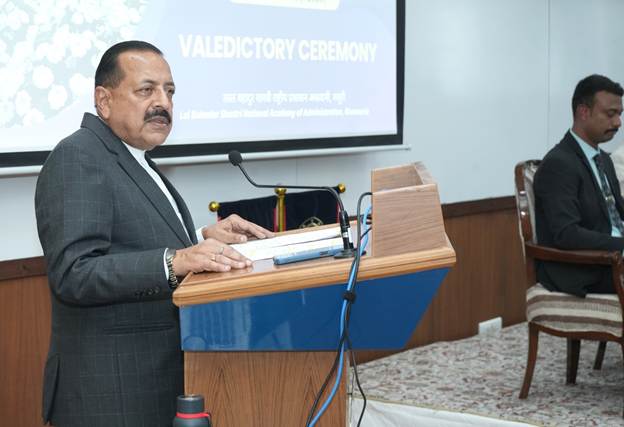
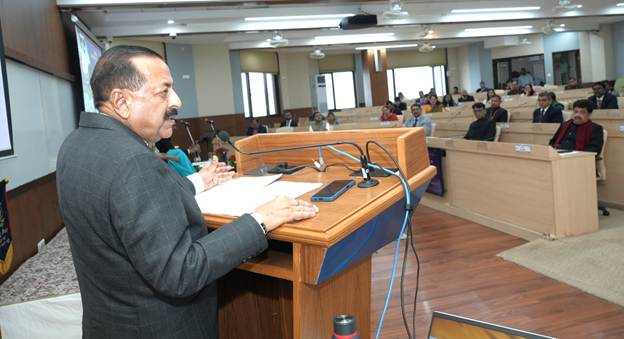
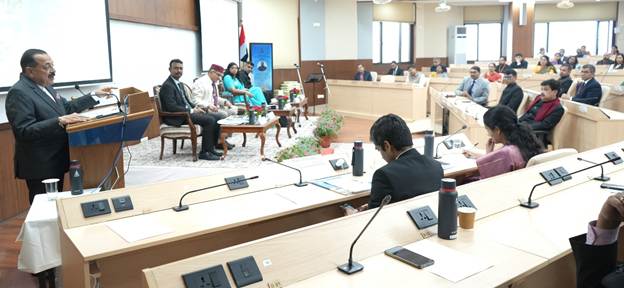
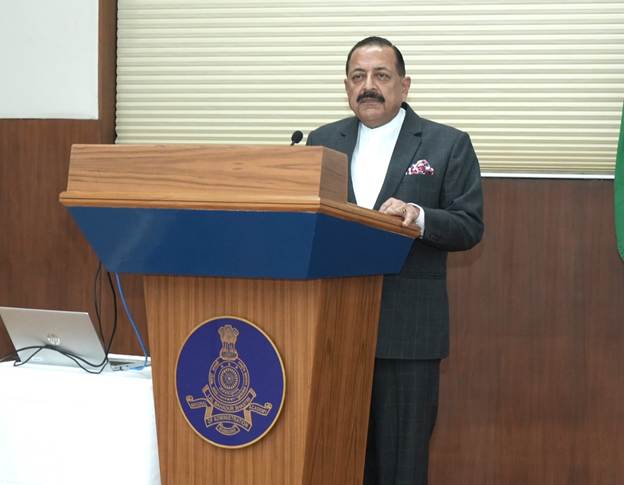
Dr Jitendra Singh Addresses Valedictory Session of 21st Round of Phase-IV Mid-Career Training Programme for IAS Officers at LBSNAA
Union Minister Dr Jitendra Singh Advocates Breaking Hierarchical Barriers to Promote Better Governance
Posted On:
10 JUL 2026 6:53PM by PIB Delhi
India's diversity is reflected not only in its society but also in its governance systems, making continuous learning, exchange of best practices and adaptive leadership essential for building the next generation of public administration, Union Minister of State (Independent Charge) for Science & Technology, Earth Sciences, and Minister of State in the Prime Minister's Office, Personnel, Public Grievances and Pensions, Atomic Energy and Space, Dr. Jitendra Singh said today while addressing the valedictory session of the 21st Round of the Phase-IV Mid-Career Training Programme (MCTP) for Indian Administrative Service (IAS) officers at the Lal Bahadur Shastri National Academy of Administration (LBSNAA), Mussoorie.
The Minister said India's next phase of governance demands continuous learning, young leadership, institutional innovation and citizen-centric reforms. Stressing that every State presents distinct administrative realities, aspirations and developmental priorities, he urged officers to actively share experiences and successful governance practices across cadres so that India's regional diversity becomes a source of administrative strength.
The four-week programme, conducted from 15 June to 10 July, brought together 51 IAS officers from across the country with over 14 years of administrative experience for advanced capacity building under Mission Karmayogi. The participants represented diverse cadres and sectors of governance. Director, LBSNAA, Sriram Taranikanti, senior faculty members and distinguished resource persons associated with the programme were also present on the occasion.
Departing from a conventional address, Dr. Jitendra Singh chose to engage directly with the officers instead of delivering a one-way lecture. He said officers who have spent nearly two decades in public service possess invaluable administrative experience and practical insights that should help shape the future direction of governance reforms and civil services training. Training programmes, he said, must increasingly become platforms for mutual learning where experienced officers contribute as much as they learn.
Emphasising India's administrative diversity, Dr. Jitendra Singh observed that governance challenges vary significantly across regions owing to differences in geography, culture, language, political context and developmental priorities. Every State, he said, has evolved innovative solutions suited to its local realities. Greater interaction among officers from different cadres would enable these successful practices to be adapted elsewhere, strengthening governance across the country.
Referring to Mission Karmayogi, the Minister said the programme has fundamentally transformed the philosophy of capacity building in the civil services by shifting the focus from rule-based administration to role-based governance. He said the iGOTKarmayogi platform has institutionalised continuous learning across government, enabling officers at every level to regularly upgrade their knowledge, skills and competencies in response to emerging governance challenges.
Dr. Jitendra Singh said governance reforms over the last decade have been driven by bold decision-making supported by technology, transparency and trust in citizens. He cited initiatives such as Direct Benefit Transfer (DBT), which has prevented leakages and generated savings exceeding ₹3.4 lakh crore, the Unified Payments Interface (UPI), Digital Public Infrastructure, the JAM Trinity and CPGRAMS as examples of governance innovations that have attracted global recognition for improving efficiency, transparency and service delivery.
The Minister said India today has emerged as a global leader in several frontier technologies rather than remaining merely a technology adopter. Referring to the National Quantum Mission, the country's rapidly expanding startup ecosystem, the opening of the space sector to private participation and recent reforms in the nuclear sector, he said these initiatives demonstrate India's transition towards technology-driven growth and innovation-led development.
Highlighting the changing relationship between government and enterprise, Dr. Jitendra Singh said the conventional divide between the public and private sectors has steadily given way to a collaborative development model. The remarkable expansion of startups and private participation in the space sector reflects the confidence generated by this approach and demonstrates that innovation flourishes when government functions as an enabler rather than merely a regulator.
The Minister said governance reforms acquire real meaning only when technological advancement is complemented by human sensitivity. Referring to personnel reforms undertaken in recent years, he cited greater flexibility in family pension nomination, extension of maternity-related benefits in cases of stillbirth and removal of provisions that denied family pension to dependents of government employees who died before completing the prescribed qualifying service. These measures, he said, reflect a citizen-centric and welfare-oriented approach to governance.
The Minister called for continuous modernisation of civil services training through greater institutional collaboration, wider faculty diversity and curricula that evolve alongside technological and societal changes. He encouraged greater participation of younger serving officers as faculty members, observing that officers currently serving in districts and ministries often possess the most relevant and contemporary administrative experience to guide future batches.
Dr. Jitendra Singh also highlighted the growing importance of effective communication in public administration. A district officer today, he said, must engage confidently with citizens, the media and the political executive, each requiring a distinct style of communication. As modes of public engagement continue to evolve, administrators must adopt modern communication practices while maintaining transparency and accountability.
The Minister further advocated a more interactive training ecosystem supported by structured and anonymous participant feedback. Such mechanisms, he said, enable institutions to continuously improve faculty quality, course design and programme delivery while ensuring that training remains aligned with the changing requirements of governance.
Calling for a less hierarchical administrative culture, Dr. Jitendra Singh said learning should never be restricted by seniority. He shared that he regularly interacts with officers at different levels because practical ideas and innovations often emerge from those working closest to implementation. The willingness to keep learning throughout one's career, he said, remains one of the defining attributes of effective leadership.
Concluding his address, Dr. Jitendra Singh reiterated that India's diversity is also reflected in its governance systems, where regional realities, linguistic and cultural contexts, political environments and developmental aspirations vary widely across the country. He expressed confidence that officers returning from the programme would strengthen inter-state learning, promote innovative and citizen-centric governance, and carry forward the spirit of continuous learning and adaptive leadership as India advances towards the vision of Viksit Bharat 2047.
****
NKR/AK
(Release ID: 2283415)
Visitor Counter : 733