PIB Backgrounder
Strengthening India's Toy Ecosystem
From Local Craftsmanship to Global Markets
Posted On:
07 JUL 2026 5:45PM by PIB Delhi
India's toy industry reflects a unique blend of cultural heritage, innovation, and manufacturing growth. With a legacy spanning thousands of years, traditional toys continue to support artisans, preserve craftsmanship, and sustain livelihoods. Strong domestic demand, driven by a young population, rising incomes, and growing preference for educational toys, is creating new opportunities. Government initiatives such as the National Action Plan for Toys, international exhibitions, ODOP, have strengthened domestic manufacturing. Measures promoting GI-tagged products and indigenous toys have enhanced global competitiveness and market access. As a result, toy exports have grown significantly, employment has increased, and India has emerged as a net exporter of toys. The sector is steadily positioning itself as a global hub for quality and culturally rooted toys.
|
India's Toy Industry: From Origins to Opportunity
India's toy industry is emerging as a vibrant contributor to manufacturing, exports, and innovation. Supported by favourable demographics, evolving consumer preferences, and sustained policy support, the sector is witnessing renewed momentum. Growing global demand for safe, sustainable, and educational toys has created new opportunities for Indian manufacturers, artisans, and entrepreneurs. Building on a rich heritage of craftsmanship, the industry is steadily strengthening its position in domestic and global markets.
From the clay carts of the Indus Valley Civilization to modern educational and electronic toys, India's tradition of toys spans nearly 5,000 years. This rich legacy reflects the country's enduring culture of creativity, learning, and craftsmanship. Besides, excavations at Harappa and Mohenjo-Daro reveal a vibrant tradition of toy-making showcasing the ingenuity of ancient India. Handcrafted wooden figurines were once produced in village workshops across the country. Colourful dolls inspired by the Ramayana and Mahabharata also became part of this tradition. Together, they connected children with India's rich heritage and diverse cultural traditions.
Today, traditional craftsmanship is being complemented by modern technology, design, and entrepreneurship. This transformation is positioning India as an emerging hub for quality toy manufacturing.
Emerging Opportunities in India’s Toy Industry
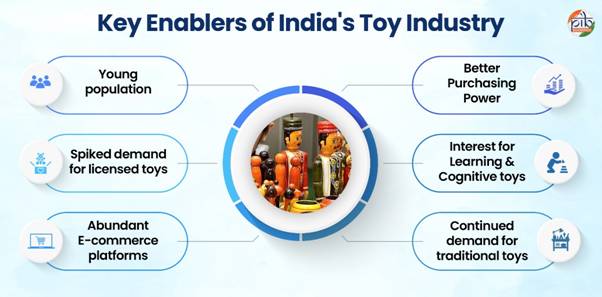
On the supply side, the rapid expansion of e-commerce platforms has improved product accessibility and expanded market reach for manufacturers. On the demand side, India’s rich tradition of toy-making provides a unique advantage, with traditional toys continuing to attract both domestic and international buyers. Several factors are strengthening the growth prospects of India’s toy industry.
- A large and growing consumer base is a key driver. With India’s population exceeding 1.4 billion, a significant share of which is below the age of 25. Rising incomes and improving purchasing power are further boosting spending on toys.
- Rapid urbanisation and changing lifestyles are also driving demand for modern, innovative and licensed products.
- Parents are increasingly opting for educational, skill-based and Science, Technology, Engineering and Mathematics (STEM) toys that support learning and cognitive development.
- Technology and digitalisation are creating new opportunities for the sector. Smart toys incorporating technologies such as artificial intelligence, augmented reality and virtual reality are gaining popularity among tech-savvy consumers.
Rising Exports, Stronger Competitiveness
India's toy industry has recorded significant progress in international trade over the past decade, reflecting its growing competitiveness and manufacturing capabilities.
Overall exports of toys (HSN 9503, 9504 & 9505) were US$152.7 million in 2017-18. It rose to US$ 384.7 million in 2025-26, reflecting a growth of over 151.9%. The most significant expansion was seen in Electronic & Non-Electronic Toys (HSN 9503). The exports grew by nearly 160%, from US$ 77.35 million to US$ 200.89 million during the same period. The United States (US) emerged as the leading export destination, with shipments more than quadrupling, from US$ 26.7 million to about US$ 111.9 million. Other key markets included the United Kingdom, Poland, the Netherlands and Germany.
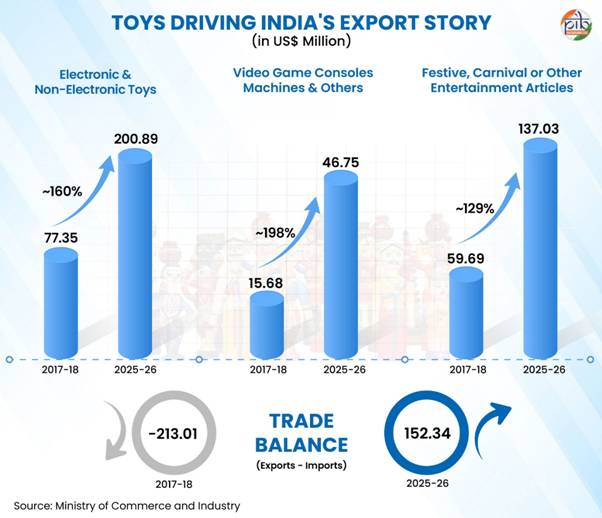
Exports of video game consoles, machines and others (HSN 9504) nearly tripled. It expanded from US$ 15.68 million in 2017-18 to US$ 46.75 million in 2025-26, reflecting growing global demand for Indian-made gaming and recreational products. Major destinations included the UAE, Russia, France and the United Kingdom, with the US remaining the largest market.
Similarly, exports of festive, carnival or other entertainment articles (HSN 9505) increased by nearly 130%, from US$ 59.69 million in 2017-18 to US$ 137.03 million in 2025-26. The United States, Germany, the United Kingdom, the Netherlands, and Sweden were among the leading destinations for these products. This highlights India’s growing presence in global festive and entertainment goods markets.
On the import side, while video game consoles and festive and entertainment articles recorded moderate growth, imports of traditional and educational toys declined sharply by 66%. This decline significantly strengthened domestic manufacturing capabilities of the sector. As a result, India achieved a trade surplus of US$ 152 million in 2025–26 across key toy categories (HSN 9503, 9504, and 9505). This marks a significant improvement from the trade deficit of US$ 213.01 million recorded in 2017–18, when imports exceeded exports.
|
Trade surplus, with exports exceeding imports, has strengthened domestic manufacturing, supported economic growth, and boosted foreign exchange earnings.
|
Overall, these developments highlight the toy industry’s growing contribution to manufacturing, employment, and economic development.
Economic Impact of India's Toy Industry
Beyond creating products for children, the toy industry is emerging as an important contributor to India’s economy.
The sector enables entrepreneurship across rural and urban areas and generates livelihood opportunities for artisans, manufacturers, traders, and small businesses. It also promotes economic participation among women and socio-economically diverse groups. The government’s focus on local manufacturing and entrepreneurship has further enhanced the sector’s economic contribution.
Employment in Games and Toys (NIC Code 324) more than doubled, rising from 8,685 in 2018–19 to 17,693 in 2023–24. This highlights the sector’s potential to create productive employment while supporting local enterprise development across the country.
’Government Initiatives Shaping the Future of Toy Industry
Recognizing the sector’s economic and cultural significance, the government has introduced several initiatives to strengthen domestic manufacturing and promote indigenous toys. These efforts are helping create a vibrant environment that promotes innovation, quality, and global market presence.
National Action Plan for Toys (NAPT), 2020
NAPT was formulated to promote the design of toys based on Indian values, culture, and history. It encourages the use of toys as a learning resource. The initiative monitors the quality of toys and restricts imports of sub-standard and unsafe products. Furthermore, it also promotes indigenous toy clusters, boosts local manufacturing, and incentivises toy manufacturers.
A major component of this strategy was the introduction of the Quality Control Order (QCO) for Toys in 2020. The QCO was implemented in response to concerns regarding the quality and safety of imported toys. ·
BIS has granted 1786 licenses to domestic manufacturers and 56 licenses to foreign manufacturers for safety of toys as per IS 9873/IS 15644 as in May 2026.
|
It mandated compliance with Indian safety standards and made Bureau of Indian Standards (BIS) certification compulsory for both domestic and foreign manufacturers.
- It exempts products manufactured and sold by artisans registered with the Development Commissioner (Handicrafts), Ministry of Textiles.
- The exemption was also extended to registered proprietors and authorised users of products bearing a Geographical Indication (GI) tag.
The measure aimed in ensuring that toys sold in India meet prescribed physical, chemical, and electrical safety requirements. The implementation of QCO also helped create a level playing field for domestic manufacturers.
|
Under this policy framework, the Most-Favoured Nation (MFN) tariff on toys increased from 20% to 60% in 2020. It further rose to 70% in 2023. Further, the tariff on Parts of Electronic Toys (HS 95030091) revised as 20% in the Union Budget F.Y. 2025-26. The MFN tariff is the standard customs duty applied to imports from most WTO trading partners. The increased tariffs reduce the price advantage of imported toys, encouraging domestic manufacturing and investment.
The measure supports local employment, strengthens the toy industry, and helps improve India's trade balance.
|
Toy Biz International B2B Exhibition
|
The Exhibition took place from 4-7 July,2026 in New Delhi.
|
The exhibition provides a platform for toy manufacturers to showcase their products to domestic and international buyers. As one of the largest toy trade exhibitions in the country, it facilitates business networking. It also enables direct interactions between manufacturers, toy dealers, and potential buyers from across the world. It creates opportunities for market expansion and promotes India's toy industry in global markets.
Toycathon
Launched in 2021, Toycathon supports the vision of Atmanirbhar Bharat. It encourages collaborative development of innovative toys and games by students, teachers, designers, experts, and start-ups. The initiative promotes designs inspired by Indian culture, heritage, local folklore, heroes, and value systems.
|
To strengthen the electronic toy segment, the Government also organised the Electronic Toy Hackathon (e-Toycathon) for the first time in 2025. The initiative showcased innovative and educational electronic toys that promote creativity, learning and child development.
|
e-Toys Lab
The e-Toys Lab, established by the Ministry of Electronics and Information Technology (MeitY) at C-DAC, Noida, aims to strengthen India's indigenous electronic toy industry. It provides hands-on training in designing and developing electronic toys, prototype development, and product testing. Selected young engineers, including candidates from SC/ST and North Eastern Region backgrounds, undergo one year of structured training.
The programme combines six months of research at the e-Toys Lab with six months of industry training. By integrating electronics and information technology with toy manufacturing, it promotes innovation, entrepreneurship, and the development of technology-driven toys.
Manak Manthan
In April 2026, BIS organized a Manak Manthan on IS 9873 (Part 1):2025. It focused on the mechanical and physical safety requirements for toys. It is a BIS initiative aimed at promoting the adoption of Indian Standards across industries. The programme sought to create awareness among toy manufacturers and other stakeholders. This encourages the production of safer, high-quality, and reliable toys for children.
ODOP (One District, One Product)
The ODOP initiative aims to promote district-specific products by identifying, branding, and supporting unique products from each district of the country. The initiative seeks to boost manufacturing, exports, and employment while fostering balanced regional development. It also encourages new ideas, technology adoption, and competitiveness in domestic and international markets.
Under the initiative, several traditional and indigenous toy products have also been identified. It adopts a win-win approach by encouraging product diversification, branding, packaging, skill development, and quality standardisation. It also facilitates market access through e-commerce, international expos, and awareness of buyer requirements and export certifications. In addition, the initiative assists in funding, marketing, technology upgradation and scheme awareness.
Geographical Indication (GI) Tagged Toys
Several traditional Indian toys have received GI status, recognizing their unique craftsmanship and regional identity. GI tagging helps preserve centuries-old traditions while creating new opportunities for artisans through greater visibility and market access. GI-tagged products benefit from legal protection that recognizes their unique qualities and reputation linked to a specific geographical region. This protection enhances their market value, prevents unauthorized use and supports local producers. It also helps in preserving traditional knowledge and cultural heritage while promoting rural economic development. GI Tagged toys include Channapatna Toys and dolls of Karnataka, Leather Toys of Indore, Madhya Pradesh, Thanjavur Doll of Tamil Nadu, etc.
Trade and Market Development
GST reduction
The reduction of GST on toys from 12% to 5% has made toys more affordable and accessible for consumers. It encourages early childhood learning through play and promotes the wider adoption of educational and developmental toys. The measure also benefits domestic manufacturers and MSMEs by stimulating demand in the toy market.
Free Trade Agreements (FTA)
India has signed trade agreements such as the India-UAE Comprehensive Economic Partnership Agreement (CEPA), the India-Australia Economic Cooperation and Trade Agreement (ECTA), and India-European Free Trade Association (EFTA) Trade and Economic Partnership Agreement, India-Oman Comprehensive Economic Partnership Agreement, India-New Zealand Free Trade Agreement, and India-United Kingdom Comprehensive Economic and Trade Agreement. Under these agreements, partner countries provide zero-duty market access for exports of Indian toys.
Districts as Export Hubs (DEH)
The DEH initiative aims to transform districts into export growth centres by leveraging their unique products, skills, and resources. It involves State Export Promotion Committees (SEPC) and District Export Promotion Committees (DEPC) as key stakeholders. These committees have been constituted in 36 States/UT and seek to strengthen India's export and promote balanced inclusive growth.
The initiative has identified products and services with export potential in all districts across the country, including GI products, agricultural clusters, and toy clusters. More than 10 districts have been identified with toy and doll export potential. This leverages each district's export potential by strengthening local industries, facilitating market linkages, driving employment and economic development.
India's Toy Industry: Looking Ahead
India’s toy industry is successfully blending its rich cultural heritage with modern advancements, emerging as a vibrant contributor to manufacturing, exports and employment. Supported by strategic policy interventions and initiatives promoting indigenous production, the sector has transitioned from import dependence to global competitiveness.
In doing so, India’s toy industry is strengthening its position in global markets while continuing to preserve the country’s unique legacy of play.
References
Ministry of Tourism
https://www.cgihamburg.gov.in/pdf/press/Toy-Story-Incredible-India_23092020.pdf
Ministry of Commerce and Industry
https://www.investindia.gov.in/team-india-blogs/traditional-toy-industry-new-indias-sunrise-sector
https://www.investindia.gov.in/team-india-blogs/charting-growth-story-indian-toy-industry
https://www.investindia.gov.in/blogs/toy-story-india-look-indias-thriving-toy-retail-market
https://static.investindia.gov.in/s3fs-public/2025-08/2025089_v32_odop_product_list.pdf
https://www.investindia.gov.in/team-india-blogs/toycathon-202-highlight-indias-toy-industry-opportunity
https://www.investindia.gov.in/one-district-one-product
https://tradestat.commerce.gov.in/eidb/commodity_wise_export
https://tradestat.commerce.gov.in/eidb/commodity_wise_all_countries_export
https://www.dgciskol.gov.in/writereaddata/Downloads/20251008161825A%20Brief%20Report%20on%20Indias%20Exports%20of%20Toys,%20Games%20and%20Sports%20Requisites.pdf
https://ipindia.gov.in/storage/uploads/docs-operator/aa9ef4c8-ae0e-477-98-52b6a9479b82.pdf
https://www.pib.gov.in/PressReleasePage.aspx?PRID=2002099®=48&lang=2
https://www.pib.gov.in/PressReleasePage.aspx?PRID=2244401®=3&lang=1
https://static.investindia.gov.in/s3fs-public/inline-files/ODOP%20Brochure_Final.pdf
Ministry of Education
https://isid.org.in/wp-content/uploads/2024/05/WP279.pdf?utm
Ministry of Statistics and Programme Implementation
https://microdata.gov.in/NADA/index.php/catalog/256/related-materials
https://microdata.gov.in/NADA/index.php/catalog/50/related-materials
DD India
https://www.youtube.com/watch?v=n3OZiJ7FdDc
PIB Headquarters
https://www.pib.gov.in/FactsheetDetails.aspx?Id=150302®=3&lang=2
Ministry of External Affairs
https://www.indianembassynetherlands.gov.in/section/forthcomming/17th-toy-biz-international-b2b-exhibition-from-4th-7th-july-2026-at-bharat-mandapam-pragati-maidan-new-delhi/
https://www.eoibogota.gov.in/page/6th-toy-biz-international-2025/
Ministry of Electronics & IT
https://www.pib.gov.in/PressReleasePage.aspx?PRID=2109677®=48&lang=2
World Trade Organisation
https://www.wto.org/english/tratop_e/serv_e/cbt_course_e/c1s6p1_e.htm
Ministry of Women and Child Development
https://www.pib.gov.in/PressReleasePage.aspx?PRID=1686286®=48&lang=2
Others
https://www.ibef.org/research/case-study/unlocking-play-evolution-of-india-s-toy-sector
https://wtocentre.iift.ac.in/PolicyBrief/Policy_Brief_23.pdf
https://silpasathi.wb.gov.in/export-hub/
https://invest.telangana.gov.in/toys-industry/
https://x.com/mygovindia/status/205409373429240565
https://www.mygov.in/campaigns/aatmanirbhartoys
https://x.com/mygovindia/status/2054093734292410565
See in PDF
***
PIB Research
(Release ID: 2282116)
Visitor Counter : 3620