PIB Backgrounder
India’s Emerging Technology Ecosystem
Technologies that will shape India’s future
Posted On:
22 JUN 2026 10:41AM by PIB Delhi
India has transformed from a large digital market into an emerging global technology power over the last decade. Earlier, India was largely viewed as a vast consumer base for digital services and internet-driven platforms. Today, the country is increasingly shaping global technology development through Digital Public Infrastructure (DPI), indigenous innovation, startup ecosystems, and emerging technology capabilities. Sustained government investments have strengthened national capability, expanded technological capacity, and enhanced global credibility. Mission-mode initiatives in Artificial Intelligence (AI), semiconductors, quantum technologies, supercomputing, cloud computing, and cybersecurity are shaping a strong innovation ecosystem. India’s trusted Digital Public Infrastructure, inclusive digital governance, and growing global partnerships are positioning the country as a reliable technology partner. These achievements are laying the foundation for Viksit Bharat 2047 and strengthening India’s role in the global technology landscape.
Twelve years ago, India began a determined journey to make technology a key driver of Viksit Bharat. What followed was a sustained national effort to build digital infrastructure, strengthen innovation, and expand technology access for every citizen. The Government strengthened national technological capability through dedicated mission-mode programmes in emerging technologies such as semiconductors, Artificial Intelligence (AI), quantum technologies, supercomputing, blockchain, and cloud infrastructure. Long-term policy support and strategic investments enabled the development of indigenous technologies, secure digital systems, and globally competitive innovation ecosystems.
This transformation was supported by major investments in national capacity building through large-scale skilling initiatives, advanced research infrastructure, startup support, and industry-academia collaboration. Additionally, Centres of Excellence, research hubs, semiconductor laboratories, and emerging technology institutions were established across the country. These initiatives created opportunities for future-ready workforce development across the emerging sectors.
Enhanced capability and expanded capacity have further positioned India’s global technological credibility. The country has built trusted Digital Public Infrastructure (DPI), secure digital governance systems, and strong international technology partnerships. India demonstrated to the world, how technology can be deployed at population scale while ensuring inclusion, accessibility, and affordability. Today, India is not only adopting global technologies, but also shaping global conversations on trusted, inclusive, and human-centric technological development.
Digital India Programme as the Backbone of Emerging Capabilities
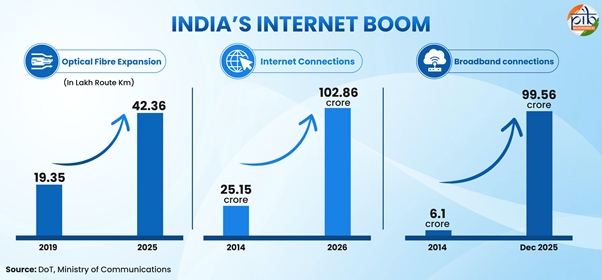
Digital India Programme, launched in 2015, laid the foundation for India’s emerging technology ecosystem by strengthening digital infrastructure across the country. The rapid expansion of optical fibre networks created the backbone for high-speed connectivity. Optical fibre coverage increased from 19.35 lakh route kilometres in 2019 to 42.36 lakh route kilometres in 2025. This expansion improved internet access, network reliability, and digital connectivity across urban and rural India. India also achieved one of the world’s fastest 5G rollouts, with services reaching 99.9% of districts. Improved digital infrastructure accelerated internet adoption nationwide.
Internet connections increased from 25.15 crore in 2014 to 102.86 crore in 2026. Greater internet penetration further expanded broadband access, with broadband connections rising from 6.1 crore in 2014 to 99.56 crore in December 2025.
This digital expansion connected citizens, startups, businesses, educational institutions, healthcare systems, and government services to the digital economy. Faster and more reliable connectivity also enabled the growth of AI, cloud computing, blockchain, fintech, and other data-driven technologies.
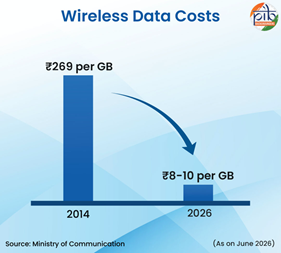
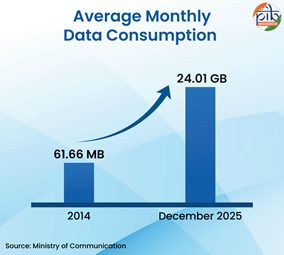
Affordable internet further accelerated technology adoption at population scale. Average monthly data consumption increased from 61.66 MB in 2014 to 24.01 GB in December 2025. During the same period, data costs declined sharply from ₹269 per GB to ₹8-10 per GB. Lower internet costs expanded access to telemedicine, online education, digital payments, e-commerce, and e-governance services. This widespread digital adoption created a strong user ecosystem for innovation, startups, and digital entrepreneurship.
Over the last 12 years, Digital India has evolved into the backbone of India’s digital transformation. The programme strengthened digital infrastructure, expanded connectivity, and accelerated technology adoption across sectors. These efforts are positioning India as a globally competitive digital economy while also building strong foundations for future readiness and expanding national capabilities in emerging technologies.
Developing Capabilities for Future Readiness
India is building a future-ready technology ecosystem through sustained investments in AI, semiconductors, quantum technologies, and supercomputing etc. Mission-driven programmes are strengthening indigenous innovation, research capabilities, and digital infrastructure across sectors. These initiatives are also encouraging advanced manufacturing, and strategic technology development, while reinforcing India’s position as a reliable and globally competitive hub for emerging technologies.
Supercomputers for High-Performance Computing
Supercomputers are extremely powerful computers designed to perform billions of calculations every second. They are used to solve complex problems that ordinary computers cannot handle efficiently. Today, they are critical for weather forecasting, climate modelling, AI, drug discovery, etc. As data volumes and computational demands grow, supercomputers help to accelerate scientific innovation, and make faster, evidence-based decisions. They have become essential infrastructure for technological leadership and economic competitiveness.

Under the National Supercomputing Mission (NSM), launched in 2015 with an outlay of ₹4,500 crore, India has deployed 38 supercomputers with a combined computing power of 47 petaflops across leading institutions. A major achievement is the development of the indigenous PARAM Rudra series, built with Indian-designed hardware and software. This marks an important step towards strengthening self-reliance in high-performance computing. Click to Read More
India's Semiconductor Ecosystem
Semiconductors form the foundation of modern digital and emerging technologies. They power devices used in communication, mobility, defence, manufacturing etc. Technologies such as AI, cloud computing, IoT, 5G, and advanced electronics depend heavily on semiconductor capability.
To strengthen technological sovereignty, the Government launched the Semicon India Programme in December 2021 with an outlay of ₹76,000 crore. The programme promoted semiconductor manufacturing, display fabrication, chip design, packaging, testing, talent development, and research collaborations. Guided by Atmanirbhar Bharat and Make in India. It sought to integrate India into global electronics value chains. Building on this momentum, the Union Budget 2026–27 further announced India Semiconductor Mission (ISM) 2.0, with an initial outlay of ₹1,000 crore for FY 2026–27. ISM 2.0 focuses on semiconductor equipment, materials, indigenous intellectual property, resilient supply chains, research, training, and advanced manufacturing capabilities, positioning India as a globally competitive semiconductor hub.
|
Did You Know?
The Design Linked Incentive (DLI) Scheme launched in 2021, plays a major role in developing India’s fabless semiconductor ecosystem. Implemented under the Semicon India Programme, it supports startups, MSMEs, and academic institutions through financial incentives and advanced design infrastructure. The scheme covers the full semiconductor design lifecycle. By strengthening indigenous chip design capabilities, the scheme reduces import dependence and promotes higher domestic value addition in electronics manufacturing. As of March 2026, under the DLI Scheme, 24 companies received fiscal support and 105 applicants received EDA tools support. Seven chips have been fabricated from 16 tape-outs, including advanced 12 nm designs.
|
As of June 2026, 12 projects worth around ₹1.64 lakh crore have been approved under the ISM. These include one semiconductor fab, two compound semiconductor fabs, and nine packaging units. This is creating a domestic semiconductor manufacturing ecosystem and reducing import dependence. Click To Read More
Quantum technologies are emerging as one of the defining frontiers of the twenty-first century. These technologies are based on Quantum Mechanics or laws of physics that apply to sub atomic particles. This realm is governed by probabilities, where entities can exist in multiple states simultaneously. Tools based on this technology have powerful computing capacities, and are more sensitive and secure than normal. They have the potential to transform healthcare, finance, logistics, and climate modelling etc. while enabling ultra-secure communications and advanced data processing. As nations compete to harness these capabilities, quantum technologies are increasingly becoming a critical driver of economic growth, technological leadership, and national security.

Recognising quantum`s strategic importance, the Government approved the National Quantum Mission in April 2023 with an outlay of ₹6,003.65 crore. The mission focuses on four key areas: Quantum Computing, Quantum Communication, Quantum Sensing and Metrology, and Quantum Materials and Devices. The mission seeks to develop indigenous quantum technologies, strengthen research infrastructure, build skilled talent, support startups, foster industry-academia collaboration, and position India among the world's leading quantum technology nations.
The results are already becoming visible. Four dedicated Thematic Hubs have been established at leading institutions, engaging more than 152 researchers across 43 organisations. The mission has supported 17 startups, including nine deep-tech ventures, strengthening India's innovation ecosystem. India also demonstrated a 1,000-km secure quantum communication network, achieving the milestone six years ahead of schedule. Further advancing this vision, the foundation stone for India's first Quantum Valley has laid down in Amaravati in February 2026. It will be creating a dedicated ecosystem for future quantum research, innovation, and strategic capabilities. Click to Read More
India's AI Transformation
AI is transforming economies through agile automation, increased productivity, and modern industrial innovation. India has also emerged as a major global AI ecosystem, supported by strong digital infrastructure and a large technology workforce.

To accelerate this progress, the Government approved the IndiaAI Mission in 2024 with an outlay of over ₹10,300 crore. The mission focuses on building indigenous AI computing infrastructure and expanding access to high-end GPU facilities. The mission also supports AI research, startup development, youth skilling, and public service innovation. Alongside technological growth, the mission promotes safe, inclusive, and responsible AI systems. These efforts aim to place India as a globally trusted hub for artificial intelligence.
Within two years of its launch, the mission has helped strengthen India's AI ecosystem. India, as on March 2026, has around 1.8 lakh startups, with nearly 89% of new startups using AI solutions. A common computing facility with over 38,000 GPUs is being established to democratise access to advanced AI infrastructure. The AI Kosh platform hosts 12,115 datasets and 306 AI models across 20 sectors, enabling innovation and research at scale. These initiatives are expanding access to computing power, data, and AI tools, helping position India as a leading hub for AI development. Click To Read More
Driving the Future Through Cloud Computing
Cloud delivers computing services such as storage, servers, software, and data processing over the internet, enabling scalable, cost-effective, and secure access across governance, business, and finance etc. As India's digital ecosystem expands, cloud infrastructure has become an inevitable necessity for data sovereignty, digital governance, and for public service delivery.
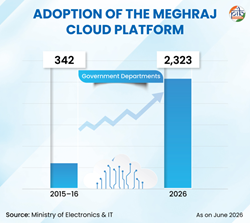
India's indigenous cloud ecosystem began with the launch of MeghRaj in 2014 by the Ministry of Electronics and Information Technology (MeitY), serving as the Government's national cloud platform. further, MeghRaj 2.0 strengthened this ecosystem through hybrid cloud architecture, and stronger cybersecurity. It enabled government departments to securely use advanced cloud resources while maintaining control over sensitive data.
As on June 2026, adoption of the MeghRaj cloud platform increased from 342 government departments in 2015–16 to 2,323 departments, powering major platforms such as DigiLocker, MyGov, and the National Scholarship Portal etc.
|
Did You Know?
The Union Budget 2026–27 accelerated cloud and AI infrastructure development through major policy incentives, including tax holidays till 2047, a 15% safe harbour provision for tax certainty, and an increased eligibility threshold under safe harbour norms from ₹300 crore to ₹2,000 crore. Automated approval systems were also introduced to improve ease of doing business.
|
Blockchain Enabling the Next Wave of Digital Innovation
Blockchain is a secure, tamper-resistant digital ledger that records transactions across a distributed network without intermediaries. Its core strengths of transparency, immutability, traceability, and decentralisation make it significant for governance, finance, supply chains, judiciary, and digital service delivery. Recognising this potential, MeitY initiated the National Blockchain Framework (NBF) in 2021 with an outlay of ₹64.76 crore, It aims to create a secure, scalable, and interoperable blockchain ecosystem for citizen-centric governance and digital trust.
Supported by conducive government policies, India's blockchain ecosystem has expanded through indigenous platforms such as the Vishvasya Blockchain Stack, NBFLite sandbox, Praamaanik app verification system, and the National Blockchain Portal. The framework supports Blockchain-as-a-Service (BaaS) through NIC data centres in Bhubaneswar, Pune, and Hyderabad. Blockchain applications are already transforming governance through secure document verification, judiciary records, medicine supply-chain tracking, and property management, strengthening transparency, reducing fraud, and supporting the vision of Digital India and Atmanirbhar Bharat.
As of October 2025, over 3 crore property documents have been verified through blockchain platforms, creating tamper-proof records and reducing land-related disputes[1]. The NIC established a Centre of Excellence in Blockchain Technology to drive research and innovation. The Reserve Bank of India (RBI) launched Digital Rupee (e₹) pilots, while the Telecom Regulatory Authority of India (TRAI) adopted blockchain-based Distributed Ledger Technology (DLT) to curb spam. The National Securities Depository Limited (NSDL) also uses blockchain for secure audit trails. Click to Read More
Data Centers as the Backbone of India's Digital Economy
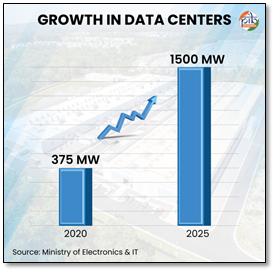
Data centres are secure facilities that power the storage, processing, and movement of digital information. They underpin cloud services, AI, blockchain applications, and future technologies such as quantum computing. Reliable data centre infrastructure enables high-performance computing, secure digital services, and real-time data access. For India, it strengthens technological self-reliance, supports Digital Public Infrastructure, attracts investment, creates skilled jobs, and enhances the country's role in the global digital economy. India's data centre sector has witnessed rapid expansion, with capacity growing from about 375 MW in 2020 to nearly 1,500 MW by 2025. Major data centre hubs have emerged in Mumbai, Navi Mumbai, Hyderabad, Bengaluru, Noida, and Jamnagar. At the same time, several large hyperscale and AI-focused data centres are being developed across Andhra Pradesh, Gujarat, Maharashtra, and Uttar Pradesh, strengthening India’s future-ready digital infrastructure ecosystem. Click to Read More
Biotechnology: Next Phase of Innovation-Led Growth
Biotechnology is emerging as a strategic technology sector driving innovation in tech enabled industrial application. Advances in genomics, precision therapeutics, synthetic biology, and digital biotechnology are transforming economies and strengthening health and food security systems. As global economies increasingly invest in bioeconomy-led growth, biotechnology is becoming an important pillar of future industrial competitiveness, scientific innovation, and economic resilience.
Over the last decade, the Government of India has supported the biotechnology ecosystem through mission-driven policies and strategic investments. The Department of Biotechnology (DBT) and Biotechnology Industry Research Assistance Council (BIRAC) implemented targeted interventions to accelerate innovation, entrepreneurship, and bio-manufacturing. Key initiatives include the National Biopharma Mission (NBM), approved in 2017 with an outlay of ₹1,500 crore, the BioE3 Policy launched in 2023, BioNEST incubators, and innovation schemes such as Intensifying the Impact of Industrial Innovation (i4) and Promoting Academic Research Conversion to Enterprise (PACE). The Government also expanded translational research infrastructure, technology transfer support, and biotechnology incubation facilities to strengthen indigenous innovation and globally competitive biotechnology ecosystems.
India’s biotechnology sector has recorded significant growth over the last decade. It crossed the USD 150 billion milestone in 2023, achieving the National Biotech Development Strategy 2021 target two years ahead of schedule, and reached USD 190 billion as on June 2026. To strengthen innovation capability, DBT-BIRAC has established 94 bioincubators across 25 States and UTs and provided financial support ranging from ₹50 lakh to ₹10.5 crore for startups and research-driven enterprises. Click to Read More
India is strengthening future readiness through sustained Government investments and mission-mode programmes in advanced technology ecosystems. Strategic policy support, and industry partnerships are further accelerating indigenous technology development and innovation-led growth. These initiatives are creating a strong national innovation ecosystem and positioning India as a trusted global hub for next-generation technologies. Under the leadership of the Government, India is steadily emerging as a global technology powerhouse aligned with the vision of Viksit Bharat.
India’s New Era of Building Capacity, Education, Research and Skill
The technologies shaping the future require more than infrastructure and investment. They require a skilled workforce, strong research institutions, and a culture of innovation. Recognising this, India has launched a comprehensive effort to build human capital, strengthen research ecosystems, and prepare the next generation for a technology-driven tomorrow. Through investments in research, skilling, higher education, and industry partnerships, the government of India is creating the foundations needed to compete in the emerging technology era.
Strengthening Research and Development Ecosystem
A major step in this direction was the operationalisation of the Anusandhan National Research Foundation (ANRF) in 2024. ANRF promotes collaboration among academia, industry, startups, and government institutions to accelerate high-impact research and innovation. Its focus areas include AI, semiconductors, and advanced materials, and other frontier technologies. Through programmes such as Mission for Advancement in High-impact Areas (MAHA), Partnerships for Accelerated Innovation and Research (PAIR), and ANRF Translational Research and Innovation (ATRI), the foundation is helping translate laboratory research into real-world applications.
ANRF has also introduced fellowships and grants for young researchers, post-doctoral scholars, and Indian scientists abroad. As of March 2026, grants worth ₹264.70 crore had been awarded in high-impact technology areas. To further strengthen deep-tech innovation, the Government approved the Research Development and Innovation (RDI) Scheme in July 2025 with a corpus of ₹1 lakh crore. Operating under ANRF and implemented by the DST, the scheme provides long-term and affordable financing to support private-sector research and innovation. Its focus areas include AI, advanced manufacturing, critical technologies, deep-tech startups, and strategic industries.
ANRF and RDI are creating a stronger bridge between scientific research, industrial innovation, and economic growth.
|
Did You Know?
The first phase of the Indian Institutes of Skills (IIS) at Mumbai and Ahmedabad became operational on 9 October 2024 under the Public-Private Partnership (PPP) model with Tata IIS as the operating partner. The institutes aim to build an Industry 4.0-ready workforce through hands-on training in artificial intelligence, mechatronics, digital manufacturing, data analytics, factory automation, and additive manufacturing, supporting India’s emerging technology and advanced manufacturing ecosystem.
|
Skilling India for Emerging Technologies
India's technology ambitions require a workforce equipped with emerging digital skills. To address this need, the FutureSkills PRIME programme was launched in 2018 by the MeitY in partnership with NASSCOM. The programme focuses on skilling, reskilling, and upskilling in areas such as AI, Big Data Analytics, Internet of Things (IoT), Cyber Security, Blockchain, and Augmented and Virtual Reality (AR/VR). Learners can access industry-aligned courses online and earn recognised certifications.
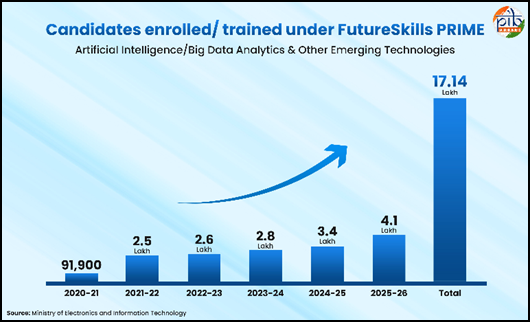
FutureSkills PRIME has emerged as one of India's largest digital skilling initiatives. As on March, 2026, more than 27.53 lakh candidates have registered on the platform, while over 17.14 lakh learners have completed enrolment or training. Significantly, around 80% of learners come from Tier-2 and Tier-3 cities, helping expand opportunities beyond major urban centres. This broad-based participation is strengthening India's digital talent pipeline and improving inclusion in the technology economy.
The National Institute of Electronics and Information Technology (NIELIT) has also played a critical role in developing technology talent. Operating through 56 centres, 750 affiliated institutes, and more than 9,000 facilitation centres, NIELIT provides training in AI, Cyber Security, Blockchain, IoT, Cloud Computing, and Electronics System Design and Manufacturing. It became a Deemed-to-be University in July 2024 and has conducted examinations for more than one crore candidates nationwide. NIELIT has established IndiaAI Data Labs across 27 centres, implemented digital skilling programmes in aspirational districts. These efforts are helping create a geographically diverse and future-ready workforce.
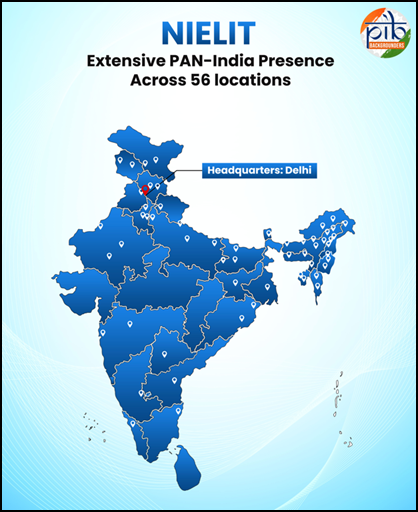
NIELIT Expansion: Agartala, Aizawl, Ajmer, Aurangabad, Balasore, Bhubaneswar, Bikaner, Buxar, Calicut, Chandigarh, Chennai, ChitraDurga, Chuchuyimlang, Churachandpur, Daman, Delhi, East Delhi, South West Delhi, Dibrugarh, Dimapur, Gangtok, Gorakhpur, Guwahati, Haridwar, Hyderabad, Imphal, Itanagar, Jammu, Jorhat, Kargil, Kohima, Kolkata, Kokrajhar, Kurukshetra, Leh, Lucknow, Lunglei, Majuli, Mandi, Muzaffarpur, Noida, Pasighat, Patna, Pali, Pilibhit, Ranchi, Ropar, Senapati, Shillong, Shimla, Silchar, Srinagar, Tezpur, Tezu, Tirupati, and Tura.
Advancing Artificial Intelligence Capacity
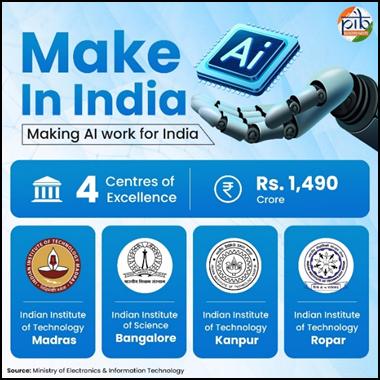
India is also investing in specialised institutions to build leadership in AI. Under the vision of "Make AI in India and Make AI Work for India," the Government established four Centres of Excellence (CoEs) in Artificial Intelligence with a total allocation of ₹1,490 crore. These centres focus on Education, Healthcare, Sustainable Cities, and Agriculture, and are led respectively by Indian Institute of Technology Madras, Indian Institute of Science Bengaluru, Indian Institute of Technology Kanpur, and Indian Institute of Technology Ropar.
|
Did You Know?
CoEs are already delivering practical solutions. The Sustainable Cities CoE is developing AI-based traffic and flood prediction systems. The Healthcare CoE is building AI tools for detecting diseases such as oral cancer, breast cancer, retinal disorders, and diabetes. The Agriculture CoE has deployed Automatic Weather Stations to support climate-smart farming and improve agricultural decision-making. These initiatives demonstrate how AI can address real-world challenges while strengthening India's innovation capabilities.
|
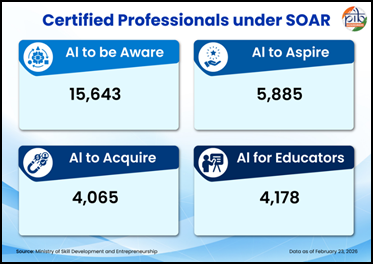
Complementing these efforts is the Skilling for AI Readiness (SOAR) programme, launched in July 2025 by the Ministry of Skill Development and Entrepreneurship. SOAR targets school students from class 6 to class 12 with three curated 15-hour modules and promotes AI literacy through self-paced courses available on the Skill India Digital Hub. The programme offers industry-designed curricula, National Skills Qualifications Framework (NSQF)-aligned micro-credentials, and dedicated modules for educators and students.
|
Did You Know:
The Skill India Digital Hub (SIDH) has emerged as the digital backbone for India’s skill development ecosystem. As of March 2026, more than 1.5 crore candidates have registered on the platform, with over 1,000 courses available across 23 languages. SIDH integrates skilling, employment, apprenticeships, and entrepreneurship opportunities through a single trusted digital platform, enabling seamless access to career pathways and lifelong learning opportunities across the country.
|
As of February 2026, 15,643 certifications were issued under “AI to be Aware”, 5,885 under “AI to Aspire”, and 4,065 under “AI to Acquire”. Additionally, 4,178 certifications were issued under the “AI for Educators” programme. The programme now offers 50 AI and AI-application courses developed with support from Microsoft, NASSCOM, CII, and other industry partners, helping democratise access to AI skills.
Building India's Semiconductor Talent Pipeline
Semiconductors are central to modern technology, making talent development a national priority. To address this need, the Chips to Start-up (C2S) Programme was launched by MeitY in 2022 with an outlay of ₹250 crore over five years. The programme aims to develop 85,000 industry-ready professionals across undergraduate, postgraduate, and doctoral levels in semiconductor and chip design. It also supports startup incubation, patent generation, technology transfer, and advanced research in Very Large-Scale Integration (VLSI), Application-Specific Integrated Circuits (ASICs), System-on-Chip (SoC) design, and embedded systems. Click to Read More
The programme has already delivered significant results. Around one lakh individuals have accessed the shared national Electronic Design Automation (EDA) infrastructure across 400 organisations, including 300 academic institutions and 95 startups. More than 265 industry-led training programmes have intensified chip design capabilities. The ChipIN Centre at the Semiconductor Laboratory (SCL), Mohali, conducted six shared wafer runs, enabling 122 chip design submissions from 46 institutions. Participating institutions have filed more than 75 patents, while over 500 IP cores, ASICs, and SoC designs are under development. These efforts are creating a robust semiconductor talent ecosystem and supporting India's ambition to become a global hub for chip design and manufacturing.
India's emerging technology ambitions rest on a simple foundation i.e. people. Through sustained investments in research, innovation, education, and digital skills, the country is building the human capital needed for the next technological revolution. From AI and semiconductors to quantum technologies and advanced manufacturing, these initiatives are creating a pipeline of researchers, entrepreneurs, engineers, and innovators. As these capabilities continue to expand, India is not only preparing its workforce for the future but also positioning itself as a global centre for knowledge, innovation, and technology leadership.
India's Growing Global Technology Credibility
India’s growing global technology credibility is reflected in its trusted digital infrastructure, large-scale technology deployment, and expanding international partnerships. The country has demonstrated how inclusive, secure, and affordable technology solutions can be implemented at population scale. Through strong policy support and innovation-led growth, India is increasingly emerging as a reliable global partner in the development of next-generation technologies.
Global Innovation Index Rise:
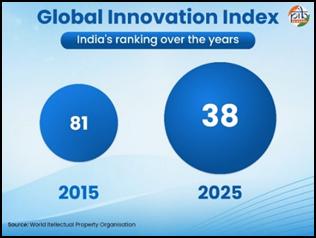
India rose to 38th in the Global Innovation Index 2025 from 81st in 2015. This reflects India’s rapid growth as a global innovation hub. Initiatives like Start-Up India, Digital India, and Atal Innovation Mission boosted entrepreneurship, digital infrastructure, research, and technology development. Strong government support, startup ecosystems, intellectual property frameworks, and industry-academia collaboration strengthened India’s innovation capacity and global competitiveness.
Network Readiness Index (NRI)
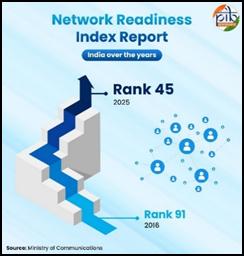
NRI is published by the Portulans Institute. The report evaluates how economies use ICT for economic growth, governance, and innovation. India’s steady rise in the index over the past decade reflects major improvements in digital infrastructure, telecom connectivity, and technological readiness. Initiatives like Digital India, BharatNet, Startup India, telecom reforms, and the Bharat 6G Vision strengthened digital access, innovation, and ease of doing business. These developments positioned India as a fast-growing global digital economy and emerging leader in future technologies.
Global Capability Centres (GCC)
GCCs are specialised centres set up by multinational companies in countries like India to manage software development, artificial intelligence, data analytics, cybersecurity, finance, research, and digital operations.
Over time, GCCs in India evolved from back-office support units into strategic hubs of innovation and value creation for global enterprises. India now hosts over 2,100 GCCs across 3,728 units, employing around 2.36 million professionals. Nearly half of the GCCs established since 2021 have been AI-focused from the beginning. This growth is supported by a large talent pool, Centres of Excellence, and collaboration with universities and startups. The shift from “delivery centres” to “enterprise nerve centres” reflects global confidence in India’s skilled workforce, innovation ecosystem, and digital capabilities. It also positions India as a key driver of frontier technologies and future economic growth. Click to Read More
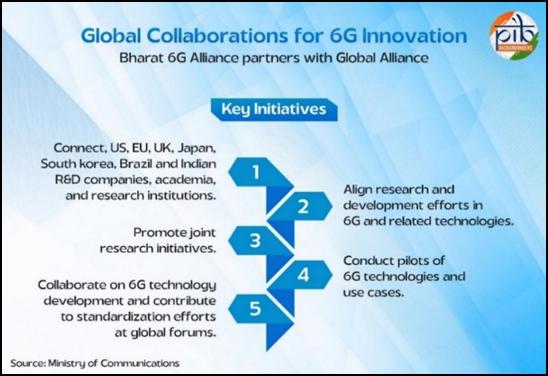
The Bharat 6G Alliance (B6GA)
B6GA formed in 2023, is an industry-led, government-facilitated initiative bringing together telecom service providers, academia, research institutions, and standards organizations. It drives indigenous 6G R&D to build a self-reliant, globally competitive advanced communications ecosystem, with focus on multi-chip modules, SoCs, and advanced IoT applications. B6GA provides a collaborative platform for public/private stakeholders and
has constituted seven Working Groups covering Spectrum, Technology, Applications, Green & Sustainability, and Use Cases. Click To Read More
Did You Know?
The New, Emerging and Strategic Technologies (NEST) Division was set up in 2020 under the Ministry of External Affairs. It handles the foreign policy and international legal aspects of technologies like 5G, 6G, AI, Biotech, Semiconductors, and Clean Technologies. The division coordinates with domestic stakeholders and foreign partners while building internal capacity for technology diplomacy. It works to foster global cooperation and shape India's position on international tech governance.
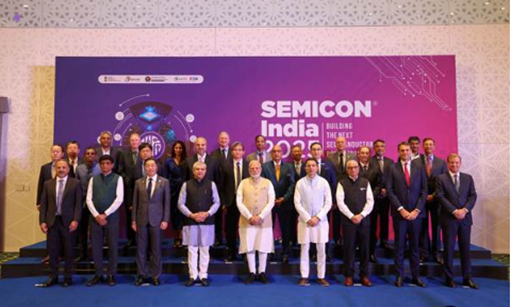
SEMICON India 2025, showcased India's emergence as a trusted global semiconductor destination. The event brought together over 350 exhibiting companies from 48 countries and regions. The conference facilitated investment, strategic partnerships, research collaboration, and workforce development across semiconductor design, fabrication, packaging, and manufacturing. The signing of 13 MoUs and participation of leading global semiconductor CEOs highlighted growing international confidence in India's policy framework and long-term vision. The event positioned India's credibility as a reliable partner in global semiconductor supply chains.
AI Impact Summit 2026
India AI Impact Summit 2026 significantly enhanced India's credibility as a global leader in responsible and inclusive AI. The summit brought together delegations from over 100 countries and 20 international organisations, attracting nearly 15 lakh participants through physical and virtual engagement. A landmark achievement was the adoption of the India AI Impact Summit Declaration by 92 countries and organisations, reflecting broad international support for India's vision of trustworthy and development-oriented AI. The event also catalysed over USD 200 billion in AI-related investment commitments and showcased India's growing sovereign AI infrastructure. These outcomes reinforced India's position as a trusted global convenor, innovation partner, and emerging hub for AI research, infrastructure, and digital public goods.

|
Did You Know?
Pax Silica is a strategic coalition of trusted, democratic nations working to secure the full "silicon stack." This spans critical minerals, semiconductor fabrication, advanced AI systems, and deployment infrastructure. The initiative aims to reduce supply chain overconcentration and prevent economic coercion by authoritarian actors. On the fifth day of the India AI Impact Summit 2026, India formally joined the coalition.
|
Global leadership in Digital Public Infrastructure (DPI) & India Stack Diplomacy
DPI refers to digital systems that help governments deliver services efficiently, securely, and at large scale. India’s DPI ecosystem, known as India Stack, gained major momentum after 2014 through platforms like Aadhaar, UPI, DigiLocker, CoWIN, UMANG, and GeM.
These platforms transformed service delivery through digital identity, instant payments, online documentation, healthcare, and governance services. India has also signed agreements with 23 countries for cooperation on DPI. UPI is operational in countries like Singapore, United Arab Emirates, France, Nepal, and Sri Lanka. This strengthened India’s reputation as a trusted global leader in digital governance and fintech innovation. Click to Read More
India is building a technology ecosystem driven by innovation, inclusion, and self-reliance. Rising investments, strong digital infrastructure, and mission-led reforms are enabling the country to move from being a technology consumer to a global technology creator. These efforts are accelerating India’s journey towards Viksit Bharat and strengthening its role in shaping the future of emerging technologies worldwide.
India’s Moment, India’s Making
Twelve years ago, India was a large digital market. Today, it is emerging as a global digital power. This transformation was driven by sustained public investment, long-term policy vision, and mission-mode implementation across critical technology sectors.
The journey is built on three interconnected pillars: expanding national capacity, strengthening technological capability, and building global credibility. Digital infrastructure created the foundation for inclusive growth. Affordable connectivity, Digital Public Infrastructure (DPI), cloud systems, and data networks connected citizens, businesses, and institutions at an unprecedented scale. This enabled India to rapidly expand access to digital services, innovation, and entrepreneurship across urban and rural India.
The Government simultaneously strengthened indigenous technological capability through focused initiatives in emerging technologies. Large-scale investments in research infrastructure, Centres of Excellence, startups, skilling ecosystems, and industry-academia partnerships accelerated innovation and future readiness. India’s growing credibility emerged from trusted governance frameworks, secure digital systems, transparent regulation, and reliable technology partnerships. Global investors, technology companies, and strategic partners increasingly view India as a trusted hub for innovation, manufacturing, talent, and digital transformation.
The achievements of the past twelve years are not isolated milestones. They represent the technological foundation of Viksit Bharat 2047. India is no longer only adopting global technologies. It is increasingly shaping global conversations on inclusive, trusted, and human-centric technological development.
Ministry of Electronics and Information Technology
Ministry of Communications
PIB Backgrounders
Cabinet
Ministry of Science and Technology
Ministry of Defence
Ministry of External Affairs
Department of Higher Education (Ministry of Education)
Ministry of Skill Development and Entrepreneurship
Prime Minister’s Office
Ministry of Finance
Network Readiness Index
NASSCOM
Click Here To See PDF
******
PIB Research
(Release ID: 2276447)
Visitor Counter : 11186