Ministry of Science & Technology
Himalayan Economy Will Drive India’s Future Growth Towards Viksit Bharat 2047: Dr Jitendra Singh
Union Minister says unexplored Himalayan bioresources are emerging as new engines of economic value creation through science and technology-led interventions
Dr Jitendra Singh Says Science-Led Himalayan Development Gaining Momentum Under Prime Minister Narendra Modi
CSIR-IHBT Palampur Playing Key Role in Harnessing Himalayan Biodiversity for National Growth: Dr Jitendra Singh
The Tulip flower from this same institute was part of the offering made by PM Narendra Modi during the "Pran Pratishtha" prayers at Ayodhya
Posted On:
28 MAY 2026 5:35PM by PIB Delhi
Union Minister of State (Independent Charge) for Science & Technology, Earth Sciences and MoS PMO, Personnel, Public Grievances, Pensions, Atomic Energy and Space, Dr. Jitendra Singh today said that the Himalayan economy is set to become a major contributor to India’s future economic growth as the country moves towards the vision of Viksit Bharat 2047.
The Minister said the next phase of India’s economic expansion will increasingly emerge from sectors and resources that remained underexplored for decades, particularly in the Himalayan region.
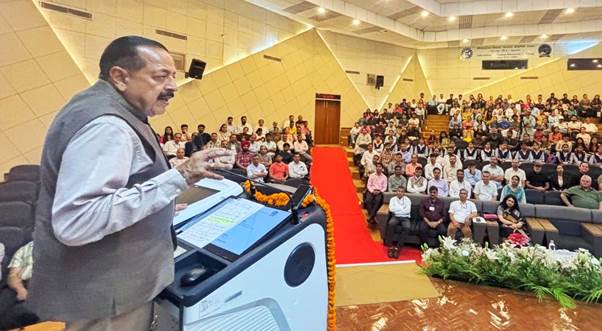
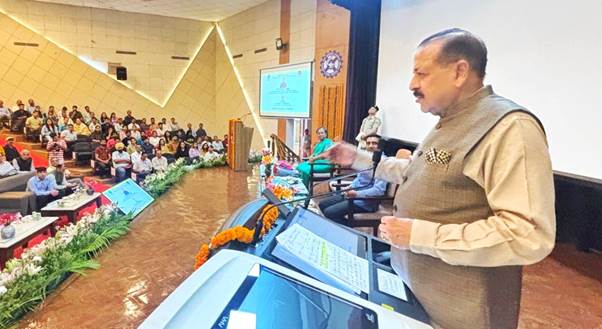
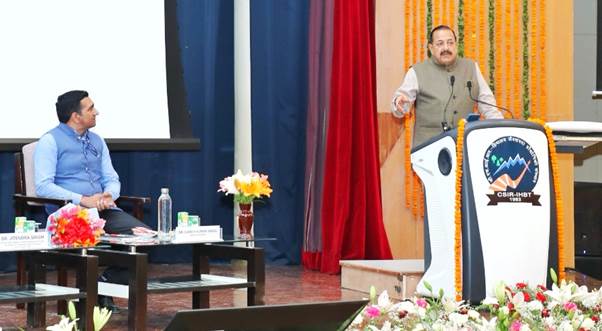
Addressing the National Technology Day programme at CSIR–Institute of Himalayan Bioresource Technology (IHBT), Palampur, Dr. Jitendra Singh said focused scientific interventions in Himalayan sectors received unprecedented momentum under Prime Minister Narendra Modi through initiatives such as the Aroma Mission and Floriculture Mission, which are generating livelihood opportunities for farmers, women, youth, start-ups and entrepreneurs across Himalayan states and Union Territories.
The tulip flower from this same institute was part of the offering made by PM Narendra Modi during the "Pran Pratishtha" prayers at Ayodhya, the Minister recalled.
Dr. Jitendra Singh visited various facilities of the institute and interacted with scientists, innovators, farmers, start-ups and entrepreneurs associated with different Himalayan technology missions being carried out by CSIR-IHBT. He said the institute is playing a vital role in transforming Himalayan bioresources into commercially viable products and technologies for sectors such as medicine, wellness, nutraceuticals, cosmetics, floriculture and agri-biotechnology.
The programme was attended by Director General, CSIR and Secretary, DSIR, Dr. N. Kalaiselvi, senior scientists and officials of CSIR-IHBT, besides representatives from industry, academia, farming communities and research institutions.
Describing CSIR-IHBT as a unique scientific institution integrating multiple dimensions of Himalayan biodiversity, traditional knowledge and commercial innovation, Dr. Jitendra Singh said the institute has emerged as one of the country’s leading centres for sustainable utilization of Himalayan bioresources. He said the institute’s work spans diverse areas including agrotechnology, biotechnology, environmental sciences, nutrition technologies, phytopharmaceuticals and fermentation technologies.
Referring to the success of the Aroma Mission, the Minister said Himachal Pradesh has emerged as the country’s leading producer of aromatic wild marigold oil, generating substantial income for farmers and entrepreneurs. He said the institute has expanded aromatic crop cultivation across several states and Union Territories while also developing improved varieties of lavender and chamomile suited to Himalayan conditions.
Highlighting the impact of the Floriculture Mission, Dr. Jitendra Singh said CSIR-IHBT has helped transform floriculture into an important source of livelihood and agri-tourism in Himalayan regions. He referred to Himachal Pradesh’s Tulip Garden initiative developed with bulbs cultivated by local farmers, which attracted over 1.5 lakh visitors this year. He said floriculture activities supported by the institute are benefiting thousands of farmers across Himachal Pradesh, Ladakh, Uttarakhand, Punjab and Haryana.
The Minister also referred to the institute’s contribution towards import substitution under the vision of Atmanirbhar Bharat through cultivation of Heeng (asafoetida), saffron, cinnamon and monk fruit. He said successful flowering and seed production of Heeng in the high-altitude regions of Lahaul and Spiti has opened new possibilities for indigenous cultivation of the crop in India.
Dr. Jitendra Singh said CSIR-IHBT is also contributing significantly towards nutrition and healthcare initiatives aligned with POSHAN Abhiyaan through development of fortified nutritional products for malnourished children and scientifically validated formulations for lifestyle disorders.
Emphasising the growing role of deep technology in agriculture and biodiversity management, the Minister said the institute is leveraging Artificial Intelligence, machine learning, genomics and drone-based precision agriculture technologies for crop improvement, disease prediction and biodiversity research.
The Minister also referred to the institute’s work in climate resilience, waste-to-wealth technologies, green chemistry, bioplastics, biodiversity conservation and sustainable utilization of Himalayan resources.
Dr. Jitendra Singh said scientific institutions are increasingly becoming instruments of grassroots transformation under Prime Minister Narendra Modi’s leadership by integrating science, innovation and entrepreneurship with rural development and economic empowerment.
Calling for greater collaboration among scientists, farmers, industries and start-ups, Dr. Jitendra Singh said the Himalayan region possesses immense untapped potential capable of contributing substantially to India’s future bioeconomy and sustainable development journey.

***
NKR/AK
(Release ID: 2266281)
Visitor Counter : 2250