Ministry of Science & Technology
EVIDENCE OF ANCIENT WILDFIRES PRESERVED IN COAL REVEALS CLUES TO EARTH’S CLIMATE
Posted On:
25 MAY 2026 4:38PM by PIB Delhi
Molecular evidence unearthed of massive wildfires that swept across ancient Gondwana forests nearly 250 million years ago, thereby shaping Earth’s climate, vegetation, and coal-forming environments.
Macrocharcoal-based palaeofire investigations in Indian Permian sediments provided the first tangible evidence of palaeofire activity at a broader scale. Based on these results, researchers began identifying distinction between various forms of microcharcoal particles within Permian sedimentary sequences, highlighting the potential for more detailed, high-resolution fire reconstructions.
It was however noted that the scarcity of molecular methods used in palaeofire research was a major challenge and especially in the distinction between various forms of microcharcoal particles particularly OX-CH (oxidized opaque phytoclasts) and PAL-CH (fire induced opaque phytoclasts). In earlier studies, reliance was mostly on microscopic observations which though informative, caused a lot of ambiguity in the interpretation of the origin and nature of charcoal particles.
Realising this gap, the researchers from Birbal Sahni Institute of Palaeosciences (BSIP), an autonomous institute of the Department of Science and Technology (DST) used a novel multi-proxy approach integrating a technique called palynofacies analysis (study of tiny organic matter preserved in sedimentary rocks) with advanced molecular methods such as Raman spectroscopy and Fourier Transform Infrared (FTIR) spectroscopy to reconstruct Permian palaeofire events from Gondwana coal-bearing sediments of the Godavari Valley Coalfield, India.
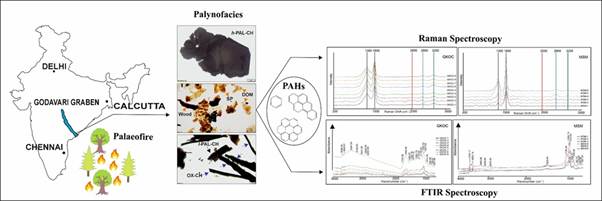
Fig: Graphical abstract illustrating an integrated palynological and molecular approach to decipher Permian palaeofire activity in Godavari Valley Coalfield using Raman and FTIR Spectroscopy
By combining microscopic and molecular-scale observations, the team consisting of Neha Aggarwal, Shivalee Srivastava and Runcie Paul Mathews bridged a critical gap between visual identification of palaeofire residues and their geochemical characterization. The main result of the work is the identification and distinction between high-intensity (h-PAL-CH) and low-intensity (l-PAL-CH) palaeofire-derived microcharcoal particles relying on their morphological characteristics, state of preservation, and optical characteristics.
These results were also supported by molecular signatures of combustion such as the existence of well-developed second-order Raman spectral features that are evidence of structural ordering (Poly Aromatic Hydrocarbons: PAHs) in carbonaceous material, and diagnostic FTIR functional groups of thermal alteration pathways. The combination of palynological data and spectroscopic signatures facilitate a stronger and more accurate identification of fire-induced organic matter and enhances understanding of ancient wildfire regimes during the Permian period.
The study published in Geological Journal (Wiley) can help create more accurate models of long-term climate change by reconstructing the palaeoenvironment of Gondwana basins and this could be crucial in forecasting future changes in the environment and the behavior of ecosystems to extreme events such as palaeowildfires that are becoming more pertinent in the changing climate.
Publication link: https://doi.org/10.1002/gj.70295
******
NKR/FT/NM
(Release ID: 2264978)
Visitor Counter : 1848